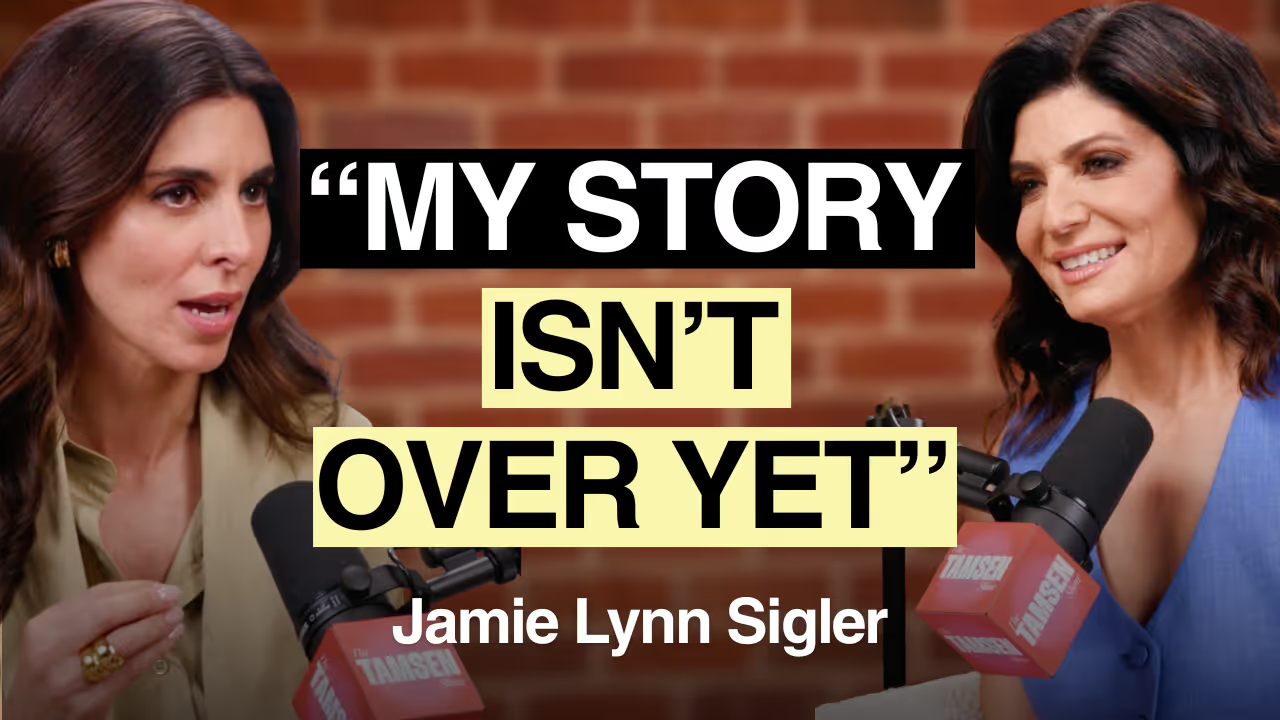
Nobody joins a cult. You join a good thing. Eventually, I stopped second guessing myself and I said, "I don't know why I'll let myself be treated so badly." Do you think it was because you became a mother? For sure. No question. Yeah, absolutely. Once you have a child, there really is no greater good than what you're pouring into your children, into your child.
Truly, if you feel like something's weird, it's weird. You know her as Haley James Scott on One Tree Hill. What you didn't know is that for a decade she says she was living inside a cult. Today, Bethany Joy Lens walks me through the warning signs she missed and the gut feeling that none of us should ignore. Well, I'm I'm so excited about a lot of different things.
We talked a little bit before we started rolling, but I feel like you have gone through so much in your life and the the women that we speak to every week on this podcast are always talking about change. We're talking about next chapters. We're talking about dealing with hard things. Yeah. But I want to talk about where you are today and what your life looks like right now and maybe what feels most like you.
For me, um, as an artist, what I'm super thrilled about is the fact that I get to write, which is something that I've done since I was a kid. Whether it was stories or a quarter of a book that I started and never finished or scripts, um, musicals, songs, I've journaling, I've always written and written and written.
Um, but I had a day job as an actress that was just always paying the bills. Um, thank God, which is that's also just such an incredible um, privilege. So, to be able to now, um, be in a place where I'm so comfortable just in my own skin, sitting down in my house and writing out, dreaming up a world and writing out a story.
It feels like, how could I be anywhere else? This is exactly what I want to do. Yeah. So, I'm sure I'm sure there'll still be acting. I mean, I'm on a show, so I kind of have to show up for work. I do love my job. I do love my job as an actor, but uh yeah, I feel like this is something I could see myself doing for the rest of my life if if I'm allowed.
Let's talk a little bit about uh where you started. We both share a similar experience of moving around quite a bit u when we're younger. Where did you what was what was life like for you? What was life like? I I was um well I I lived in Florida till I was three or four.
Um we took a road trip to Dallas and stayed there until I was 12 and then moved to New Jersey. I think I've moved 25 times in my life. That was the last the last move I had. I counted like I think that's 25. It was a it was I was a creative kid. Um I was an only child. So I think being in that environment as an only child uh with two working parents I I had a lot of time to world build in in my be in my imagination you know we didn't have tablets we didn't have phones so the car rides were me staring out the window and writing a song about the passing trees
and the birds you know uh so I had a lot of a lot of time to just imagine and it was beautiful and um yeah I think that's what My early early life was like a lot of a lot of imagination. And what brought you into acting? Well, probably because I had I was so hyperactive. I mean, I got a I got a latestage ADHD diagnosis um at 40, but my whole life I have been internally hyperactive uh certainly as it usually manifests in women as an internal hyperactivity.
But um yeah, I was always jumping around. My dad just told me the other day that uh he remembered hearing from my teacher at school that we when I was eight, we went out on the playground and I asked her to stand about as far away from me as a director would so that I could perform a song for her playground.
So I feel like that's been in your blood for quite a while. Yeah. And both of my I have two grandparents that were in show business. And so I think it's just in my blood and and my parents, I'm so grateful, uh, recognized that and fostered it and found acting classes and music classes and just gave me something to do.
I was a great tap dancer. I really had to get all that I really had to get all the energy out. So let's talk about life uh for you. You know, One Tree Hill obviously a very big part of your life. Yeah. But there was something else going on at the same time that you have talked very openly about.
For anybody who is listening the first time, meeting you for the first time, hearing your story for the first time, can you go back and talk a little bit about that? You joined a religious group, right? Yeah. Well, joined is an interesting word. I think I I and I've said this in interviews a few times.
Mark Vincente from Nexam, I don't know if you saw the vow, but um he had this great quote in the vow when I when I was watching it. It always stuck with me. He said, "Nobody joins a cult. Nobody." No. You know, you you join a good thing. You said it. you walk into something and you I'm paraphrasing now, but anyway, that was the quote.
And um it's so true because I thought that I was just um attending a Bible study in somebody's home, which was very similar to many of the others I had been to growing up um in a in an evangelical uh Christian home and environment and being in Dallas, which is that's a huge environment for that.
Um, and then in New Jersey, I went to a church that where there was um a huge boom of um I think it was Willow Creek Church, the sort of seeker sensitive non-denominational church. For those of you who are not religious, I'm this probably sounds like a lot of uh language that you don't know, but um it's a it's a charismatic evangelical church where they sort of interpret scripture based on however they want, right? um which is very common in the Protestant denominations.
And so because of that um I had been to many Bible studies and I had went to LA and was looking for artists who were also had a faith. So, I started going to this Bible study and um because of some other experiences that I'd had in my youth with um coercion and manipulation, there was I I think I had already sort of been groomed into feeling like my instincts were off and I probably couldn't trust myself.
And so if if everyone around me is telling me everything's fine, everything's great, I tended to just believe everyone else instead of myself, which is also very common when you're young. I was like 20, you know. I think it's common when you're older, too. I mean, I think a lot of us do that. It's why your story was so compelling to me because I I think that it it speaks to women no matter no matter what they've been a part of, whether it's a relationship, and I'm sure you're hearing this all the time from other women now that you've spoken
up, you've helped so many people maybe see their surroundings. I hope so. Uh there there is an education that is required to be able to identify these things and um if somebody's willing to do the work to see it, there's it becomes very clear. Um, so I did I I became a part of this group that uh I think it was really just a simple Bible study of young artists when it started and there was a pastor that came in from another state who uh saw a lot of young Hollywood actors and went, "Oh, you know, dollar
signs and ding and um and became increasingly more involved and then increasingly more controlling and you know, coercion takes time." Uh so there was a lot of trust built and then a lot of control enacted. Um, and eventually I that just became my whole world for for 10 years. Luckily, I was also on One Tree Hill 9 months out of the year.
Thank God for the 22 episode days, which we don't do anymore. But, uh, nine months I was surrounded by secular artists and people who were just trying to figure out life and other teenagers and people who were just living their regular lives, being professional, showing up to work. And so that grounding in reality, as much as you could call Hollywood, that you know, life on a set reality, but it was it's still people just showing up for their jobs.
I think the proximity to that on a regular basis really kept me sane and kept me uh from completely turning over my autonomy to this this group and well, the leader really. Um, and yeah, so by the time I became a mother, I had already married someone in the group and um, and then I had my daughter.
And really at that point, it had been a long build. I'd been in for 10 years and it had been a long build of something's wrong. Something's wrong. So no, no, something's really No, something's really wrong. No, definitely something's wrong. And eventually I stopped second guessing myself and I said,"I don't know why I'll let myself be treated so badly and I need to figure that out, but I'm not going to let her be treated the same way that I am.
So whatever this is, whatever's going on with me, I got to I got to figure this out outside of this environment." And once I got out and started doing therapy and you know that then everything kind of opened up. Do you think it was because you became a mother? For sure. No question. Yeah, absolutely.
That was the c I mean I I just didn't have I needed the kick in I mean pardon me but I needed the kick in the ass to like really say I needed a reason outside of myself. Um which I think a lot of empaths do because we will lay ourselves down over and over and over in order to help someone else. So while I was in the marriage and in the group, I was in a perpetual state of self-sacrifice because I believed it was for a greater good.
Mhm. But there's no once you have a child, there really is no greater good than what you're pouring into your children, into your child at that point in time. Um especially when they're young. And um so my my whole concept of greater good just shifted to her. And since then I've learned boundaries and self-care and you know all the things necessary to not fall into something like that again.
But um yeah that that it for sure was becoming a mother. It's hard to figure out boundaries and self-care and and intuition and trusting your gut versus second-guessing yourself over and over again. And I know that a lot of people, a lot of women are in controlling situations, whether it's work or whether it's an actual relationship that they're in or it could be a friendship for, you know, for all I know.
But if they're listening to this right now, how did you go from really turning your life over to somebody else to saying, "I have to take that back and and really do it because that is got to be so hard." And I I I think about what that must have have taken. And I just wonder how it's how you started that.
Well, I think it's just a survival instinct. I don't know that the, you know, people have said this to me before like, "Oh, you're so brave to leave. Like, that's such a brave." I don't I think the the hard work the hard brave courageous work that we do after we extract ourselves from harmful situations is uh the healing and the wrestling with concepts of forgiveness or self-acceptance.
Um, those are those are the really dark places to go to and to wrestle with. But the leaving is a that's just pure survival. I was watching your episode with Dr. Romney and you had mentioned that you'd had a couple relationships where you've experienced this. I mean did did you feel like the leaving was some was a big courageous act for you or did it feel like it was and I don't I don't mean to say that in a I'm not trying to take away from people who it is it is brave to leave.
Yeah. Yeah. It wasn't that it Yes. Of course. It was so necessary at that point. There was no other alternative. Yes. Yeah. There's no other alternative. That's what it was. Is that what it was for you? Yeah. For sure. Cuz I've been I was like I'm dying here. So I'm either going to die here or I'll die there.
But I know I know for sure this is death. It's dun dun dun. This is the door of certain death. No, but you're but you're right and you write about it in your first book, but I do think that I understand why people would call it brave, but I also understand why it is the only alternative at some point. Yeah. And what and what it takes to get there is a long long road.
And I think when people say you're brave, I think they just really respect the hell out of you for being able to appreciate it, you know, to to be able to see that. So, let's talk about what the first year looked like for you because I pro that's probably something and Dr. Romney. She's so amazing. Um, for those of you who are are listening and may have not heard the episode or seen the episode, she talks about narcissism and she talks about understanding signs and and control and you know and and what people do really
to to fool you in so many ways and how difficult it is to get out of those situations. Um, you were in one that was to the extreme obviously. Um, that was 10 years. Is that right? It was 10 years. Yeah. Uh, it was not. What was interesting is that the narcissist, the real narcissist, I was not married to.
Um, it he was like leading the whole thing. And so there were all these different issues and dynamics within other people in the group and with my ex-husband and all all this kind of stuff. And but um the the intimate partner violence of narcissism wasn't something I experienced there. I did experience it later at another point, but not not in that space.
Um, sorry, I didn't mean to cut you off. No, not at all. I No, I think it's important to to define that and understand it. Could you you can tell what a narcissist is today? Do you have a totally different understanding of people at this point? I I do have a different understanding of people. Um I am I have lived in the anxiety of mistrust to a point where the loneliness is unbearable and uh I can't live that way.
So, um, that's where I had to go into the deep dive of of self-acceptance and forgiveness and, um, and education and figure out, okay, if I can't just close myself off and disappear from the world, as much as I would love, which I'm very glad you didn't, but, uh, what does it look like to live with an open heart and try and trust That's really tough.
So, education, I I can't tell you. Dr. Romney's videos like saved my life and her books and I I feel like I I got such an education about, okay, and now I know what this looks like. I'm still going to get it wrong sometimes because I am choosing to believe the best about people as often as I can, but I don't ignore the instinct now, the gut instinct.
When something tells me that was weird, I'm like, "Huh, that's off." I'm I'm much better at identifying and much more comfortable being willing to be wrong and just trusting that person with like go with God. If you are totally uh innocent and I'm putting this label on you because of my own stuff, I'm sorry, but I'm not willing to risk if I sense something.
I'm I'm just not willing to risk like uh be get getting involved on the off chance that I'm wrong. You know what I mean? I I just I do I want all women to hear that because I think that it's I think it's so easy for us to mistrust our gut and think that it's maybe fear that's stopping us instead of our instinct. And I I think sometimes the world is very noisy and it's hard to hear instinct, but you you have to like it's not your job to make everybody feel good about themselves and be happy.
Say that again. It's not your job. It's not my job. It's not your job. It's my job to protect myself and curate people in my community that will uh be safe. Mhm. That doesn't mean we all have to think alike or, you know, have the same opinions or thoughts on everything, but there has to be a not there has to be no narcissists in the group.
That's really that's the only we need. So, um, yeah, if I sense something, I usually have a two strike, sometimes three if I really feel like I'm not sure, but first time I'm like, okay, sometimes ADHD looks like narcissism. It's it can be like there's there's some quirks there that maybe are off. Um, sometimes people are can just be selfish and have uh been raised in an environment and they're but they're good people and they're learning and you know you you pay attention to what people do and not what they say.
For years I'd known that strength training is the move in midlife. It's key for muscle, bone, and metabolism. And for years my plan was a folder of saved Instagram workouts that I never opened. between New York, LA, and everything else. I needed a real plan I could follow anywhere. That is a ladder app.
Ladder is expert strength training programming from certified coaches, not a content library. You get a new plan every week that builds on the last one. The coach in your ear feels like a personal trainer in your headphones. There are cues and form reminders whether I'm at the gym or in a hotel room with dumbbells. It tracks my weight and reps automatically.
It now includes nutrition tracking, too. It's less than a dollar a day versus a hundred or more for a trainer session. Remove the guesswork with Ladder and get a real coach in your ear telling you exactly what to do for every workout. No thinking, everything planned for you. If you have an iPhone, head to ladder.fit/tamson and take a quick quiz to find your perfect ladder plan.
Use my link and get a free 7-day trial with no credit card and $10 off your first month if you join. So, we talked a little bit about Dr. Romney, when we talk about narcissism, are there any things that you would want women to look out for or things that you realize that you saw as you look back? Yes.
Um, the biggest tell I think is confusion. If you just feel like perpetually confused within the context of the relationship, there's a good chance that you're being manipulated. Um, yeah, that's a huge one. Um, a lot of the little things. I actually put a lot of these in my book because Miles Vale is a very typical Mchavelian narcissist. And the way that it works is so subtle that, you know, from the outside when you're reading the book, you're like, "Oh, this guy's this guy's a total narcissist.
" But when you're inside the story and and hopefully the readers will see through Kora's eyes what it feels like, what that confusion feels like and why it's so easy to get caught up in. Um so yeah, I'm hoping that people will read that and they'll be able to start like checking off the boxes of oh this and that.
But it's a it's a lot of um a a constant feeling like you're being lied to and you you it's easy to explain away and oh, I'm paranoid or I've been hurt before and so I'm assuming this is the worst and blah. But but that doesn't happen in a healthy relationship. You don't constantly feel like there's just something wrong.
I like how you shift in your seat for for somebody that's not watching somebody not watching this and listening like you've shifted in your seat two times because that is what it is. It's kind of like you want to shake it off. Yeah. It's just a little uncomfortable like what is this feeling that is something is off and if you feel that something's off that's that doesn't happen by accident.
And when you're in a healthy relationship when you that's another thing defensiveness. If if you ask questions if you say something like why did you why did you say it that way? That felt weird. You know, that's an easy thing to ask. A friend, a parent, a partner, a boss, like, "Sorry, the thing you just said, that kind of made me uncomfortable and felt weird.
Can you explain why you said it that way?" Um, if the response that you get is, "Oh, sorry, I didn't that's not what I meant. Uh, blah blah blah." That's fine. But often with narcissists, what you'll get is um a response that's something like, "I can't believe you always assume the worst about me. Why don't you trust me? Why is it that everything I do seems to trigger something in you? You know, I'm just trying to love you.
I'm just being here. I'm fine. I'm just functioning." And you pick on every little thing. I mean, if you're experiencing that kind of a cycle, it's bad. I feel like anybody who's listening to that and has gone through that before can feel that right in their gut. Did you live with that for years and years? Yes. Oh, yes.
I've lived with that several times. It it you know, I didn't heal right away. I there I had to go through a few different iterations of that type of relationship in order to really hammer home the message for me of what this personality disorder looks like and how to identify it and how to get away from it. Um, so yeah, it it have grace for yourself.
Like it's going to take time, but truly if you feel like something's weird, it's weird. What has changed since uh Dinner for Vampires came out in your life? I I get messages every day, um, Instagram messages mostly from people who have experienced something like this in some format. I mean, the narcissistic personality is functions in a variety of locations.
So, um, but people who maybe grew up in an environment like that and didn't realize that that's what it was, or people who just left it, or people who are in one and they're going, "Oh my gosh, I'm seeing some of the same things that you wrote about in your book. Am I involved in something like this?" Um, or I think my sister is in something like this.
like there's there's a every day there's a message and I'm just so grateful that I have been able to like make a dent in the world like take this thing that happened and make a dent in the world for for good. So I think what's changed is just my um awareness and my it's really solidified my determination to take hard things and turn them into something good.
You're changing lives though because when people don't have an example, like you talked about Dr. Romney, we don't have an example to look at. We don't know what to do and we think we're the only one. Yeah. And that can be really scary. And it doesn't matter if you're 20 or you're 40 or 60 years old.
If you don't have that ahead of you or something to look at or some kind of guidance, it's very difficult to not think you're just imagining things. Yeah. You need a road map sometimes. Yeah. Okay. Let's go to One Tree Hill because I'm sure that people DM you about that all the time, too. Sure. Um, there are certain shows that just stay with us forever, I think, or for a very, very long time, for years to come.
This is one of those shows. Do people talk to you all the time about Haley and Nathan? All the time. Every day. That's the other message I get every day. I was going to say like along with those DMs, what do you think made that show still stand today? Oh gosh, I think it hit at exactly the right time.
First of all, you never know when you're going to catch lightning in a bottle with a cast. And they just it was just well cast. Everybody worked well together. Everybody the everybody was so well defined. Um it just that just worked. And that's a magic I don't think that you can uh calculate. But um I think it hit at the right time because it was prior to cell phones really.
I think maybe season six or seven we started getting our little like you're texting on the um what was it called? The Blackberry. No pager too. But no but when you had to like hit the button you know number three. Yeah. You all I can remember 40 texting on the phone basically. Um but anyway that was later. But when it started out and it was just a show about teenagers feeling their feelings in a small town and um which I think shows like Dawson's Creek did as well, but there was something about Winry Hill that it was like just enough drama and
like kind of outrageousness, but it always kept coming back to the very real feelings. And then when the people who watched the show as teenagers and 20s grew up and had kids, now streaming exists and phones exist and so all of these kids now I can speak to this because my daughter's almost 16 and she just started watching it because all her friends were watching it.
Um but she's like everything '8s. She loves Stranger Things. I hope she doesn't mind me talking about her. But um yeah, anything that has to do with a simpler time in life cuz they never knew it. All they've known is technology and the disconnect. So I think they're really intrigued by that.
Um but yeah, all the younger generation is watching it now. So we just had a convention in Paris and it was a ton of teenagers and early 20s. Is that fascinating to you? You weren't even born. I know it's hard to put your head around. It's amazing. It's the gift that keeps on giving. It It does keep giving.
To have your daughter's friends all watch it and then be like, "Oh, yeah. My mom my mom did that. My mom was on that show." What is that like for her? What is that like for you? I don't know what it's like for her. I can't speak for her, but um I mean she's told me it's funny. Sometimes it's a little weird, but like I think she doesn't watch the scenes of me and Nathan kissing.
She's like I cannot I cannot I really hope it's okay that I'm talking about her. I'll have to ask her. She's kind of private. But um yeah, it's for me it's fun. It's fun to have the the kids come over and, you know, they I can tell they want to ask me about it or they want to talk about it and but it's it's great because we usually just get it out of the way and then I'm just Miss Joy and then your then your mom.
Yeah. Yeah. I'm in the kitchen making grilled cheeses for everybody. Like you played Haley for nine seasons, right? Um what did you love about What did you love about her? Oh gosh, I love Haley. She's just smart and solid and uh reliable and um I think she's brave. I like that she was willing to try new things and um she had a lot of siblings, so I think she probably saw a lot of mistakes get made that she knew how to steer clear from even though she still made some of her own, but none of them were too
crazy. um she just was like always trying to see the best in everybody and I guess similarly to me uh learning how to set boundaries when you're the person that everybody goes to for acceptance. Yeah. So can we talk about you you really said you live two different lives almost you know onset for a majority of the time and then offset which is a very different life.
Can you explain like how that worked for you? I I mean it worked out of necessity because I was contracted to be on this show, so I just had to show up to work and be a professional. Um, so I think the the back and forth was um, as I said, it was kind of a lifesaver because it kept me grounded in reality while I was having all of these experiences that were false, these sort of pseudo spiritual experiences.
Um, but it did it did make it really hard to get to know anyone outside of the group. And that's that's another telltale sign of narcissism is the isolation. Like you don't you don't trust anybody outside of your pastor or partner or boss or parent or whatever the whoever the person is. Um, that isolation was really huge.
So, it did make it difficult to build deeper relationships with anybody on the show, which is if I had a regret in life, that would be the big one is, oh, I wish I had I wish I had known more. I wish I had been able to be more free and really invest in those relationships. Um, which is another reason I'm glad the show's had such a long life because I get to do that now.
Have you connected back and been able to feel like you've gotten so much closer and you feel like a totally different person, I Yeah, it is. It's it's just it's a different life. I mean, I really I think back on that time. I'm like, who was that girl? I do not I do not remember so much about what was going through my mind because I was in such a bizarre state.
And thank God I kept journals cuz that's what I wrote dinner for Vampires off of. I wrote all I read all those journals and it started to jog my memory and bring me back to it. But if I didn't have those journals, I don't I don't know how I would have remembered everything because it's just so so disconnected from who I am today.
What does it look like with you watching your younger self now? How does that feel? Do you feel a little more kindness toward her? I do. Yeah, when we did the Drama Queens podcast, I for sure felt it was hard at first and then and then I gained through through watching it, I really gained a um for forgiveness maybe is not the right word, but well, for all the things that I used to hold on to dislike for myself, I sort of was able to clear that out and let that go.
And um I just like seeing young me trying to figure her way through the world. and I made it this far. So, I wonder how I feel I'll feel when I'm 70 looking back on this. What do you What do you say to to 20-year-old Joy? What do I say to 20-year-old Joy? It's all going to be okay. That's That's all I That's all I think. Um, it's something I know now that I didn't really know then.
You don't have to try so hard. It's all going to be okay. Do you teach that to your daughter? I try to. I I wish we all knew that. I think sometimes still at 40, it's hard. It's a hard message. Yeah. Yeah. But it is. It's I think that there's just always struggle. There's always going to be struggle and suffering and you can't escape it.
Don't try and run away from it. Just let it just pass through you because the further you run, the harder the lesson's going to be. AI to do this, AI to do that. I swear every week there's a new tool I just have to try. And instead of making my life easier, I end up frozen thinking, where do I even start? Should I use this one or that one? Before I know it, I'm bouncing between five of them and I still haven't gotten a thing done.
That is why I am obsessed with Perplexity Computer. It runs the leading AI models behind the scenes and picks the right one for each step so I don't have to figure it out. When I was planning our family trip to Italy, I just told it what we wanted and it compared the options, mapped out the days, and kept going until the whole plan was done.
And when I'm bouncing between New York and LA, it sorts out my grocery list for whatever city I'm in, so I'm not starting from scratch every time. You don't need to be an AI expert. You just need to know what you want done. For a limited time only, our listeners can try Perplexity Computer for free. Head to pplx.ai/tampson.
That's pplx.ai/tamson to try computer today. Most AI tools are still answering questions while Perplexity Computer is completing full projects. This is your second book though. So you you you wrote your first book and that was it for vampires vampires. Jennifer Vampires and this book though is fiction and we started talking about it before we sat down.
Um because I'm looking at your shoes by the way for anybody who's just listening and not not watching this on YouTube and somebody painted hand painted shoes to match your new book, The Betrayal of Cora Wexford. These are from an artist named Nefari Moda. Yes. and she's she's just a marvelous artist and she hand painted these shoes and she read the book.
I sent her a copy of the book and she read it and and painted some shoes for me. So that was one of the exciting things about when once the book was done being able to start communicating with the artistic community online and saying, "Hey, what do you can I send you a copy of this book? Is this if it inspires anything, would you mind creating a piece of work?" There's another um woman named Christy who runs a company called Verse and Sip.
And so I wrote a letter for from Kora to her readers and she mails out uh actually real physical letters with a wax seal on it and you get it in the mailbox and so that's coming out to her subscribers and so it's it's been really fun. The the whole art element of the book has been really fun to play with. What made you decide to write a fiction especially at where it's set? So tell us a little bit about it.
Okay. So uh yeah. Okay, I'll tell you about it and then I'll tell you the why. Yeah. Yeah. Yeah. So, it's set in 1888 London and it's about a woman who is an artist. Um, she's a post-mortem portraiture artist, which was a real practice in Victorian times if you could afford it. Usually, they took photographs of their dead and then would save like a locket of hair or something.
But, um, so she has some secrets in America that she has fled to London to start a new life. it's going pretty well and uh she's got a nice group of friends and a good career that's keeping things quite comfortable for her, but she's in her late 40s and um it's unusual for a woman to be independent in this way.
So, she's really keeps to herself and keeps her head down and um she's I I love Kora because she is she has so many opinions and she's so strong, but she's got this wisdom about knowing when to open her mouth and when not to and like what what society is ready for and what they're not ready for. So, she's constantly gauging like where can I rebel, where can I not.
Um, so she's commissioned by the Women's Protective and Provident League to paint a series of portraits for a gallery exhibit of the forgotten women of London. Uh, women who have been marginalized, pushed to the sides, even more than they already were in that society, but truly who have been made invisible. And um, while she is painting these women, the Jack the Ripper murders begin.
And so she becomes increasingly involved in the lives of the victims and wanting to bring honor and visibility to these women who are being treated by the newspapers and by the community as sort of just this grotesque trophy uh rather than being acknowledged for having lives prior to being only known as the victim of.
So she's doing that and she gets involved with this man. She meets a man. She's set up by friends with this man named Miles Vale. And he is, sorry, this is not the elevator pitch. I'm really telling you. Okay. Um, so Miles Vale is a Dutchman and uh he's very beloved, very charismatic and um as their relationship continues, she is spending time trying to bring visibility to these forgotten women while in her own world, she is being made invisible day by day, piece by piece.
and um she doesn't really understand what's happening to her and the community around her can't recognize it. And I wanted to really parallel the reason I said it in this time period is um I wanted to parallel physical violence and psychological violence and let the reader consider why very often physical violence is the only thing that's taken seriously.
um when psychological violence is happening all the time behind closed doors in living rooms all over the world. So, but it's set in a nice lush setting. It's fun to read. I hope it is fun to read. Oh, good. Okay. It is fun to read. Yeah. Um do you relate to Kora somehow? I'm always curious when somebody goes from writing, you know, a non-fiction or a memoir to fiction, how it comes about.
How did you think about it? How I I I don't even know where to begin. Well, I I have experienced a relationship similar to this as well as many other women in my life have experienced this and our collective memories. I think we kind of I put them all into a pot and went, "All right, let's stir this pot. Let's add some other ingredients and figure out how I can alchemize all of this into one story that is specific to Kora and Miles.
" But every woman who and and men who've also experienced narcissistic abuse will read this and go, I know exactly what that is. That tactic, okay, the language was different. Okay, the circumstance was a little different. Maybe the year was a little different, but that happened because the top notes are all the same as Dr. Romney says.
I can identify it. I know we should have invited her here today. Yes, we will. We can absolutely do that. Do you want the betrayal of Cora Waxford to be a show? Is there a show in the works? I would love that. Yes, I think it's I think it I mean I when I wrote it, I was kind of writing it the movie of it or the show of it, you know? I feel like it could work as a series, a limited series or um or a film or also I could really see it on stage.
Actually, I keep dreaming of this as like a rock like Florence and the Machine kind of like darker vibe musical. Okay, we're putting it down to Yeah, it does. I love it. I I think it needs to have a life outside. I'm a huge theater fan. Oh, yeah. I have a Broadway show that I do every week. It's an entertainment show, so I love the idea of that.
But I was just thinking of TV with you. So, yes. No, I would love that. I would love anything beyond I think it it's so cinematic. It it could easily live outside of the book. And we'll see, you know, from your lips to God's ears. Let's see. Uh for a woman who's listening to this right now and maybe feels really defined by a difficult chapter in her life, whatever that chapter might be, what would you want her to know? Someone who's feeling defined by a difficult chapter.
Yeah. They're in a difficult chapter. Um I know for me when I have felt defined by difficulty, there's usually uh shame involved in that. Um, that's the the biggest like uh demon for lack of a better word that like will come at me and probably a lot of us with um an identifier because shame is the one thing that um can totally isolate you so quickly and effectively because you're just you you feel you're hidden and when you're hiding you're unseen.
And so when you're unseen, you feel unloved and then you're just alone. So, um, I would say do your best to talk about it. Find some safe people to talk about so that the shame doesn't build up so that you just are constantly purging that. And I I just think getting it out of your body, talking about it, saying things out loud, and seeing love on the other person's face, um or even seeing like, you know, the other person has a freedom to respond however they feel.
But like ultimately, if it's a safe person for you, you're going to come to some kind of like loving resolution and they'll reflect back to you that you are loved and you are seen um and that it's going to be okay. So, I would recommend talking about it. You have so much strength in you and so much to offer people in terms of advice and, you know, and what you've been through and what you've come out the other side really understanding about people.
Thank you. That's uh it's a blessing. I I'm doing my best. All right. What is this next chapter looking like for you? Got the books. Yeah. I mean, Cororo Expert. I don't even know if I said the title of the book. It's the betrayal of Koro expert. And um I I think the next chapter is looking like spending time um trying to share people with share Kora with as many people as possible.
And um I'm already thinking about the next one. I've been really thinking about the next book a lot. Um trying to figure out how to piece that together. And then I'm on this show uh this horsey corset show. I had an interview with Zasha Mamemoth the other day and she said, "You're on a horsey corset show.
" I was like, "I am on a horsey corset show." It's a pioneer show with corsets and horses. So, that's called Hope Valley and um it's on uh I think it's coming back for season two on Hallmark Plus next season. Um so, I'll be doing that, but my my destiny this year was really to live in the 1800s, I guess. So, I love that. I'm I'm just going to run with it.
Do you think there's ever going to be a reboot of One Tree Hill? You can go back. I have no idea. I kind of hope not because I I really like this the pure the purity of just having something be what it is in time and and letting that exist as it does. Um if somebody had a really fantastic idea, I think it's always fun to to explore.
But um there's this book I just read, The Betrayal of Corexford. Maybe that's a Oh, yeah. Yeah, that could be the next thing. Do that instead. And then uh I will be I'll be writing more. I hope. I know you will. Thank you. Thank you so much. Thanks for having me. Great to talk with you. You're wonderful. Thank you.