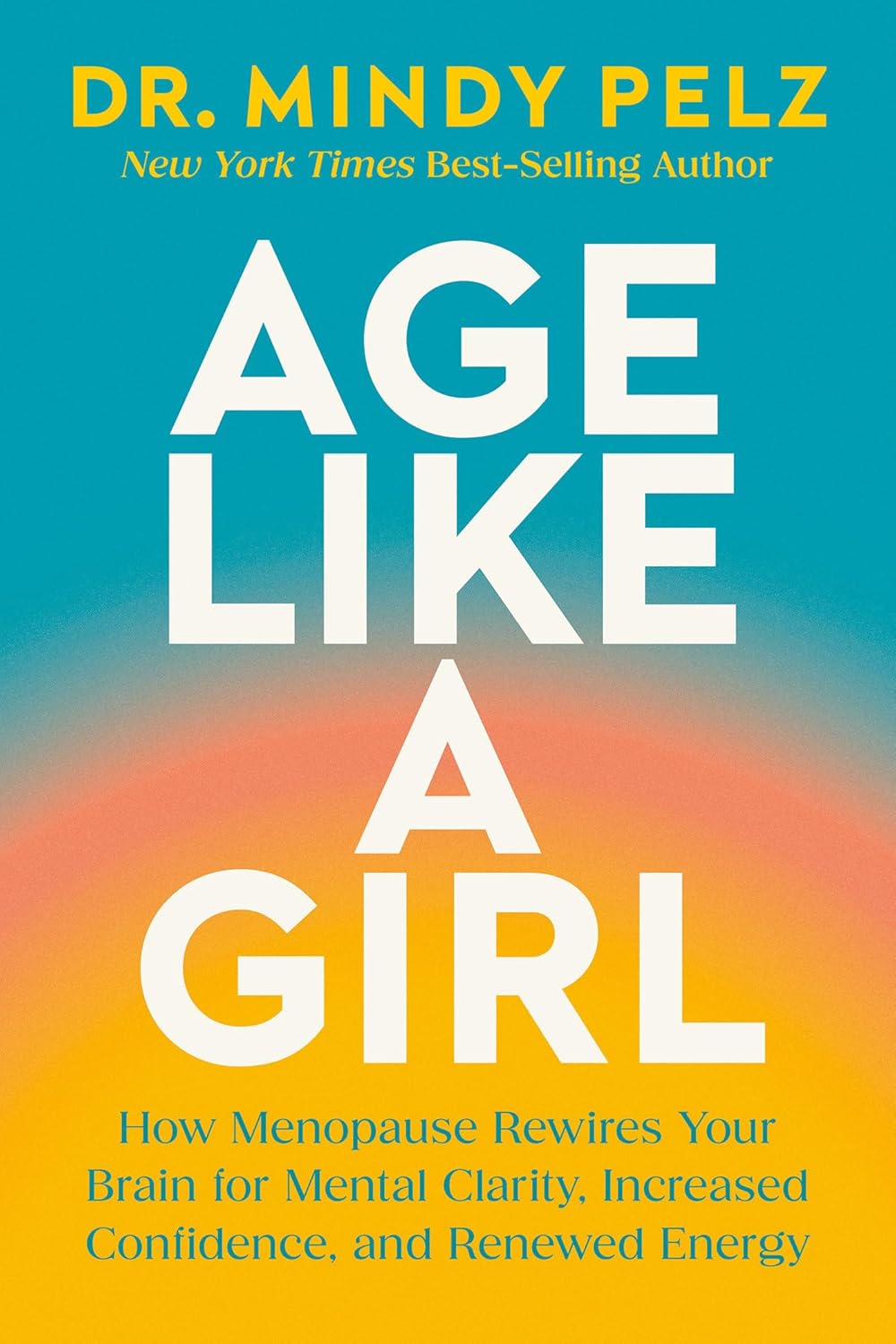
Dr. Mindy Pelz is joining me with the conversation that I personally needed over a decade ago because what no one told us is that when your hormones start changing, you don't just need more discipline, you need different information. You probably know Dr. Mindy Pelz from her New York Times bestseller, Fast Like a Girl. That book helped millions and millions of women rethink fasting, food, and their bodies, including me.But here's the thing, she is back now with a new book, Age Like a Girl, how menopause rewires your brain for mental clarity, which we all need, obviously, increased confidence, and renewed energy. If you're heading into this next year thinking, "I want to stop feeling tired all the time. I want to feel strong again. I want to understand my body instead of fighting it." You are definitely going to want to hear this. Dr.Mindy Pelz, welcome to the show. Oh, thank you, Tamsen. I'm so happy to be here, and that was quite an intro. I'm like, "Oh, yeah." She You can see the journalist in you coming out. That was impressive.Did all those things though, and you really are continuing to help millions of women every single day. And now with this new book, which I'm I'm super excited for people to get their hands on. Well, first of all, how have you been? Let's let's start there. Let's start there.Well, that's a loaded question. Yeah, I've I've I've been exhausted. I've been doing a lot over the last several years, but I would say like from a happiness level, I'm sitting here the happiest version of me. I have found a beautiful landed in a very beautiful sweet spot for myself. So, I would say on this day, I'm doing really well.I'd love to hear that, and I feel like that's what a lot of people want to feel, you know. So, Fast Like a Girl was just an incredible, incredible book that it you know, if you mention it to most women, they know exactly what that book was and at a time in their lives when they needed it. Age Like a Girl, what why did you write it and what did you feel like needed that more explaining at this stage in life? If you look back at what Fast Like a Girl did is we redefined intermittent fasting, hormone balancing, and weight loss for women. And I felt like the menopause conversation needed another voice in there talking about the upside.Like I think it's really interesting that we have gone from a cultural hush around menopause to where we sit now, which feels like a cultural chaos where nobody knows where to who to believe, they're overwhelmed. Like there's just so much going on in the conversation. But what we were seeing with women across all of our socials is they were starting to get overwhelmed and losing hope. And so, I wanted to dive in and bring hope back to the conversation. I'm so glad you did that, and I agree, there is a lot of information.
I I said to somebody, "Is it my algorithm or is it" and I feel like everyone is seeing that right now. I mean, maybe not everyone, but a lot, right? The same thing to all my friends. I'm like, "Is your algorithm doing this?" Yeah, so funny. Is it telling you about belly fat every morning when you wake up and how to sleep?
Yeah. Oh, so what does it mean to age like a girl? It's so interesting because I've been asked this question a lot as we've been promoting the book. And I I obviously want to give the obvious answer, which was it's my brand, like a girl. We do We should be doing everything like a girl, including aging.
But what I as I've been talking about the book a lot more and listening to people's response and having my own experience with the content in the book, I think aging like a girl means taking back the parts of us, the childlike, girl parts that we turned away from when we were told we needed to look a certain way, act a certain way, be a certain thing. We shy away from that essence, that girl-like essence that was playful and joyful and did things just for the experience of them and traded that in for the responsible woman. And I'm hoping that what people will do with this book and this cultural conversation is we'll start to take back the parts of us, the girl parts that we really enjoyed. Well, and I also think that gives you a a different type of strength that you don't realize, you know, that you need every once in a while in life. And I and I agree with you.
I When I go do the things that I not that I should do, but that I want to do, I feel very different when I have to go back to the things I should do. Right. Which is really nice. Yeah. Well, we were talking about work before.
Like I found life outside of work in my in my new location where I'm living. And in that, I also found my little girl and things she used to love to do, and it was it's really I realized that I had put all the responsibility ahead of everything else. And I really have hit a point where I'm like, "Nope, I come first." So, even here, coming to New York to do all this media, I came in 3 days early so I could play. My best friend's here in town. I'm like, "Let's go have fun." Great.
Okay, the old me wouldn't have done that. The old me would have been much more like, "I got to do the responsible things. I need to like, you know, conserve my energy." I'm like, "Let's go play." It just made more sense. The let's go play Mindy. Why do you think we did that for such a or do that for a long time?
Because I I agree with you. I understand it. I do feel often times like, "If I do this, like go and enjoy myself, I'm going to lose something else on the other side and I'm not going to be as responsible or get as much done." I do think that's ingrained in us. Yeah, by the culture. Yeah, but totally by the culture.
So, I want to go to Carol Gilligan's work because that was profound for this book. And for people who don't know what she did, she was a feminist psychologist that back in the 1980s studied girls. And she noticed that if you ask a girl and a boy what they want at nine, they both will tell you the very same you know, they'll be very clear with their answers. By 11, the boy is still very clear with his answer, and the girl's wavering a little bit. By 13, the boy will tell you exactly what he wants, and the and the girl will say, "I don't I don't know.
What are you want? Or what are you having?" So, she came out of that research in the 1980s, which I just want to say [clears throat] we're products of the 1980s. I feel like we were total products of the 1980s. So, she came out of that research and she she wrote a book called In a Different Voice. And the her concept, which I think is so important to the menopause conversation, is that we were taught in order to be worthy, we need to be selfless.
Mhm. So, when you are give to everyone else, you will get feedback back that you are a good, worthy human. If you look a certain way, you're a size two. If you weigh a certain amount. If you don't have any wrinkles on your face and you stay looking beautiful, then the culture will love you.
And I think what's happening during menopause is all the brain re-wire-ment, the neurochemical armor that comes down, we go, "Oh my god, that was so hard." 30 years of it or however long. Of it. But I don't know if you resonate with this. I When I hit that point about a year ago after all this book launching and book writing, I didn't know who Mindy was. I didn't know what Mindy wanted outside of work, outside of her family.
Like what did just Mindy want? I'd never given myself permission to ask that. How did you start to unwind that from where you were? Because I could imagine a lot of women that are listening are like, "Okay, I'm I'm that Mindy from before." How do you get to where you are today? Because you consciously had to do that.
It wasn't just sheer I just I give up. I have to I have to change this. You know, I for many years wondered what a mental breakdown would feel like. And then after the LA fires, I felt it. Like I was like, "Oh, this is it." Like you just can't function.
And yeah, and I was still in like really I wasn't sleeping. I was full of anxiety. Like I was still trying to find my footing after that traumatic experience. And so, what I did and I and I if every woman can do a version of this for herself, I highly recommend it. Is I isolated myself.
Ooh, okay. Let's talk about it. And I think this is really important, and I just use myself as an example. I realized this year, and I think a lot of women are this, I was your classic codependent. And what I mean by that is if my husband was feeling bad or my daughter was feeling bad or my sister was feeling bad, I would do anything to make them feel good, but not because I wanted them to feel good.
I wanted them to feel good so I could feel good. I took their pain on. I totally I feel I feel it. I I know exactly what you're talking about. And so, all of a sudden I had to stop that behavior and realize that I needed to get to know like who I was and what I wanted.
So the isolation became a moment for me to feel my own energy. Mhm. And and at first it was horrible. I'm not going to lie. Like going to ask you that.
Was that ter- Like I don't always like sitting with my own thoughts. Oh, yeah. Let's talk about that. Oh, yeah. It's very confronting when your brain keeps talking to you.
Like I would have nights where I would go to sleep and I'd be like, "Whoever is up there, could you just shut up? Just shut up." Like stop talking to me. I'm just trying to take a moment. But when I got alone, everything started to slow down and I stopped adapting to everyone else around me. That's the key.
I had to see my codependent nature. I had to see that I was absorbing everybody else's energy and I had to start to do everything on my own. So there were little things that I did. Like, "What time do I want to wake up?" Mhm. Like am I getting up for work?
Was I getting up for a family? And I realized I like getting up before the crack of dawn. Yeah. Okay. What time do I want to go to bed?
What time do I want to eat dinner? Do I I even went I because of the fires and I had no clothes because our house didn't burn but but my clothes were in a house I couldn't get to. I didn't know if my clothes were had smoke damage or what in them. I had four outfits. It was really liberating to live off of four outfits.
Wow. And I was So So I would put my outfits on and then I'd be like, "Do I like dressing like this?" I mean I did I inquired about everything when I was alone. How do I want to feel? How do I want to be? And that isolation gave me myself back.
If somebody can't isolate or doesn't know how to do that. Like there different ways you can go about doing that. Is it really being on your own or finding pockets within, you know, if if you're not able to do that. If you have young children, whatever it is and you're Can you do it for a day? What What do you think you can do?
Yeah, I I've since learned that a lot of women go through this. So I just and and I I think it's really I just want to point out that I think it's really hard when you've been in a marriage for a while, when you still are actively parenting. Like everybody's kind of like, "What's going on with you?" And like you don't under- And you don't even understand yourself. I don't think so. If I look at the moments up to my breaking point, I was actually crying for alone.
I just didn't know it. So it started with I had one chair in the house and I called it my thinking chair. And I would get up before everybody else in the house would get up because it was the only time I could get quiet. And I would sit there for an hour before everybody woke up. Mhm.
And then I'd started telling my family, "You can't sit in that chair." That's my chair. That's my chair. Did you see my books next to it? My my crystals? Like that's I called it my thinking chair.
But you went there every morning. Every morning. Every morning. Wow. Okay.
Started with that. Then I created a room that was just mine and it again had all my stuff in it. So you could do that. And then I it went to actually 4 months at an Airbnb by myself. So there's a lot of versions of it.
But I think sometimes we just have to find a way to move out of the noise. What do you think it taught you about going back into I don't I don't want to say going back into your life but like but moving beyond that. I mean you're you're really talking about changing the structure of scheduling of of eating of re- you know, relationship, being around things. What did it teach you at the end of that? And the relationship was a big one.
Yeah, because I also questioned every relationship in my life. Does this work for me? Are they supporting me? Are they not? I have aging parents who needed my help.
I was like, "How much do I want to help out of What's my duty to help?" I asked, "How much do I really want to help? When do I enjoy calling my mom? When do I don't enjoy it?" Like literally the inquiry was deep. You know, to answer your question, here's what I found and I think most women, if you're really like intentional about this process, is my body told me. So when I got by myself, my body finally could relax.
I could sit on the couch and I could relax. I could just be. I was near the ocean, so I could sit and watch the ocean. And then when I would get around a situation that wasn't right for me, my body would tell me and I would feel like a knot in my stomach or I would feel tension in my shoulders. I think prior to that, the knot was always there, the tension was always there that I was numbed out.
So you didn't even recognize it. It was always there. Wow. I get it. Our nervous systems adapt to things and then you just are in a heightened state forever and you probably were doing that for decades.
Right. And this doesn't have to be complicated because I'm still using this as a guide for myself. So 2 weeks ago I looked at my schedule and I could just feel that compression in my gut and my sides and I was like, "God, it's just work work work work." And I'm like, "I'm going to rush from thing to thing to thing this week and then I'm going to come and do this book launch in New York." And I was Then this thought came in my head, "You control your life, Mindy. What needs to go?" And I literally looked at my schedule. I'm like, "That appointment's gone.
That I'm not rushing there. That's going to put me in traffic. That's going to annoy me." And I just started to like cancel all these appointments. The old me would have been like, "What does that person think? Oh, no.
I'm going to They're going to get mad at me." But I promise after this experiment of isolating myself, I will never betray myself again. And I when I get in those moments and I feel it, I'm like, "Oh, oh, oh. You're betraying yourself. You're You're going back to a pace of life you no longer wish to do. Don't do it, Mindy." What do you recommend for people and explain how menopause is rewiring our brains because I think that's something that we haven't heard a lot about in this conversation.
We've talked a lot about how your brains do change from a scientific place but when we're talking day-to-day, how does menopause rewire? I think that's the biggest message I want to bring forward in this book is that your brain is now setting you up to take care of you. Okay. Yep. Like think that through.
You've gone through menopause Yeah. Like you're actually getting a brain that is now ready for you to put your needs first. So when we look at it through that lens, what's happening and here's the best way I can explain it. And Lisa Mosconi brought us this work. So we know that the female brain, once estrogen comes in, it stimulates a part of the brain called the called the corpus callosum.
The corpus callosum in the female brain is bigger than in the male brain. And estrogen ignites it. And that is the highway between your right hemisphere and your left hemisphere. The right hemisphere says, "I I want to be in relationship with you. I want to create with you." It's that creative emotional side.
The left side is like, "I'm going to set a goal and I'm going to go after that goal and achieve it." It's the logical side. Business, logic. Okay. So when estrogen came in at puberty, what happened is we started operating from both sides of our brain. So every single thing that we did in our life was through the lens of I want to kick butt and hit this goal but I want to make sure I don't step on your on your shoes doing it.
I want to make sure that I'm in relationship as I do this. We brought relationship and caring for lit relationships because we're nurturers to every decision that we made. Regardless if it's if it's if it's business or if it's personal or if it's Is that why the 13-year-old girl says, "What do you want?" when that happens at 13 because of puberty? Okay. She's not in her relational brain.
So she actually before that corpus callosum got stimulated, she's like, "I'm just going to tell you what I want." She went straight to her left side of her brain. She's like, "I want this." And then estrogen came in and all of a sudden now she's like, "Well, I don't want to be out of relationship with you. So maybe one of my wants is going to put me in friction with you." Yep. Okay. So that's puberty.
And 30 more years. 30 years of that. And so what Lisa taught us was this pruning of the brain, the changing of the brain. But what we need to take what she started in that beautiful research and bring it to a new level of functionality, which is now estrogen goes away and that highway is not as as prolific for you. So I can sit here and you and I could do business goals and I would tell you exactly what I want in business without thinking about your feelings. Or you and I could go into, you know, a conversation like this is probably we're both more in our right hemisphere going heart to heart.
But we don't cross reference. We go to a lateralized brain. So all of a sudden we're not taking everybody else's feelings into account. That's like, "Okay, I'm in this stage. I I understand it.
I'm feeling it. How do I get to that next feeling with that confidence?" Because you're saying that menopause that's the rewiring of the brain, right? What does it do for our energy? What does it do for our confidence levels? Because I do talk to so many women you know, as you see on social all the time and they feel that lack of confidence and lack of purpose because so many other things have changed at the same time.
Yeah. This is why I call it the brain remodel project. We have to see that it's a limited period of time. So I just and I I get like 10 years is a lot to be in that But if we understand that there is an end to it and you're going to a place that's really amazing, I think that's really important. Okay, second thing.
So that chunk is perimenopause to menopause about, right? So what are we saying? In your in your 50s? 40s, 40s, 50s, early 50s. Average age of menopause is still 52. Yes.
So yeah. So beyond that now. Beyond that. You know, look at some of the people who are paving the way. Michelle Obama.
Like I I like freaked out last summer when I saw her say, "Can I just do things for myself now?" And I was like, "Yes, there she There it is." Jane Fonda is like I, you know, the most prolific time of her career was post menopause. Mhm. I think we have to think about like some examples. That's always important. Energy.
Let's talk about energy. So, in all the research that I did, when I went back and looked at the evolutionary explanation for menopause, which Mhm. You can call it the grandmother hypothesis. I know there's been critics of yes and no on both of that, but the hunter and gatherers, what they acknowledged was that when a woman stopped cycling, that energy, this one just blows my mind. The energy it took to release an egg every single month is a tremendous amount of body energy.
I would imagine, right? But I didn't know that. Know that. It wasn't like we were in like a board meeting like hold on, I got an egg releasing right now. It's just I just woo.
Might need another cup of coffee. Like nobody did that, right? Nobody I know. Right, exactly. No, we were taught to hide all that, you know?
All that energy it took for the reproductive system comes back to you. Yeah. That's one of the most pivotal parts of the grandmother hypothesis. Is that energy gets restored back to you. And when you look at what those postmenopausal women did in that day Mhm.
And we have a current example of this in the Hadza tribe which is one of the blue zones by the way that we hold up as Yeah. Hey look at these this tribe has got aging knocked out of the park. Well, guess what? The postmenopausal women when they were done cycling they go on a 7-hour trek every single day to go forage for food every day and bring that food back to the clan so the clan can stay alive while the men were off making a big animal kill Mhm. Which they only came back with an animal kill 3% of the time.
Right. So, there's a tremendous amount of energy that comes back to you. We're not talking about that. We're not talking about any of that. We're talking about that we need, you know, we're very tired.
Yeah. I'm in hot flashes. We can't remember anything. But I'm I think this is so exciting for younger women to hear it too. But especially for women in this in this period because I'm seeing a a big trend of a lot of people saying okay I I hear the menopause stuff.
What about post menopau- what happens next? Right. And this is the next. So, then that ties into the confidence piece because I really want to reframe confidence. Yeah.
So, as you It needs it. Yeah, like as you go through this experience, what you're being offered is the opportunity neurologically, neurochemically in your body to start to be congruent with your authentic self, to finally speak your truth. Mhm. Which is why you have so many, you know, you look at the we do not care club. Yeah.
What did that What did she do? She was like enough. Yeah. And she stood up and spoke her truth. But and then woman after woman after woman did the same.
Permission. Permission. Confidence comes with congruency. When you say that again. Confidence comes with congruency.
Okay. Okay. It doesn't come from experience. It can. Yeah.
But you're right. But the biggest moments of confidence that you will discover in yourself is when you are congruent with who you were designed to be. Mhm. You asked me how I feel about this book and I was telling you that every other book when it comes out, today's pub day, I'm usually nauseated. Yeah.
I am not nauseated today and let me tell you why. Because I said what I wanted to say authentically in this book and so I have confidence. How freeing is that? So freeing. So I feel like people are going to just pick up on your energy cuz I can feel it in your voice.
I can. I can. I could I felt it when you walked into the I felt it when you walked in here. Yeah. Well, I I want to free women.
Like we've got to start living life on our terms, not the expectations of the culture. We got to get to know ourselves. We need to love our body. We need to love our wrinkles if that's what you choose to love. I look at my gray hairs and I'm like oh there's another wisdom strand.
Like I got to get to that place cuz I got a lot of wisdom. Yeah. So, I think we need to start looking at at confidence as every time you're feeling a lack of confidence, ask yourself where you're out of congruency with yourself. What do you do to get back in to where you're feeling good? Yeah.
Because I I know that for me and I I mentioned at the beginning, but it was my early 40s. I'd gone through a divorce, but I know it wasn't really the the divorce that hit my confidence. It was everything else. I was just feeling I was out of sorts. Yeah.
And I think it's important for women if they are feeling like that, whether it's their bodies, whether it's just not even understanding where they are right now, whether they're not Yeah. Paying attention to themselves anymore. How do you get that back when we have those ebbs and flows throughout the day? Yeah. So, the first thing is this self-inquiry.
I just want to say if you keep asking yourself what do I want and if we're really honest with ourselves I hadn't really asked myself that very much. I was I would get up in the morning and I was like okay, what do I have to do for my practice? Mhm. What do I need to do for my kids? What do I need to do for everybody else?
So, just start by getting to know yourself because I got to say the first time I did this I actually was in therapy and my therapist said to me Mindy, what do you want? You have time. Yeah, you have money. Your kids are grown. What do you want?
And I and like nothing came to me. That's how I feel when you say that over and over again. We're sitting here with you right now. I'm like oh my gosh, I hope she doesn't ask ME THAT QUESTION. I REALLY HOPE NOT.
WE'LL DO THAT AT ANOTHER TIME. YEAH, let's do that at another let's do that over freaking tea. But did you have an answer finally for that? Nothing came in the beginning. This is what I want to say.
Is I looked at her and I the first thing I said was nobody's ever asked me that. I wasn't even asked that as a child. The environment I grew up in, my sister created a lot of a lot of chaos in the household. And so I was told shut up, sit down, you don't get a voice in this chaotic house already. And you kept that.
And I kept that. So, it was blank for about a month and this is where I started really looking at like silly things. This sounds but it's easy. Everyone I did this. It sounds silly.
I think it sounds necessary. Yeah. So, like work. I was like what parts of work do I like and what parts of work am I doing for money? What parts of work am I doing for affirmation?
Mhm. Mhm. What parts of work are draining me? So, I took all of my work and I started to break it down. My daily schedule.
So, I've learned I don't love rushing out the door in the morning. Okay. I did it for so many years. Know you didn't love that? No.
Didn't know it. I like getting up in the morning. I like reading. I like having my cup of coffee. I love listening to great music and I have a whole set of girlfriends that we talk in the morning.
Every every morning. We send messages back and forth and here's what I'm going through. I love that. So, that just came through like self-inquiry. Mhm.
I even looked because I only had four outfits. When I went to go get more clothes and bring them back into my life, I was like how do I want to dress? Why do I dress the way I dress? And then I started to see Wow. Like oh my god, my mom told me I needed to look like this and that.
I literally broke down my whole dress attire. I'm going to tell you something I did the other day that was so liberating and if a woman hasn't ever done this, I highly recommend it. I live in Santa Cruz now, which is a very natural, nobody cares what they look like. And I was getting ready to go to the chiropractor actually to go and and get adjusted and I was running late and I couldn't find my bra. And I was like why do I wear a bra?
Like do I care if it's not like my breasts hurt when I don't wear a bra. I was like wha- I don't even like wearing a bra. Why am I wearing a bra? And so I'm like I'm not wearing a bra. So, off I went and I was like oh my god, then I went into are they going to notice I don't have a bra on?
Yeah. Why do I care if they notice it? I it was a whole moment. I then I felt so liberated like I walked in and I was like I don't have a bra on. Everyone, I'm not wearing a bra.
I even I JUST LET YOU IN ON A LITTLE a secret. I flew here on a red eye on Thursday night and I'm like I'm not putting a bra on. I love that though. I love that. I feel like women are going to be like Mindy said I didn't have to wear a bra.
Yeah. And I was like oh my god, what? Then I went to what if why do I wear a bra? Well, I don't want to see I don't want people to see my nipples. Yeah.
Because you have nipples and God forbid they would go you're a woman with her nipples that are showing through her shirt. Like this is crazy. Isn't it unbelievable when you twist back to how things started? I mean, I will tell you in full disclosure, I wear those nipple covers all the time. They're in my purses.
They're every- they're all over my house. They're stuck in my luggage and that's what I wear. I don't even wear the bra most of the time. Mean Yeah. I have one on today.
But most of the time I don't. When I'm like on my playtime or on a I I love that. So, it's like I love that you twisted it went went all the way back like and kept digging. I did a keynote last week and I had a shirt like this on and I put my shirt on. I'm like there those nipples again.
I had a bra on and I was like freaking and then I'm like do I care if a thousand people I'm speaking to see my nipples? I'm like I don't care. [sighs] That's where we have to get to. So, do you think when that happens at this age do you think that that's what builds somebody into having more energy, having more confidence because the brain is being rewired? Yeah.
That's that we're back at the congruency. We're back Yeah. Of energy it takes to worry about everybody else and what they think of you. Like that's a tremendous amount of energy. You talk about the butterfly.
Mhm. Can we talk a little bit about that? Yes, let's Yeah. I love that. When I I opened it up, I got your book and I opened it up and the sticker was there and I went aw, I just love this." Yeah, thank you.
Always remind me of my mom and so it was like extra special. But could you talk about the butterfly effect? Yeah, so in this 4-month period, I fell in love with a mythologist. His name is Michael Meade. Mhm.
Have you Have you heard [clears throat] of him? No, I don't know who that is. Oh, he's great. He teaches life lessons through mythology. And so he was sharing this episode about what truly happens to the the caterpillar as it becomes a butterfly.
Now, check this out. When I explain this, you're going to hear it You're going to hear menopause all over. Okay. So, the caterpillar is born with a set of cells called imaginal cells. Okay.
And these imaginal cells are the essence of of who the caterpillar is supposed to be and will one day be the cells that turns it into a butterfly. Okay? I hear menopause all over it. Yep. The caterpillar goes through life and it consumes grass.
We go through life, we consume life. And one day it's like, "I'm tired of this." Sound familiar? Yeah, of course. And then it literally gets a drop in hormones. I am not joking.
The caterpillar has hormones. Yeah. Were you blown away by that? Totally. I had to look it up to make sure it was right.
I was like, "What? It lost hormones?" And that drop in hormones combined with the exhaustion of consuming grass signals to it to wrap itself up in a chrysalis and dissolve the parts of it it no longer desires so it can become a butterfly. Wow. So, it goes into the cat the chrysalis, creates this chrysalis, and then you know what it does? It resists its own transformation.
And the resistance is important so that it can amp up the caterpillar's immune system to destroy itself. It's an autoimmune response in the caterpillar. Oh my gosh. When we look at menopause, we have this moment where we're like, "I need to do something different." Yeah. But it's natural to resist it.
It's important to resist it. Right. Right. That, if you go into the self-inquiry and you go and go, "Okay, what needs to dissolve right now?" Then you're left with a dark gooey place Mhm. Is the 10 years we're in that middle part of our our menopausal experience.
But then the imaginal cells Yeah. Of what you were supposed to be kind of merge if you're willing to go in and dissolve what no longer works from you for you. And then the caterpillar comes out a butterfly. And I have a butterfly sitting here in front of me. That's right.
I Well, you notice I now I know. Well, so I did something I got so into this story that one day we were out at the garden store and I found a hat with a butterfly on it. And I turned I put it on and I turned to my husband and I'm like, "I'm going to start wearing this so that you know what version of me you're looking at." good. Does he know now? Yeah, he knows.
He's He's learned. I saw him out there. I saw I know he learned. You know, you talk about health all the time and how it matters. And in this time of menopause, because if somebody has gone through menopause, there's still a lot of things they have to do to take control of their body and their health and and what else happens.
What are you finding that's in line with this? I know that you know, a lot of the book talks about, you know, memory and and mind and and body. Yeah. What do you suggest for people that kind of feel, you know, there's this whole generation of women that feel like they were skipped over. You know, hormones were not part of the the solution for them and now they're postmenopausal and they're wanting to feel like a butterfly and maybe they don't ever feel that.
Yeah. Yeah. I think the most important thing that we look at through this whole process that is not getting enough attention is our metabolic health. Yeah. If you go into this experience with your metabolic health off, meaning you have a high hemoglobin A1C, like maybe it's up in the sixes or you're prediabetic or you have diabetes.
What we know is that if insulin is out of balance, then sex hormones will go completely whacked. Okay. So, I And then you start gaining weight because you were already metabolically off, estrogen declined, you became more resistant, and now you're gaining weight just looking at food. And people that have had no problem before are saying they have thyroid, cholesterol, I was I was told I was prediabetic. I I was shocked by it all.
Yeah. What do you start doing there to to pay attention to that, get control of that? What kind of test What do you recommend the first thing is? If there's somebody listening saying, "Yeah, that's me. I woke up one morning and I feel like I have a tire around my my belly." Well, first get to know that one blood marker.
Every Most everybody gets it tested every year. Okay. So, let's try to get your hemoglobin A1C close Yeah, A1C close to five. Okay. That's a really strong stable spot. 5.2 is even good, but anything over 5.5 starts to put us in a little bit of a danger zone.
Second thing, bef- let's just eat real food. So, what is real food? Real food is a food that doesn't have a label on it. Mhm. It came from the earth and it didn't have to be packaged up and reformatted in order to make it palatable for your taste buds.
So, you might have gotten away with the ultra-processed foods at 35, you are not getting away with it at 45. So, start to clean up your diet. And it I'm not talking deprivation. In the book, I have something in that I call the primal menopausal diet, which is just simple food like things like grass-fed meats if you eat meat. Let's wild meats.
If you don't eat meat, let's double down on legumes. But then stop eating the same black beans. You got to look at lentils and you got to look at white beans and all of those are bringing different nutrients. Fiber, you know, I don't have a meal without some kind of vegetable. We have a whole set of bacteria in our gut called the estrobolome that breaks down estrogen and you feed these bacteria by giving them fiber.
Wait, explain that. So, fiber like vegetables and fruit, they feed the bacteria in our guts Okay. A very specific set of bacteria called the estrobolome. Mhm. The estrobolome, these bacteria break estrogen down and make it so that estrogen is usable for our cells.
Mhm. So, if we have been on birth control for decades, that has destroyed our microbiome. If we've been on, you know, one round of antibiotics destroys your microbiome. It kills all those bacteria. What do you do when that when you when that has happened?
Because most of us have been on antibiotics, most of us have eaten too much sugar, most of us have done so many of these things. What do you start doing to course correct that? Because I I always worry that, you know, people think it's too late. I've It's been years. And I I think your message is it's not too late.
Three days. Three days. In three days, you can change your whole bacterial profile. So, there was there was a National Geographic reporter. You'll like this.
And they measured his microbial profile and he lived in London. They then sent him to Africa to go live with a tribe that was like lived in tents. They they ate porcupine. They had a completely different environment and diet than he did. And so he lived there for three days.
He did exactly what they did. He ate exactly what they ate and then they sent him back to London and they re-measured his microbiome. He had a whole different set of bacteria in three days from a different environment. Okay, what do we do? Yeah, so first is diversity of food.
How many of us eat the same food over and over again? So, when I go to a restaurant, I look at a menu. I don't ask what I'm in the mood for. I ask what haven't I eaten. Okay.
So, I look for food that I don't normally eat at home. Vegetables. Vegetables are amazing for the microbiome. Fiber is amazing. Stop eating like I love red peppers and I'll eat red peppers over and over and over again.
I'm like, "Okay, no, I need to start to look at other types of carrots and celery and things that I can make sure that I'm getting good diversity." Lettuce. I don't ever buy the same type of lettuce. I get all different kinds. Thing over and over again. Right.
That's just habit, right? Right. So, it's called a monoculture and you start to feed the same bacteria. They get stronger and stronger and then they bully the other bacteria in our gut. Diversity is key.
So, start looking at what you're eating from a wider lens. This is not deprivation. This is fun. No, I know. And what we learned is deprivation all the time.
We learned calorie counting. We learned no fat. We didn't learn I mean, fiber I didn't I never even talked about fiber, you know? So, protein, fiber, super duper important. Protein and fiber, incredibly important.
And then let's talk about carbs because Please. Because my favorite thing is when people think that I'm anti-carbs. I'm like, "I'm not anti-carbs." I think for cycling women, you need to be strategic about the point of your cycle that you eat carbs. For postmenopausal women need carbs. So, but what type of carbs?
So, just like the fat conversation went from, "Oh, there's good fat and there's bad fat." Let's just say there's good carbs and there's bad carbs. And anything that comes from nature like fruits and vegetables is a good carb and anything that came from a from a lab or from a warehouse, that's a bad carb. If we think of it from a lab, it makes it makes it so much less appealing, right? Of what they do. I know.
I know. So, even like fermented bread, I've gotten There's some A lot of people are doing like big thing in my world right now is everybody's talking about their sourdough bread and the mother and where they got the mother from for the I'm like, "Wait, I need to be in on this." I have a fermented bread sourdough place right at the bottom of my hill. Oh, they don't even make bread. But I But it's so funny because everybody thought that I was anti-carb for so long and I swear I need to get that bread out and just to go on to social media. On it.
There we go. Like, look, y'all. I Mindy eats bread. Yeah, exactly. Okay, so let's talk about sugar because I do think that, you know, we're all aware sugar causes inflammation.
What else does it do for women that are postmenopausal? Well, so remember you're more insulin resistant now than you've ever been. Okay. Does that mean? So insulin is the hormone that stores sugar.
Let's just make it easy. So when you eat something high in sugar, insulin pops in and says, "Okay, I'm going to grab this sugar molecule, which is called glucose, and I'm going to escort it into the cell so your cell can use it for energy." Mhm. But but estrogen was a part of helping the cell use it for energy. Estrogen went away, you're eating a lot of sugar, and now the pancreas is putting out insulin and putting out insulin, and then all of a sudden, it's the cell's like, "I can't take any more. I don't know what to do with this." And so what your body does is it stores that sugar as fat.
What do you do? Right. Well, and then let me just say what we do right now is we look at the menopausal belly weight, and we look in the mirror, and we're like, "I must be undisciplined." And we start ridiculing ourselves, but really, your body doesn't know what to do with sugar anymore. Right. So ideally, you want to get off sugar, but I understand that's easier said than done.
So hard. So let's How about we go to more of nature's sugar? So how about you go to fruits? How about you eat chocolate? Why don't you get a high-quality chocolate?
We started doing in my family years ago, and it's a great swap, coconut sugar. Oh, good. It's a not stevia. It's not one of those funky sugars. I just swapped out coconut sugar in my house.
Nobody knew. I just started making everything with coconut sugar. And so you can There are other sugars that are lower on produce less glucose in your system. So you really got to monitor that because otherwise, that's contributing to the storage of fat. I agree with you.
A lot of women feel like, "Oh, I'm not doing enough, or I've got to get to the gym more, or I've got to you know, I'm not restricting my calories enough." And not realizing just how bad sugar Yeah. Really really is. The other thing I want to say about getting off sugar is if you went cold turkey, it would be pretty brutal for about 3 days. What happens? You you would crave the heck out of it.
Yeah. You might be a little tired, you might get a headache, but the cravings would tell you like more more more cuz it's an addiction. It gives you dopamine. Mhm. So a couple of things you can do in that 3 days.
Well, dopamine loves novelty. So how about you do some things in your life to bring dopamine in other places? Ah. Like go do some new activities, hang out with some new people. I'm getting a lot of dopamine living in a new town.Like you go and find new environments that you can put yourself. Change your workout up. Maybe you don't go to the gym, maybe go outside, maybe you don't lift weights, maybe you do a weighted vest. Like change everything up while you're going through this 3-day Okay. So that that would be like there's a lot in the book I put about dopamine.Then after the 3 days are over, then stay off the sugar that you were addicted to as as long as you can, and you'll start to change You'll start to starve out really the microbes that made you addicted to sugar. Mhm. They start to go away. They're they're not being fed, so they go away. Your patterns change, and all of a sudden, you will start to crave You will you won't crave sugar.
Let's talk about dopamine because I you do talk about it in the book, and I I think it's important for people to understand where you know, where it comes from, how you get it, and what you can do like little easy fixes. I think that was the most intriguing thing that I found in my research is I started to see in my practice all these women that were like super fit Yeah. I just don't want to work out anymore. Mhm. And that's when I realized estrogen's connection to dopamine.
And so it's natural. This is the first thing I want women to know is it's really common to feel loss of motivation as you go through this experience. Because of the lack of estrogen. Because estrogen went down, and dopamine went with her. Mhm.
And so dopamine is the motivation molecule. It is the molecule of more. It's not the molecule of enough. We can talk about that in a moment. But it definitely is the thing like, you know, go go get it.
That's kind of what dopamine says. So estrogen goes away, dopamine goes away, and all of a sudden, your motivation goes away. So even your motivation go to the gym, your motivation to lose weight, your motivation to care really starts to dramatically go. But dopamine has some very simple principles. First, we already talked about novelty.
Novelty could be as simple I don't know if you've tried this. Change the furniture around in your house. Really? Yeah. Have you ever Yeah, have you ever done that where you just go into your living room and rearrange the whole all of the furniture?
I have to tell you a confession. I did this in my office and in our and it's a room that like I really like to watch TV in, and I was using as my office, and I took the couch I don't It was the middle of the night cuz I couldn't sleep, and I was pushing it with my legs cuz the couch is so heavy on the other side, and I love this room now, but I didn't know it was dopamine. I just thought like it I don't know what I thought. I just thought I did something cool. You got a big dose of dopamine.
Good if you're doing that more. Everybody can do that. Change your room up. Up. Okay.
Okay. So change your routine up. If you drive the same way all the time, do a different drive a different way. Like seek novelty. That would be the first thing.
In diet and in all parts of life, yeah. Stop eating the same foods. Stop going to the same supermarket. Like just change it up, and you will find a vibrancy come back to your life. I promise you.
And it's free. And I mean, you did it uninten- not intending to have to do that. But but where I see, you know, where you were on one side of this to where you are right now, must feel very Yeah. That's why I say when you ask me how how am I doing, I was like, "Today I'm feeling really proud of myself." I'm really proud of you, too. I'm really proud of you, too.
One of the greatest things that was said to me this year was by my 86-year-old mom. And she watched me do this process of self-inquiry and and and isolation, and she said, "I am so proud of you for taking yourself on." Wow, that's an incredible That's incredible. That's what I'm doing." I'm taking That's something you're never going to forget. And I still like challenge my beliefs all the time. Do I really believe that?
Can I think differently on that? So it's fun when you get curious. Dopamine loves curiosity. So how could this room look different? How could my routine be different?
You will start to see that you bring dopamine back. Second thing, and this one's really important because I think it doesn't get enough credit, which is find a purpose. Let me speak for my good friends who are recently divorced, were amazing super mamas, and are trying to find their purpose in life right now. Yeah. The last thing they want to hear from me is find your purpose.
But purpose can be something as simple as every time you go out of your house to a store, you're going to smile and and talk to the people that are helping you in customer service. That's a purpose. My my husband has a purpose of every time we get in an Uber car, he wants to get to know the Uber driver. Oh, wow. Drives me crazy.
I'm like Literally, I'm like, "Okay, I'm going to be on my phone, so thank you for talking to the Uber driver." But he's like he's he's serving he's giving us a service. We should get to know him. So he has meaning when he gets in an Uber. That's amazing, though. That really is.
And you know what? You it he's probably like excited when he gets out of the car cuz he's got like a different kind of story that he's heard. And it's such a fun game that I Now I actually the last time I took an Uber by myself, I found myself doing it, and I was like Hi. Talk to the Uber driver. What am I doing?
And then I came home, and I was excited to tell him, "Hey, I talked to this Uber driver. Let me tell you what I learned." That is hilarious, but I love that. It's a different It's And maybe, you know, a purpose we need now in our world. How about in go go to social media, and instead of finding all the people you hate and letting them know on a comment, how about you decide you're going to cheer everybody on who's putting out content that you like? You're going to make a comment and be like, "I love your comment your content." I did this morning with this morning with a comedian.
I can't I can't remember her name, but she's got the red curly hair. I don't know. Oh, she's got a Netflix series out. But but I'm sure she's going to be coming back to you and commenting. I know.
I God, I can't remember her name, but anyways, this morning, I was realized I she was bringing me so much joy, and it was coming through my Instagram newsfeed. I was like, "I need to stop and let her know that her little vignettes she does in her 3-minute reels brings me so much joy." So I stopped, I took a moment, and told her, "Hey, thank you. You have really brightened up my day." So purpose doesn't have to be like, "Oh my god, I know how I'm going to save the world." Oh, her name is Michelle Wolf. Well, that's what I think happens. I think we're like, "What what's my new career?
What's my new nonprofit? What's my new whatever I'm doing?" And we make it so big that we're paralyzed by it, right? Yeah. So it can be that simple. Be that simple.
You also talk about friends and support and people, and you mentioned your friends that you talk to every morning. Can we talk about how important community is? Because I do hear a lot of people say like, "Gosh, I'm having a hard time like finding new friends or staying in touch with friends, and everything's really different." Can you give some advice on that? Cuz I I do agree with you that I I feel different, and I'm been trying to make a concerted effort over especially over the holidays like, "Who haven't I talked to in a long time?" So I you know, "Who haven't I seen?" If it's for a coffee, it's for a tea, it's for a dinner. How do you do that though on a consistent basis, not just because the holidays rolled around, and I felt nostalgic?
And you're you're an amazing connector. Oh, you're kind to say know if you've taken that on as your thing, but I just want to say that as you know, you really I I watch you, and I'm like, yeah, she's like really brings people together, which is really beautiful. So I think as women sometimes we make horrible choices in friends. I'm just going to say it. Like I want to What do we do?
Well, like I want to call it out. We have situational friends. Like, "Oh, our kids went to school together. Oh, we work together." But we don't make intentional friendships. You can have a friendship that's built around cutting your husband down and talking about how bad your marriage is or complaining.
A lot of women like to get together and we together. And I think that as you go through this experience, that's the friend you need to let go of. Do you feel it pretty much right away? Do you know it after you've gone through this experience? I can't actually if I get in a conversation where somebody's complaining over and over again, I'll stop the conversation and I'll tell the person like this is this is the new I don't care.
I will tell the person like I'm not unless you want me to help come up with a solution for you. I'm not the person that's going to sit and listen to you complain and argue for your limiting beliefs over and over again. But I would love to share with you like I'd love to help you. Yeah. But I can't keep I I had a friend who she got divorced and she every time I got years later just finally this over and over all the things that her husband was doing wrong and finally I looked at her and I was like I can't hear it anymore.
Good for you. How good how good did that feel though? It was it was liberating. I was like you you left him two years ago and he's still with you energetically. Do you think people respect that and feel like it helps change that some I guess it helps change, right?
Others might not not be able to hear it. Not looking for respect. I know what you're saying. Oh, you got confused. I don't care what they think.
I'm looking to respect myself and I couldn't sit and listen to the complaining all the time. So with we got to know how to step away from relationships that aren't serving us and one of the biggest ways you know is how do you feel when you leave that interaction? Do you feel better or do you feel worse? So I think that's the first thing to ask yourself. But then you need to seek relationships that fill you up.
And in the book I talk about three that I absolutely love. One is the butterflies. Where are the women ahead of you that have been through this process? How do we go and seek like a lot of my friends are 10 years older than me. So many women who are butterflies helped me through this moment.
They would tell me like a good one of my butterflies was the one that said Mindy I want you to take this with love because I was there at one point in my life. You're the classic codependent. Wow. And I was like okay, tell me more. And she's like I was there.
This is what it looked like. This is what it felt like. And I was like oh my gosh, that's me. And this is how I undid my codependent ways. Wow.
And she taught me how to start to unwind codependency. It's hard to see. It's hard to see. I remember the book forever ago codependent no more. Like that was but but that was really based on something else.
I mean this is this is kind of like everyday life codependency, right? Yeah, and I'm going to be fully transparent. I thought codependency was for wimps. Yeah. I mean I was like you can't stop that?
Yeah, like oh you're so weak. You have to like yeah. No. And I've since learned that a lot of high performing women are are huge codependents. So so that's the butterfly has been where you've been will will put a mirror up and say look at what you're doing.
Let me show you how to unwind that. So I think that one's really important. Another one that I love is the potentialist and my one of my closest friends is this and through this whole like the LA thing I went through a lot of anger. I did not want to leave the Palisades. I was really happy there.
I know. And I just got vindictive at times and she would remind me I know that you want to be a compassionate caring human and you don't want to go into that resentful angry place like let me help you start to see what the person is that I know you are and the person you want to be. Wow, that's like I can see her handing putting her hand out to you, right? And pulling it. Yeah.
So we all need yeah, we all need a potentialist that is like look at you there's a higher version of you here and I know you can access her. So really powerful. And then the third one that really was great was the anchor. And the anchor has been one that was like I have a couple of friends that are anchors and they are so amazing because they're like okay. They just pull up a chair and they're like tell tell me everything girl.
Give it I'm just here. You just let it all out. I had I I have many anchors around this book because there were times I'm like I'm not doing this anymore. I'm not writing this book anymore. My agent is one of those anchors.
I'm like I am not doing this anymore. Like I I would throw like two-year-old tantrums. Like no. And and the best thing you can say to me when I'm in one of those moments is just talk to me. Tell me what you're doing.
Tell me what's on your mind. And the anchors allow you to just vent without fixing it and I think that's really important. The community support I I don't know about you but when I I was going through you know, working all the time I'm like yeah, I have friends. I have you know, some friends that I haven't talked to in a long time but I could pick up the phone. But then I didn't have a lot of people that like really understood the place in my life.
That's it. Right? And now I feel like I I do and I see them and I feel them and I feel like motivated when I walk away from them for not motivated like work motivated like in my relationship or to go work out or just feel a little happier and it feels very different than it did when I was younger. And I don't know if I'm more aware of it or if it's just age and that's what we need. Yeah, the first thing I thought of when you're like I have a set of friends that I need to connect with I wanted to say do you want to connect with them?
I know I know, right right? Well, some I did and some I didn't. So it's only been a few of those. That's right. Like are they out of duty you feel like you have to connect with them?
No, I you know what I feel like? I feel like I was working so hard this year that I put everything on hold. And then I I was this weekend I was home alone and I'm like and I was like what am I my thoughts are really Oh, yeah. There it goes. Cuz I'm not home alone a lot.
And so maybe I was starting to isolate and I got scared. Yeah. It is it's really scary when you isolate in the beginning. It's just you and your thoughts. What do you recommend for a woman nowadays for fasting and you know, cuz there is a lot of noise out there.
There's a lot of confusion. And and you have researched this not just with this book but but before this with Fast Like a Girl. What do you recommend women to do if they say hey, I think I want to do that. Why should I do that? Yeah.
So the first thing I want to say is fasting is your is a biological instinct that comes with all kinds of healing mechanisms. So when I hear women say I can't fast or I shouldn't fast, I just want to point out that it it is a healing response that goes on and everybody has the capability to do it. I've taken people through the craziest eating disorders and food challenges and taught them how to fast. So second thing is that a woman should fast according to her cycle. I put that in Fast Like a Girl.
When we go through menopause because the brain becomes less sensitive to glucose, we have to rely on another fuel source. Lisa Mosconi and I talked about this on my podcast and I do not think it gets enough credit. And ketones are that fuel source. And I asked Lisa that. I was like so when a woman goes through menopause then if she her brain doesn't know how to use glucose for energy, we have another energy source and it's called a ketone.
Why wouldn't she go into using ketones for energy? And she's like I think that's an amazing idea. So when we're looking at it through the lens of brain energy, nothing will supercharge your brain more through this whole experience like dosing ketones into your body every single day. So what does that mean? 13 to 15 hours of fasting. That that's intermittent fasting.
It's not hard. You know, you can skip dinner, you can skip breakfast. Just look at your day and go I have an eating window and I have a fasting window. Okay. And once I open up my eating window, then you eat and then you close that eating window down at some point.
What what is the amount of hours that's the best? 13 to 15? To 15 is So if you're 7:00 at night, Yeah. 8:00 the next morning and that's enough? Yeah. So I think some people think that it needs to be like noon the next day and then we're talking about 16 and 18 and like crazy hours of things, right? No.
So 13 to 15 is what we're talking about. Yeah, and you're learning how to get your body into this what we call the fat burning energy system and your body will burn fat, the fat you're tired of and it will [clears throat] make this ketone that goes up into the brain and it starts to supercharge your brain. Now, if you still are you're perimenopausal and you're still cycling, I really want to point out that I still stand behind don't fast the week before your period. Progesterone doesn't like it when you fast. So so I still stand behind that.
So if you're still having your period, you have that one week leading up to your period, you should not do that. Then the other three you can. That's right. And then would you do it the same way with the 13 to 15? 13 to 15 is the 13 to 15's great if you if you want to do more, go for it and I will that leads me to the next point which is I have watched postmenopausal women bring their memory back like a boss from going on longer fasts. And let me let me explain this because this is the most misunderstood part of fasting and menopause cuz it's the brain.
I'm not talking about your athletic ability and we'll go there in a moment. But when you go into like a three-day water fast, you have given yourself three days of ketones. Ketones are neuroprotective. When a woman goes into a longer fast, she's bathing her brain in in ketones which repairs that. If you did a water is a water fast is a longer fast you're talking about.
How do you how do you succeed at that? How do you do it? What is it? So in the book I have like the transformational, you know, reason behind the three-day water fast. And I'm not you know, I don't want to lose people on this and then go like peace out.
I can't do three days. Yeah, it sounds crazy but you train for it. How do you run 26.2 miles in a marathon? You don't put on some some tennis shoes and go run 13 miles in a day. You do small increments.
Okay. So, you may So, I this is how you the best way to train. Okay. I really like something called a 5-1-1, where 5 days a week you do a comfortable fast. Whatever comfortable is, 13 hours, 12 hours, whatever. 1 day a week you elongate your fast.
Can you go to 24 hours? Just push it till it's a little uncomfortable. Fast water. Water only. Plain water.
You can have coffee. Okay, I love you. Yeah. Just no sugar in your coffee. So, and then 1 day a week you don't fast.
Okay. Got it. 5-1-1, easy. Do that for a while, and then once you can get to like one meal a day where you're just maybe eating lunch or you're eating dinner, what you'll find is that you can launch into a 3-day water fast much easier. We do In January, we actually, this was part of my fire story, we with our publisher, we do a 100,000 people water fast across the world. And here's another neurosis That's amazing.
Of the of the overachieving woman. Your overachieving woman. When the LA fires hit, I had I was on the sec I was leading a group of 100,000 people through a water fast. Oh my gosh. It was on the second day of the water fast, and I'm exiting my neighborhood with my neighborhood burning, and I'm talking to my husband, and I'm like, I just need to get down to PCH and get to a parking lot so I can pop on the call and lead the lead the group.
You are That's commitment. And is that what you did? Did you try to I was like, what are you talking about? My husband was like, "Honey, go to the hotel that I just which is right near your apartment. And and just get there.
We've got you." Yeah, cuz I thought that that that was like you're unbelievable, Mindy. Yeah, I was just committed. I Well, you were committed else but me. I was just going to say, to every other person but you. But I want women to start to look at fasting.
Let's go back to the confusion. I want you to understand that whatever late fast you choose, in Fast Like a Girl I put six different lengths. You can make a choice and decide what you want to do. And it's for your brain. So that's what people need to hear, I think.
I think that that's fascinating. I mean, you know, Dr. Lisa Mosconi has been on the show. I am a You know I'm a huge fan of hers. But you know, to talk about that was is really exciting to put that into play.
Because I think that her research, there's so much hope. There's so much hope. And to know that you can do something for your brain like that. So, how do you feel when you're on a water fast? When you first hit the new levels of fasting and you're a little uncomfortable, here's what I want to say, and this is why I love the 3-day water fast, is that you start to see your relationship to food when you get hungry.
Okay. You start to ask yourself, "Why am I hungry? Am I bored or am I actually hungry?" and then it usually goes into a place of like, "I'm going to die without food." Mhm. And then you all of a sudden hit a place where the body metabolically switches over into ketones, and it starts burning fat to make a ketone, and all of a sudden you go from "Oh my god, am I going to survive? I'm going this long" to "Wait a second.
I'm not hungry. Wait a second. I'm kind of calm." Do you stop thinking about it? Yes. On like day two?
It can happen on day one. Ah, okay. Okay. The noise in our head stops. That's nice.
Ketones bring GABA. GABA is the neurotransmitter that calms us. And so all of a sudden the longer you go into it, you would think you would die, but you don't. The opposite happens. You hit a place where you see your relationship to food, and then all of a sudden the noise ends.
You know, we talk about longevity these days, and I think it's just it's a big blanket, you know, like, "What is What does that mean? Live longer." the effects of fasting on longevity. Yeah. So, we know that fasting stimulates something called autophagy. Mhm.
And autophagy is your brilliant body's ability to repair itself. So, at about 17 hours without food, the cells look inside and they go, "Hey, there's some parts in here that are broken. We need to fix them." And so it'll fix intercellular parts. Sometimes your your brilliant body will go, "Wait, there's a bacteria or virus in here that or or maybe there's some heavy metals that needs to kick out." So it'll start to push out the bad, and it revitalizes the cell. Okay.
Then we have cells that are called zombie cells. Let's just call them that. The zombie cells are the aging cells. Those are the ones that are aging you quicker and quicker. When you stimulate autophagy and you stimulate this intelligence, what will end up happening is the zombie cell will die.
It's something called apoptosis, where the intelligence inside the cell says, "Well, this one is really messed up. There's There's too much to fix in here, so we're going to kill it and get it out of the system." So, you could also call them aging cells. So, these cells that are starting to age you quicker and quicker, when you start to learn to fast, you tap into your body's ability to get rid of those cells. I think I need to do I need to try it with you in January. I think I'm going to commit to that.
Just for people who are listening, yes, Age Like a Girl, you also have Eat Like a Girl, you also have Fast Like a Girl, which we mentioned. So, we'll make sure all those are in the show notes. Just because there's so much in each one of them that I don't want people to feel that they don't have a the source of all of it. So, don't feel overwhelmed. Yeah.
You have a lot. I'm I'm so happy you came today. I so appreciate it. It's your pub day. I know.
It helps ME GET THROUGH IT. IT'S such a big day, and it just it feels really great. Okay, if this conversation made you rethink what is happening in your body or helped you feel less alone in all of it, you are not imagining things. Dr. Mindy Pelz new book, Age Like a Girl, How Menopause Rewires Your Brain for Mental Clarity, Increased Confidence, and Renewed Energy, goes deeper into everything we talked about today.
Thank you so much, really. Tamsen, I love this. And I love you. You I felt a kindred soul today, and that yeah, so We sat there for hours, which is really I'll never forget that. The book is available now wherever you get books.
There's a link in the show notes for everything all of Mindy books, actually. And if this episode resonated with you, please take a moment to leave a review. It helps other women find the show and keeps these conversations going. Thanks for being here, and I'll Mindy, the care women deserve.