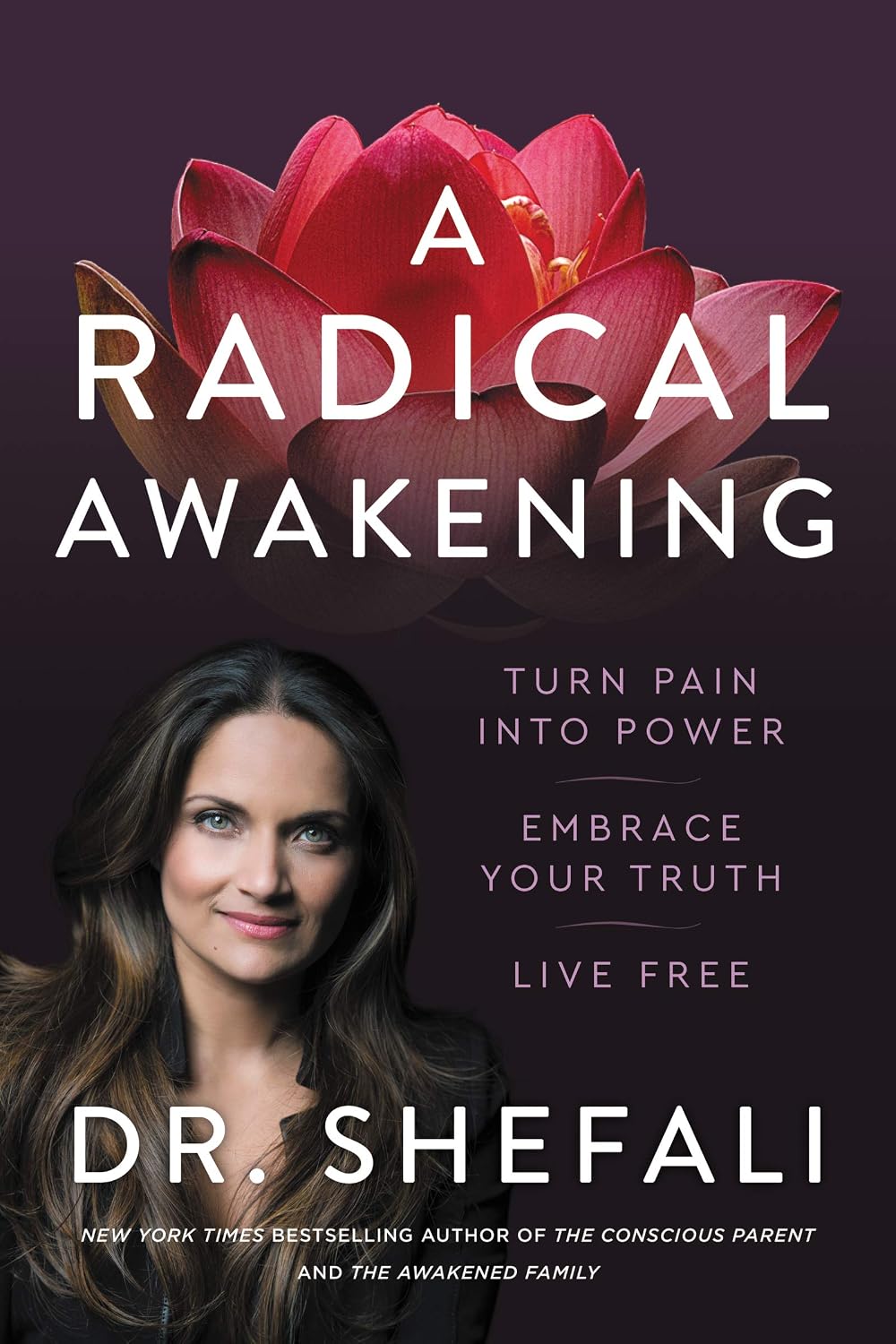
So I want to ask you this question. When did you first learn how to talk about your body? Maybe it was a parent that said, you know, you got to watch what you eat. Or you overheard your mom call herself fat in the mirror. Or maybe it was a coach that said, maybe you'd be better if you're just a little bit smaller.Most of us didn't invent these ideas about ourselves or these fears. We absorb them from the people who raised us and the culture we grew up in. And without even realizing it, we may be passing the same patterns down to our own kids. That's why I wanted to have this really important conversation with Dr. Shefali.Her work has helped millions and millions of parents all around the world. Her best-selling book, A Radical Awakening, is going to teach you to break free from societal expectations and really rediscover the person you were always meant to be. I love hearing her talk and I'm so excited she's with us because she's giving us the tools to break these patterns, not only for your children, but for yourself as well. So, let's go ahead and get started. Dr.Dr. Chafali, it's so good to see you. Oh my goodness. A dream dream dream dream come true. I I feel I feel like that too.I have been a fan of yours for a very very long time. And when you said yes, I was excited that you were going to be here today. Of course, talking about what I was just saying is, you know, how we how we get these beliefs, I was thinking about it, thinking about you coming here today and thinking about something that I hadn't remembered in a long time. My grandmother was always about women's body. She was in the fashion world clothes.Everything was about clothes. And I remembered it was a story that came up when I was researching all of this. I remember her talking to my mom and saying Tamsen is too big for her size. I was 16 at the time. She's going to be a woman size four.
She's got to get smaller for men to like her. And I I don't think she ever thought she was saying anything wrong. This was a the time. But I I remember that even to today when I look at a size on a on a ticket. So everything that you're saying is is so right on about our belief system in oursel and it's incidious, you know, it's in the air we breathe in our mother's breast milk.
It just in the way she holds herself in shame or in empowerment, how she looks at herself in the mirror. You know, all my life I was told, "Oh, you know, she's so cute. She's so sweet. You know, pretty. Oh, but she's just too fat, too plump, too this.
And when we girls at a young age begin to realize that our self-esteem, our value, our worth is tied into how we are perceived as by the other in terms of beauty, in terms of, you know, size. We then attach to it because we think oh yeah you know and and this may not be too different than how a boy may attach to his I was wondering about that athleticism or his earning capacity so boys are not exempt from this you know extreme focus on how we are how what we do our achievements or how we look but I think for us because how we look is genetic it's just what we were born as for the most part it becomes so treacherous, right? It's not what we can change or I can change my career or I can work harder. There's nothing I can bloody do about my the way I put on weight or the way my nose looks or the way my face is shaped. And so for a girl, it becomes more treacherous, right?
And our self-esteem, the girls self-esteem, because we have estrogen and oxytocin and we're bonders and we're connectors. We care about what people think about us more perhaps than the average boy. Just because of that bonding hormone, we it matters to us. We're sensitive. We we like to take care of people.
So if we're seeing that our mother is not happy with how we are, our caretaker, our inner caretaker vibrates with anxiety, with anguish. We want to fix it. We're fixers. We're healers. We're saviors.
So then we save our parents by sacrificing ourselves. Right. When did you start looking into this and say like this is something we've really got to would dig down deep and pay attention to or otherwise this pattern is going to continue and continue. I have been suffocated in the you know in the cage of toxic patriarchal messages. So, it's been a personal battlecry, but then watching my sisters, watching my clients, my female clients suffer at the hands of this and now I have a daughter and it's so hard to, you know, be realistic about health and tow the line about data and science and weight, but not shame, right?
You know, she calls me an almond mom now. You know, that's the thing that the I I had to get a definition of it. I think I was late to the game. I didn't know. Now see, our generation really grew up with an excessive focus on our outer appearance.
I mean, we have been done a number with our generation, right? I agree. I always wondered if it was just me and I started talking. Yeah, we have poisonous, treacherous messages that the millennials and Gen Z's are right to criticize us for and scold us. My daughter's always scolding me, "Mom, you're not that's not healthy, Mom." And I'm like, "Oh, yeah, you're right.
I need to be checked because it was just the way we grew up that we should be skinny. We should be always looking at our weight and criticizing ourselves and we are self-loathing almost. We are and it's a cycle. It's a cycle. It's a spiral.
And I love watching my daughter and her generation not have this inner chatter. And I'm like, what? You don't think about food and what you're putting in your body and do you don't punish yourself for eating the chocolate cake? Like you're just okay eating it? Wow.
Isn't that fascinating? It really I will torment myself and I will go on a cleanse the next day. Right? Like I for for hours or days and days there has to be a punishment. Punishment.
Oh, while I'm digging into the cake, I have to say, "Oh, tomorrow I'm going to go to the gym." Like there has to be some confess some compensation, some guilt. Like that is self-punishment. That is loathing. And I love how my daughter will just eat it and have no commentary. When do you think the awareness of bodies starts to happen?
Especially for girls is that six or six, seven, eight, you know, it just depends on the environment. But even if you have the most conscious mother and parent, culture will do a number. You know, our media, you know, watching these airbrush filtered, you know, polished images and now with social media where I feel insecure looking at all these airbrushed models constantly showing up in my feed, I can only imagine how susceptible a 9-year-old girl is, right? Who hasn't yet understood that this is, you know, artificial, this is superficial, this is not reality, this is fake. I have to keep combating those images and and telling myself, no, no, no, this is not real.
Just come back to ordinary life and be okay with your ordinariness. Imagine what the nine-year-old girl is up against today, right? I can't in some ways because I, you know, I have a I have a nephew who's who's 14 and so he's a boy. So maybe it's a little bit different, but even with him, I see that, you know, the constant real, you know, I I hear it and see it. But you're right.
I look at that stuff and I do have to try to bring myself back to reality and dissect it a little bit for my brain so I can be settled with it and realize that's not all true. So I can't imagine how difficult it must be for a a really young girl and then for parents that are dealing with this too. And that's why the parent has to be so on top of their game today to combat the toxicity of the messages that our children are, you know, ingesting because children are gullible. They're naive. They're trusting.
They can't even perceive for a second that they're being manipulated by a, you know, commercial marketing, you know, angled world that has an agenda to to make them depressed and anxious so that then they are on medication and are part of the system. They can't fathom that. They can't fathom this evil of the commercial industry and the business of of social media. So we have to be up on our game to shield them from this and really protect them and speak out against the artificiality, the superficiality and also make sure that we are walking around in our ordinary cellulite wrinkled bodies with ease. We don't have to, you know, keep talking about how much we love ourselves.
We just have to accept ourselves, right? And self-acceptance is is the best kind of medicine that there is. You brought up Gen X and I think it's really important and we know it's impacted Gen X in particular. Why do you think it's been that generation? Do you think because we had a little bit more media and a little more conversation about it than other generations?
Well, I think we were coming out of the boomer generation that was, you know, postwar, you know, just struggling. The woman was finding her identity. She was going to work for the first time, you know, in that period and and discovering who she was, but still heavily under the chains of a of an unscrutinized patriarchy, right? And the Me Too movement has only just come about where women are finding their voices and now we're rallying with each other and we're we're seeing each other on social media in a new way and we're we're owning our power in a way that we perhaps have never had the ability to do. So, Gen X was the last generation of the really oppressed woman, our generation.
I so agree with you and I think sometimes I look and I go, "Oh, well, that was a long time ago and we should be." But it it really it really did have quite an impact and I can imagine, you know, I'm not a parent myself, but you know, I'm around young girls all the time. I I consider myself a mentor to young women and I and I look at it a lot from, you know, from where from my vantage point. How does it translate into how Gen X women parent? Because I have to imagine that can be very very much a struggle. Yeah.
And that's really the women I help and and and of course millennials and but Gen X women have had messages of sacrifice and martyrdom and you know feeling tremendous guilt for every decision we make where we put ourselves first. I mean we've really you know worn the cross as as our second skin. We don't carry it, we wear it and we are breaking free. When I wrote this book, a radical awakening just 5 years ago, it was a wakeup call for and so many women are so grateful to me for having written it. Although it should like if if a Gen Z picks it up, they'd be like, "Yeah, I know this, but they don't do this all the time, but they don't understand that we are the generation that helped break the shackles, right?" And the millennials are now coming forward.
They paved the way for the Gen Z's, but it really began with women like us. And we're we're breaking new ground and now we've allowed the next generations to have this force within them and that they scoff at us for living in in the cage for too long. But they don't understand that we were breaking eons of heavy messaging that brainwashed us and we had to wake up and we had to, you know, smell the roses and and say no. And we were terrified to say no because because we weren't given the permission for in every in every area whether it was within a relationship in a workplace saying no to a aggressive boss or don't touch me no more or we were not allowed to say no more. And so now it's such a pleasure to watch the next generations carry that inner sovereignty and authority with such a plum as if you know they always they have no idea what we had to go through to allow them to do this.
I am so with you and so proud that we've gotten to this place. But I do have to check myself a lot like you were saying that every once in a while I have to remind myself you know don't don't be like that about yourself. Don't don't say that about yourself. If there's a parent out there that's listening saying like, "Yeah, I I grew up in that. I'm I'm Gen X, but I'm trying to make sure that I'm not passing this on to my daughters or sons." What is the what is the most important thing to do?I think just this awareness of our cultural toxic belief systems, become aware of how we grew up and then try to not pass that down and own it. Right? So, I tell my daughter, you know, every time I'm a martyr, right? I left my country, look what I've given you. I tell her, "Okay, I need to, you know, sing my own praises a little bit, you know, because you're not giving me any acknowledgement." She taught you to do that.Oh my god. Yeah. And and to to own my story. She'll tell me, "Mom, you know, yes, you left your country, but I grew up here. You cannot put your immigrant burdens on me." Wow.Right. And I put them on her very lavishly. But I'm just conscious of them. So I think just becoming conscious that it's a different era not to be afraid of the you know Gen Z is another fantastic you know cultural shift that our generation doesn't understand and sometimes we get we roll our eyes you know every generation likes to do that but they are becoming just better and better at owning their truth. They are not here to to be slaves.They're not here to not live in their power. They are not here to waste their life on just sacrifice. I love that about that generation. However, they can be a little bit fragile. They can be a little bit entitled.But we have to just see them for their beauty and not be so scared of them and not create this scasm. You know, it's it's very typical for the older generation to go, you know, we were never like this and look how spoiled they are. Every generation thinks the next generation is so entitled because every generation is giving so much to the next generation. We have given them the cell phone, the Netflix, the Uber Eatats. So when they're just like sitting on their butt and ordering and stuff comes on through the door and we're like, "Oh my god, we had to ride a bicycle.We had to save our allowance." And our parents told us we had to walk 20 miles. Exactly. This is not their song. This is not their song to sing. This was our song.And we have to let go romanticizing and staying in this nostalgia of how things used to be. It isn't. And we shouldn't romanticize how it used to be either. What do you do instead? Because I think you're right.It's every once in a while you want to go back to that safe space of how we romanticize it because it's scary. Change is scary. Period. What you know? No.And we don't recognize we we didn't grow up digitally. So we we are not savvy. We don't understand the language. We we don't get how comfortable our children are making friends across this texting space. So we criticize.The minute we something is unfamiliar, right? It's it's kind of xenophobic of us. We criticize we so now we've we criticize that generation and in doing that we lose touch with them and they don't appreciate that and they will alienate from us because all they see in our eyes is this you know like who are you? We don't understand you but instead of trying to understand them we shame them. Do we do that in the workplace and at home too?I I have to imagine that because we have intergeneral workplaces now too that you hear somebody go, "Oh, boomer." Or somebody else going, "Oh, you're a millennial." And I hear it every once in a while. It took me a while like, "What's the definition of all these things? What are you know, what are the the traits of each person?" But yeah, I see it all the time. But it's because the generations are shifting so fast. It's in one way they're artificial labels.
They're just of course but there is a truth in that because we are sweeping through eras so quickly, right? Technology is changing so fast that we can really define the era and we shouldn't get stuck on the label and use labels to distance ourselves because that's what we're doing and and mostly our generation does it for the younger generation because we're like oh look at these kids they're so entitled who do they think they are but I think what we need to do is create a true bridge and an allyship and an understanding but also communicate with them that you are speaking an alien language I don't understand you. I say that to my daughter. I don't get you. Like I don't understand your values and I don't shame myself for it.
I understand that you are growing up in a completely different context that I will never touch. And good for you, but you need to understand where I'm coming from and I need to understand where you're coming from. And we may never meet in the center, but we just need to respect where we are at. And I think that's what parents do wrong. We try to get the child to agree with us, to endorse us, to to, you know, capitulate to us.
No, we we we need to have a healthy respect that we may never bridge this chasm. And that's okay. And that is okay. Yeah. I love that lesson because I think that that's important and not feel like we failed if we didn't make this perfect, you know, union of everybody agreeing with everybody else because it's not going to happen.
Yeah. I just spoke with a mother the other day and she was so guiltridden because she's like, you know, I just don't like being around my son and he's in his 20ies, right? And she was so tormented with this guilt. And when she saw compassion and complete acceptance in my eye, she was like, "You're not shaming me." And I said, because in which playbook does it say that we have to stay in this inshed kind of entanglement with our adult children and they should stay in reverence of us. It's okay for us to not be each other's match, but we eternally are in love.
We're always loving, but we can, you know, tell our children, I may not be your person anymore. Like the the tribe that you come to for solace because everything I say makes you upset. My breathing on a constant my breathing. Yeah. So I get that I'm not your person anymore.
But you know we can always have this loving devotion for each other. But we set our children free and we set ourselves free from being the the person our children need to come to. Because when we put that pressure on ourselves that you need to come to me, I'm your mother. That is that is a deep illusion that we and a trap we fall into and and we actually keep our children in mesh with us. We keep in guilt and shame trying to become something we're not.
But when we set each other free and we tell our children, you know, maybe right now I'm not your person, but maybe in a decade you'll come back or I'll I'll become more evolved to be in your exalted presence. But we're not putting pressure on ourselves. I wonder if if we see in time that those those relationships form differently, different respect. The minute you allow breathing space in and you accept the isness of whatever's happening in whatever relationship, if you and your partner are just not sexually attracted to each other and there's no chemistry, instead of fighting it, you allow space. It's it's the complete opposite of what your instinct wants to do.
Your instinct wants to control it. But but you learn through meditation to allow space. Now we see what will evolve. Maybe we'll come back together, but maybe something else will come. And that is scary for people.
But that is life. And life is forever in the unknown, but we are so scared to lean into it. And when you become a parent, you double down on control even more because you know or your ego thinks that their happiness is your happiness. So you're like, you got I got to control this situation because if you go off, I go off the cliff, right? And that I don't have control anymore and I'm going to die.
Right? So that inshment is the toxicity of parenting. And that that's what I teach is to release your children and parents like rebel. They argue with me. They're like, "What do you mean I, you know, when I say things like your goal is to become irrelevant for your children?" They're like, "Irelevant?
You want me to be irrelevant after I've spent half a million dollars? Look at my body. I gave up my body, my soul. I could have been a, you know, a neuroscientist and I gave up that career and you want me to be irrelevant. But what I'm saying deeply is to allow space is to give give the freedom for each one to emerge into our own sovereignty.
And that's been the missing piece, right? Going back to women and daughters and bodies, women our age. Are you hearing common stories now that we're hearing it more out there in the zygeist of you got to train more, you got to go, right? You got to protein, you got to do this, and you got to do that. Are you hearing common stories over and over, women talking about their bodies and how to deal with that as we go forward?
Because Gen X is sitting in the middle there of all of this. Now, the focus is on health. Yeah, but no, it's just an out of focus, right? It's what we're calling it now. It's like a positive psychological term.
It's health. But the way we're going after it is with that same lack and scarcity and desperation like I I got to have my creatine and I got to muscle muscle mass and I got to I got to. So when you come at the problem with the same energy, it's still the same problem, right? So we think young women are going to hear that too. I think women are seeing us doing it with such a fervor and I hope that they unshackle the chains of that desperation and come to it with self-acceptance and ease and rest.
You know, I see myself doing health in the same way I did disease. You know, it's just with the same attack mode. I see what you're saying. And and when you come at something with a desire to fix because you see it as broken whether our children, our partners or our own health, when you come to it with that ferocity, it's actually you're still in the same, you know, you're still draining, you know, you know, circling the same drain. You're still around that same problem and you're not coming to it with a fresh perspective.
So what is the fresh perspective that you want to give your children that you first accept all of who you are with a true celebration and an honor and then you can lean into improving. But you can't be going to the improvement out of a sense of brokenness. You have to lean into the the improvement out of a wholeness. And that is the missing piece. And we're still missing it.
It's very hard. Right. I mean, what do you do to get to that? Because I I think about maybe you didn't have a parent that criticized you, but maybe you heard them criticize themselves and what that does to you. It's that inner voice.
It's combating and taming, but first becoming aware that you have an inner voice that you've inherited from culture and your parents perhaps. And that's not your true self. Your true self, which is there within us all, is truly okay with who you are. Your true self is good. Your true self is at rest.
Your true self is like a child's true self, right? A a 2-year-old is not thinking, "I'm not dark enough, light enough, my hair is not curly enough." The 2-year-old is in presence, in attunement. That was our original destiny till we got off track through culture scarcity based messages that brainwashed us into self-loathing so that we could buy everything we needed to fix ourselves. So that's our model. Fix it.
Fix it. It's broken. I mean, it's really bad business if we all walked around feeling good about ourselves. Like, there's no business. There's no business.
Yeah. People won't be tuning into us either, right? Because they're good, right? Right. They're in nature.
They're under a tree. They don't need They're whole and that is our destiny. That is our truth. That is our authentic truth. So, all of this, you know, come on, let's do this is a lie.
It's it's actually a mask we're wearing because we're deeply disconnected. And what I'm talking about is deep stuff which can only come about when you truly go on a journey of inner solitude and inner healing and take it upon yourself to to to to bridge this inner chasm because no one's going to give it to you. Well, right. And the world is moving so quickly right now. How do you take that time to get quiet?
Yeah. Because you see the the fast trains and and realize this is the machine of the matrix. Yes. Toward toward a gutter. Yeah.
If you have to see where this is going, don't you can't buy into it. And all my work, you know, is about deconstructing the cultural paradigms. All of it. Defiantly and boldly and provocatively. And people don't like it when I do it.
I I don't have a popular message. It's not entertaining to to constantly have to examine the that you've inherited. Right? We don't want to do that work. It's it's terribly inconvenient because then you begin to speak in truth and people don't want truth because the work.
You can't go you got to do it. You got to do it. And and it takes critical thinking. It takes defying the matrix. It's it's being willing to get up from the table and say, "I don't agree.
No more. I'm not buying into your lies. Walking away from people even though you know they're the popular crowd. Speaking for the oppressed. It takes a lot of courage to do all this work.
But if you don't, you'll be swept away by the crowds. Yes. You may belong in in in that in that popular. Yeah. But it's not a true inner connection.
It's just a it's just a fake momentary sense of belonging. Do conversations like this, especially when we go back to body image, do they show up in different cultures differently, do you think, or do you think at this point? I think we're all swept by the western imperialist mindset of what beauty is and what a body looks like, you know, and what features are valued and prized. And it is the western model, right? It is white, skinny, blonde, blue-eyed.
I mean, really, that is the ultimate what has been set up by culture. So imagine for all the brown girls and the girls with you know wild hair and different color skin and I mean even the white girl cannot handle it right I mean the poor white girl with the prototypical features she's actually the most in the trap because imagine the standard she has to live up to right like and I say this about you know when we talk about the patriarchy I talk about the men who suffer under the patriarchy so when we talk about the ideal white woman no one really thinks about her and how she must be feeling, right? Poor girl. Like, what a standard, right? Or or pretty girls know this, right?
What's what a pressure they have to live up to. Now, we're all suffering is what I'm trying to say because the messaging is created to pit woman against each other and to pit woman against herself. This is how those in power stay in power when we don't love each other and we don't love ourselves. You know, I I worked in TV news and women were all pitted against each other and the norm was I was told this, you need to be more like the girl next door. Yeah.
And I'm like, yeah, what is that? Like that's the last thing I look, you know, what? And it was skinny and it was, you know, straight hair and they wanted me to get rid of my name because they said it was too ethnic. And so I I lived that and I still think about it. I write my name down and I still it's still the the thing is still running back there.
And so I can imagine, you know, it's it's just gotten louder and louder and louder, you know, in time. I want to go back to talk about mothers and daughters because I think that there there's a lot there. You know, I lost my mom at an early age, but I I watch a lot with with young women and I think that a lot of who I am was shaped by who who she was. Obviously, I feel like a lot of these relationships carry on as we're adults. What do we carry with us?
We carry body image with us. We carry insecurities. Do we carry jealousy? Do we carry all that with us? Even if our, you know, my mom, I haven't had my mom in my life for for years.
Do we still carry that into adulthood? Yes. And it's so subtle, almost imperceptible how we pick up on our mother's cues. You know, when I gave birth to a daughter, I was like, "Oh my goodness, the burden is even more now." Because the mirror is so much more, you know, identical. You know, when when a son looks at the mother, there's an immediate separation.
Like, okay, I don't understand you. You don't understand me. We we know we don't understand each other. That's like some healthy space. But when you have a daughter, the imshment potential is even greater, right?
And she's seeing herself through how the mother is seeing herself. So, how the mother eats with gusto or or turns her face to the sun and smiles, how she shrinks in a crowd, how she speaks up at a table, how she, you know, wobbles around the house in her pajamas, all of it is imperceptible, but being profoundly of influence to your daughter's psyche. It's a it's a pressure but I don't mean to be an alarmist just so that we can become conscious that the greatest gift we can give our daughters is our self love and selfacceptance not to say I'm beautiful but to say you know what and I'm an Yeah. You know all of it and to accept it. When I had to make the choice to to divorce, I thought about, you know, how much easier it would be to stay and allow her to have that stability.
But what was on the table was not just stability. It was the price of my inauthenticity. And I was like, [clears throat] and I was like, which one? Which one now? Do I give stability?
And the keep it in the box, keep it so clean, keep it so comfortable, it's so easy. But do I give up my authenticity? And it was so hard. It is still hard and I could still cry at the torture of the choice. But here's the thing.
The fact that we have to make a choice, that is the treason that marriage has been set up as a choice of either this or there's shame and there's instability and she will have to suffer cultures projections on what culture decides is a failure. This is a setup. Marriage is a setup. It's a cultural setup too. And the woman feels trapped and the man too in this exclusive lifelong bond that if it breaks is an indication of your value and worth.
Again, just like the body has been touted as an indication of your value and worth just like your job, just like your beauty. This is a lie. And until we uncouple the value and worth from external factors, we will stay in the cage. And that work to uncouple is an individual radical awakening. I mean, it's not sexy.
It's not fancy. It's not. And it's it's it's messy. It causes a lot of isolation because you're going against the tide. But when you do begin to liberate yourself and you actually walk in your truth, that is your gift.
That is the legacy you want to have left behind of a trail of authentic choices. Well, and it's also, I think, what people see, right? When you walk into a room and there's some beauty and confidence and and feeling of power, that's what they see. They might not even know what it is. Exactly.
It's that it's that inner strength of somebody who's comfortable in their own skin and isn't here to to be a competitor who who wants to lift other women up, who whose worth comes from the sisterhood. And that's what we need to reclaim each one of us. What do you think is the most important thing that we can do to help especially daughters? You know, we've talked about body image. We talk about being authentic.
We talk about you know, the the outer appearance that that young women constantly I mean, I'm sorry. It's just it doesn't matter what we say. Even if we say we're aging or we're pro-aging or we're not anti-aging, whatever it is, we're all aware of what's going on. How do we how do we start to change this message so that I don't know our daughters and our our daughters aren't only teaching us that we can also continue to teach them. Yeah.
I'm I'm going to I'm going to show you what this Okay, because this is what we need to teach them. The lies that we've been told. I'm just going to show you. So, the [clears throat] lies about love, the lies about marriage and divorce, the lies about our sexuality, the lies about motherhood, the lies about beauty and youth, the lies about niceness. We as women need to tell our daughters how we've been lied to.
And they cannot fall under the trap and the hypnosis of what culture has ins snared our generation with. So when a woman liberates herself and sees through the of the matrix, she liberates other women. She liberates. And that's why I wrote this book. Even though I was outing myself, right here I was going through a divorce.
I I was a clinical psychologist. What? I couldn't even keep my marriage for another 25 years. I only did 20 or resoundingly, but I knew that that was a lie. I know that I know my lies.
I know all the lies that my ego tells me. So, I'm able to to talk back to it and and tell it to hold and and keep marching on. And had I not and had I been gullible to the influence and the power of cultural projection onto me, I would have cowed. And never written a book. But upon writing this book, you know, when I see it in people's houses, I ask the husbands, "How you doing?" You know, like because this is a fire starter, right?
This is a an ignition. And if the woman is, you know, discontented, disconnected from her truth, this book is going to reclaim that for her and create a ripple effect. But here's the beauty. When one woman speaks her truth, and you know this so well because you do this, it liberates the men in her life. It liberates the children in her life.
It gives everyone permission to fail because the failure is is the greatest alchemy possible into your next self. Right? If you don't die, there has to be a death. So you could call it failure, you could call it divorce, whatever that is, there has to be a disintegration for your next self. And what a tragedy if all your life you're just one self.
Like what a you have to, you know, how boring. We we we owe it to ourselves as we live longer. Right? Back then we were dying by 55. So we lived two lives now.
Now we have to have different versions of ourselves showing up with different chapters and different eras and different people and and we never had access to longevity. We never had access to travel, global travel or meeting strangers from all across the world. So we we must grow and allow that shedding of the old skin. But we're terrified of what people say is terrifying of what But what are we really terrified of? Of what people will say.
That's it. And here's where we give our power away to what we think they must think about us because we really never know what anyone's thinking about us anyway, right? It's funny. I had a a therapist one time when I was young and I was I was battling an eating disorder. You know, it was I was in my 20s and he said, "You're looking, you're talking to somebody and you're painting their canvas of what you think they think of you." And it was such a mind, you know, I'm like, "Wait, what?" But I never forgot that analogy because and I thought like, "Oh my gosh, every time we do that all the time, right?
How my body looked, how my, you know, how nice I was, how successful I was." Yeah. And it's actually even though it appears that we care about what other people think, it's actually the ultimate self-absorption because we so care about what they care about what we think. So we are the focus of what we care about. So that is highly, you know, selfcentered and that deep attachment to what are people saying about me? What do people feel about me?
Am I pretty? Am I good? Am I smart? This focus on the eye is the disease of this modern western imperialist culture. The eye, the ego.
You know in eastern spirituality in Buddhism in particular, you understand that the eye is the greatest illusion. The eye, the eyes, right? My daughter, my my and I are the greatest traps and the disease of the human mind. And this is where we're heading, right? We're becoming more my and I.
You know, we're living in nuclear families. We are talking about our children. We care about our social media account now. We care about our faces on the I mean it's a it's a mass obsession with something that is designed to disconnect you right the obsessive focus with one's own ego is the disease of the world. If you ask me give a diagnosis I will say we have become insanely delusional, deranged, obsessed with our own ego.
And this is the illness of society. So you know once you understand this you can shed that and look at it differently or do you have to do how do you unlearn it? How do you unlearn something like that when you realize that the eye this ego that you're so chasing? Mhm. That you think is something it's permanent.
It's a thing. It's not a thing. It doesn't exist like you whatever you're chasing. I am the CEO. I am the author.
I am the podcaster. It in itself is in your own mind only because you don't know what that means for anyone else. So you're projecting it like your therapist told you all the time. So you're playing a game within your own mirage in your own internal psyche and you can eat yourself alive, manipulating that image of yourself in the world when it really doesn't even matter. Right?
When I leave here, I may think, "Oh my god, I hope hope you know they [clears throat] they liked me. Did I say something? I I I I times and times. Did she Did she Did I Did I You won't even give a I know because when people when I when you leave me, I'm not going to be thinking about you. I'm sorry.
I will love you. I will hold you, but I'm moving on and so does everyone else. Well, we are attached to the image. Gosh, you're so right. It's our own attachment.
How do you teach kids that? You know, you you referenced like what's real, what's not real. How do you start to show I mean, adults have a hard enough time with that. I think because we have become so so fragile and we we're so positive psycholog psychologizing everything our children can grow up with a mistaken obsession with their preciousness okay you know like I'm precious I'm special and we need to break that it's different than confidence oh yeah this is nothing this is about this attachment to the ego I'm talking about right how do we help our children not have this obsessive attachment to their image of who they need to be in the world. It comes from us parents.
Like I tell parents all the time that please teach your children that yeah they're unique but they're not special you know and that message needs to come through in when our kid comes to us mom I got a D-grade. Oh my god I got a D-grade. Okay. So maybe your your mind for that is D-grade mind. It's okay.
Like you don't have to be agrade. You see it seems counterintuitive. It feels like I'm shaming, but it's not. It's it's this focus on you need to get an A grade. This is narcissistic.
You're so special. You need to be a well-rounded person. Maybe you're not talented, you know, and that's okay. This idea that we are constructing children who need to be these amazing rounded people is pressure on them. It's unrealistic and it creates only anxiety and breeds this fragility that I need to be special.
So if I'm not special, I am nothing. Then what am I? Yeah. It's all it's all or none. Yeah.
So I teach parents your child is ordinary at best. They may have a spiked talent here and there. I mean poor kid if they are talented because then you know that parent is send sending them to Giuliard, sending them to Hollywood, signing them up for like better the ordinary kid. They can just be under the radar of the parents projection and live a well-rounded life. But try to focus on your kids's ordinariness and find worth in that.
But ordinariness, average, these are dirty words for parents, right? They're like, "My kid is average. My kids." Yeah. I mean, I didn't have a kid to have an average kid. I had a kid to be, you know, a superstar.
See the parents ego. But when you do have so much ego, you actually create fragility because now your sense of self is dependent on that image out in the world. And when that image is gone or Yeah. So when the CEO loses his job, when the stock broker, you know, and the market crashes, when the woman puts on weight or when she becomes older, she now goes through an existential crisis. And in order to to buffer her from that, she needs to develop an inner worth.
Do you think it's hard for women because our bodies, this is where our bodies have changed now. So, especially Gen X women who went from I've got to be this perfect and maybe I I worked really hard in these in between years to now I have belly fat or my arm looks different or my you know and they're they're fighting it for, you know, just like we've talked about. Do you think that that that's what we're seeing here? Like how do how do you say to a woman that's in midlife or in menopause and their body is changing? You've got to start accepting those kind of changes and work at it at the same time so you feel good about yourself.
We're not accepting our changes and we're not working at it. We are trying to reverse it. We are. I mean, not not you, not you. I'm talking about it's hard.
You are. Yeah. No, I understand. I understand. And we see it in Hollywood.
We see it in media. You know, plastics. I have, you know, and of course you press one post then you get a burst of algorithms that come at you. Just because the technology has allowed us now to fix and tweak and that's fun, go ahead, do it. You know, we've been dying our hair forever.
That's technology. So, we've been on the pill forever. That's technology. So, as technology advances and our ease with which we can reverse some signs of unpleasant aging that we don't like, go for it. But we need to understand that if we obsess about this and if we believe that we are lesser than then we are you know just sabotaging our own highest potential because the the main growth and the main gift of growing older right our age now when you know for me my child is older I'm no longer the parent the mother the reverent mother is the the gift of this age is not to cling to youth the gift of it is to finally release the need for others approval like finally you know I don't need a man or a lover or my mother I don't need and when we don't give ourselves that gift and it takes work to walk through the threshold to your own liberation but we actually spiral back into trying to be the 20-year-old who you can never be now you're you're literally sabotaging what this error in your life is supposed to be about now.
Of course, I look in the mirror and I go, "Oh my god." Every day I see changes. Yes. Compared to just 5 years ago. I know. Me, too.
I found I found crepey skin all over my I was like this. I went into my husband. I'm like, "Is my skin crepey?" Like, he's like, "You I'm not answering. I'm not I'm not in this conversation, but I know what you mean. I I'm different than I was 2 years ago." Right?
So we have to now understand that age is accelerating by the moment and find our connection to ourselves through other ways. You know my grandmother never used to look in the mirror. Okay? Now she came from an you know Indian heritage and a era that was very self-sacrificing and she didn't have to be so extreme about it but she would literally never look in the mirror. But what she told me will always stay with me.
She said you know what freedom it is that I just don't look at the mirror. It's like not having the weighing scale, right? But not having a mirror. So, she would look down, she'd have a mirror, she'd check at the end, but she'd put her whole sari and her bun and look down. She said, "Because I don't want to focus on this anymore." And I was like, "What?" Like my entire at least half of my image is based on what I see.
What a freedom she gave herself. Yes, she did. So imagine just like you don't buy the weighing scale, just like you don't shame yourself after digging into the chocolate cake, maybe you don't look at yourself that much. Yeah. And do yourself a favor.
I love that. When did she stop doing that? When did she stop looking in the mirror? Like in the last 10, 12 years of her life, like a long time, she just let it go. And there was a little bit of self-sacrifice there and a martyrdom.
You know, Indian, you know, that that that generation had to have some like I'm a martyr now. I'm older. I don't deserve to look pretty. All that was there. Do we martyr now?
Do we do that? We martyr, but the I don't see my daughter's generation martyring. In fact, I wish there were like some martyrdom like something give up something for your for your comfort. Can you like sacrifice something? But they refuse to.
And I think again we have I mean to take credit maybe it's not due, but I think we've we we've paved the way for them and no one paved the way for us. You know, I I think Gen X is is a defining generation. I like that conversation though because I don't think we've actually looked into that. You know, I don't I don't think we talk about that part enough because I think it all kind of moved very quickly and then there was this difference of generations. Yeah, I've been studying this so much because I see it in my practice and a 35year-old is I'm talking to a different animal to a 28y old even like the errors are changing so fast and what was fed to the mind of a 35year-old is already different to 10 years younger.
You know, I'll be curious to see what they're like when they're older. So like I think you know I was a I was tried out for like a cheerleading team when I was young. I was on it, not young, college. I was on it. We had to have weigh-ins in order to be able to perform on the field.
That was very normal. No one My mother never said you can't do that with my daughter. It was a It was a norm thing. I can't even imagine if you said that today. But does that still happen today?
I don't know whether that happens. I don't think it does in the same way. But the looks and the sneuth bombs. Yeah. This whole setup that the woman is under scrutiny, the woman is under attack.
The woman's body, the woman's face, the woman's age, all of this is created by modern toxic patriarchy. What I mean by that is we as a female species were the choosers. We are meant to be the choosers, not the chosen in the relationships. In in the relationship because if you look at it biologically our egg is waiting. Mhm.
And the sperm billions of them cheap as and dying fast have to swim to us. If you look at it as a metaphor I understand we have the golden egg we only have around 400. We have to use them wisely. We have to choose who gets to penetrate. We have to select with discernment.
Every female animal knows this. We did too. What modern toxic patriarchy did is made us be chosen. What that does is that we began competing with each other. We had to be the the peacock.
See, in the animal kingdom, it's the peacock. It's the deer with the big antlers. It's they know it's the it's the silverback gorilla. They know who's the alpha and how to compete. The males do it.
The females select. If you look at the puffish, the puffer fish, the mannequin, they all have to fight for the attention of the female. But look what an amazing reversal modern toxic patriarchy took us off our crown and said, "Oh, you're going to choose." No, no, no, no, no. We are going to choose. So, you walk into a party today, the men are fat and balding.
They haven't even combed their hair. No. Do you sometimes look at your partner and go, "No, you are not leaving the house like that." Yeah, of course. And they're like, "Of course we are." You know, they don't put no face cream. They don't have a chemist shop in the bathroom.
They have one maybe a hairbrush. Why is that? It's not because they're more confident. It's not because they're more confident. It's because we fell into the trap and the trap was laid for us.
And now we willingly participate. We mutilate our bodies. We go on crash diets. We torment ourselves in our body. We we take 24 hours, you know, to get ready for the next big event.
We start dieting 6 months. All of this is our own inner persecution now. But of course, the trap was laid out and to we were told this is the way to be so that we lose our power. Do you think we're starting to reverse that? I hope so.
But the main way to reverse it is when women enter a sisterhood. We have to stop competing with each other. So the more you and I show up, you know, messy, you know, ourselves, humble, of course, we don't have to be like how men show up, you know, God forbid, but but more natural, more ourselves, bearing ourselves with vulnerability. When you talk about how you're losing your mind, that is how we allow our sisters to know we are safe. The the enemy is not here, right?
And and when we rise in sisterhood, in sorority, that is how the power changes. It doesn't change when men give up their power to us. Why would they ever do that? No. And it's not about them giving up something because we don't want somebody to sacrifice anything for the other, right?
We have to rise and we're doing it more and more. We're seeing it more and more, you know, with the Epstein files or with the Me Too movement. And but we we women have to create the space to stop competing with each other and stop outdoing each other and out beautifying each other and stop laying ourselves at the at the threshold of male attention and male energy. We have to take it back. We have to say, "Oh, you like 20-year-old women or you like, you know, your secretary.
The road is paved with gold. Feel free. I am good. But instead, what we do is we mutilate ourselves to become the secretary. Right.
Yeah. If there's one message you would want women to hear leaving this, what what would it be right now? I mean, there's a a lot out there to take in. There's a lot of things that we sit and, you know, talk about mutilating ourselves and changing our bodies and trying to be perfect. If there's something you wanted women or parents to hear, what would it be?
Mhm. Is just understand that you are masquerading as your true self and you need to wake up and let go of the show of the of the persona of the way you present and stop being defined by that presentation because it's an illusion. And when you wisely enter that awareness, you discover that your greatest relationship is is the one you have with yourself. Dr. Shefali, I'm so happy you came.
I really am. A Radical Awakening. This book is extremely extremely special. If you do not have it, go get this and make sure it is on your bookshelf and on your night table and you're reading it. And where can people find you?
Well, I think my Instagram is Yeah, I have a podcast. It's called Parenting and You and it's about the inner work of the parents. So parents come with their uncensored issues and it's unedited and I help them in real time. So it's it's great to tune in and just see how I deconstruct everyone's problems. They come from teenage they bring teenage issues, bulimia, body issues, spousal conflicts and we deconstruct it in real time in on the pod and then I have a coaching institute.
I coach people to do what I do. They can find me on Instagram at Dr. Shefali and all you know regular. You're coming back, right? I'm coming back.
Thank you so much. Thank you, Dr. Mindy. Menopause can bring so many surprises. From your experience, what are some of the changes that women often overlook, especially ones that can mimic or mask early signs of breast cancer?
That is such a great question because I think that many people know of the classic menopausal symptoms like hot flashes and night sweats and sleep difficulties and mood changes, but there are so many other menopausal symptoms that people may not be aware of and they either overlook them or they seek out support from specialists. Things like hair thinning, hair loss, dry mouth, constipation, palpitations, joint pain. So many many symptoms of menopause. I think that the pmenopause which is the months or years preceding menopause is often that time period where people start experiencing those symptoms and they worry what's wrong with me? Mhm.
And when it comes to breast health, I think what happens is a lot of people start experiencing all of these hormonal symptoms and they may ignore some of their screening. So they may forget, oh, I am due to get a mammog or I have a family history of breast cancer. I need to be followed more closely, but they're so focused on what's going wrong, what's going wrong with me that they ignore and they don't get their recommended screening. So I think those two two things overlap a lot because people miss out on getting the screening that they need. So are there particular windows during pmenopause or menopause when women should be especially vigilant about breast health?
Yeah. Well, one of the things we know is that the incidence of breast cancer really starts going up around age 50 and that's the same time average age of menopause is 51 and a half in the US. And so the same time that women are experiencing all of these hormonal shifts and hormonal changes are the same time that we start seeing breast cancer rates go up. The other thing is if you look at the indications for screening, almost all the large organizations recommend beginning screening at 40, but there's a lot of individualization in terms of how often to screen in the 40s. But every organization agrees the benefits of screening are there starting at age 50.
So women need to be coming in. They need to be getting their exams, their regular screening, and it's the exact same time that they're going through all of these hormonal changes. So, how do you guide women in making safe, informed choices around hormone therapy? Because I know that is continuing to be a big question. I know we just have about 5% of the US taking hormone therapy, but there are a lot of women that want to know if they can.
I love that you point out that statistic because it is crazy that only 5% of US women are taking hormones. And I think the reason that number is so low is still the fallout that we're getting from that large women's health initiative that was published now 25 years ago and really scared women and made them think that hormones caused breast cancer. We know a lot more about hormones since then. We know that hormones do not cause breast cancer. We know that that study used a specific formulation and showed a higher risk of breast cancer with one specific formulation of hormones.
But the fallout from that has persisted to today. So most women think hormones are dangerous. I should just avoid them and suffer with the symptoms. And unfortunately in the medical community, anyone who is also trained since the women's health initiative thinks that too. And so they're giving the same message to women, which is just deal with the symptoms, they'll get better with time.
Women are wanting more. They do not want to be told the same thing anymore. And that message is finally changing. And we are very proud at MIDI to be having these conversations with women and giving them the appropriate evidence. And it turns out that for the vast majority of women, hormones are not only the most effective treatment for alleviating menopausal symptoms, they are safe and they are started at the appropriate time soon after menopause.
They can decrease the risk of heart disease, which is the number one cause of death, decrease bone loss, and have cognitive benefits as well. That's the message, you know, to to constantly get out and talk about the other things aside from just working on hot flashes. You know, you have worked with many cancer survivors and high-risisk women. How is menopause different for them? And then what kind of care do they need that gets, you know, oftentimes overlooked?
For a lot of cancer survivors, they get the message of be thankful you're alive and just deal with the side effects of treatment. And we know that that's not true. No one should have to suffer and cancer survivors oftentimes experience earlier menopause. So for example with breast cancer sometimes people will be recommended to have their ovaries out as part of their breast cancer treatment. Also many breast cancer patients get put on ovarian suppression drugs.
Drugs to quiet the ovaries so that they can then take certain types of hormonal medications what are called aromatase inhibitors. Those drugs are used as a breast cancer treatment but they require someone to be menopausal. Other times some of the drugs that we use to treat breast cancer like tmoxifen can cause a lot of side effects like hot flashes. So for a whole host of these reasons, cancer survivors end up experiencing more severe menopausal symptoms and sometimes end up going through menopause early. The other big thing we see is for cancer survivors who get chemotherapy.
Chemotherapy affects rapidly dividing cells which is why it's effective for heard and also supported? It's amazing that women are saying that they do feel dismissed and not heard in every part of this country. One of the thing that's been so surprising as we launched MIDI is we are now in every state. We are in rural areas, urban areas and women are being told the same thing. Again, I think some of the reason why they are is the fallout from the women's health initiative, but they are being told just deal with the symptoms.
They won't last that long. They'll get better with time. Hormones are dangerous. Don't use them. And at MIDI, we are trying to change that conversation.
So, we have evidence-based protocols that guide our care. And we have care providers all over this country providing care to women in every state within this country insurance covered care because if you want to change this conversation you need to make sure you're reaching people by offering insurance covered care and we are doing that in every state. We hire people who are experienced in women's health and then on top of that they get very extensive training into our many protocols. We cover both classic areas of women's health. Certainly the core competency is pmenopause and menopause, but we also know women have access problems to primary care.
And so we have protocols to help people with their bone health, with lipid management, with their mental health, with their sleep, with their brain fog, whole host of symptoms. And then we have ongoing support to ensure that our providers are kept up to date with the latest information that they can then share with their patients. And I think educating women throughout this country, letting them know that do not let someone tell you that you just need to suffer at this time. Getting that information out. I love what you do on your podcast that you get this information out there to people everywhere.
It's so so important. And at MIDI, we're trying to help. Thank you so much Dr. Mindy. You know, you know, you address some of the big gaps in menopause care and breast cancer awareness.
How is MIDI working to close those gaps? Some of the gaps in menopause care are a little bit different than [snorts] what we see with breast cancer. So, with menopause care, I think the biggest gaps are in educating people about what are the benefits and what are the risks of hormone therapy. So at MIDI, we are trying to educate our patients who come see us by giving them evidence-based information. I think one of our special sauce, if you would, is that we also know that medicine is changing all the time.
So, not only are not only is the information we give people consistent with large guiding organizations like the Menopause Society and the American College of OBGYn, but we take new information, evolving information, and incorporate that into our discussions with our patients. So, one way we are addressing that is by our direct one-on-one with our patient visits. We also realize that none of our patients see us in a vacuum and they all have other health care providers. So we also partner with health institutions where 20% of our patients need in-person care. So we send our patients back into those institutions and we provide lots of education for the people that are there.
We do webinars. We have these detailed care plans. We provide letters to other physicians to support the treatments that we are providing. We also do it on the employer side. So, MIDI is now a health benefit for many large employers and we provide webinars for employees of these large places like Pepsi and Oracle, big companies.
And so we are doing the best that we can by educating people throughout this country. We are also trying to expand access by in expanding our insurance coverage. So every day we are trying to expand our insurance coverage across this country because until you can provide this care for in insurance covered care for women everywhere, I don't think we will make a big enough impact. On the breast side, I think there's a lot of misconceptions about breast screening. A lot of people think mammograms are are going to expose me to radiation.
That's dangerous. I shouldn't be getting testing. If I compress my breasts, it will spread a breast cancer that's already there. That is not true and we need to do a better job of educating people. There's certainly disparities.
There are a lot of communities across this country that don't get access to appropriate breast health education. People need to know what's called breast self-awareness. The old days of doing self breast exams are gone. But everyone should be aware of what their normal breast tissue feels like. And if you feel something differently, you need to know I need to go into my provider and get that checked out.
So education and awareness and making sure we are reaching people throughout this country, I think is so important. I love the fact that you all do it 360 because there's so many different areas we need to hit right now to to reach women and reach providers. For women who want to take charge of their health in their 40s and 50s because I think that is that time where we say this is what you need to do. What steps do you recommend to stay proactive when it comes to menopause and also breast health? So one of the things is making sure that you educate yourself and you understand what are the symptoms that of perry menopause.
We have found at MIDI that the average age of patient that we are seeing is dropping and it's dropping because I mentioned before the pmenopause is oftentimes a more confusing period of time than menopause because people start experiencing all of these weird symptoms like dry mouth and palpitation and hair thinning and weight gain and they're wondering what's wrong with me. So, one thing I would say is if people start feeling different than their usual selves, think that this could be pmenopause and don't accept someone who tells you, "Oh, it's just a normal part of aging. Seek out expert care. Come see us at MIDI or see your own providers, but don't accept the standard." So that's one thing I think when it comes to breast health, people need to realize we are seeing more breast cancer in younger women. Even though the time period when we commonly see breast cancer being diagnosed is in the 50s, the rates of breast cancer are increasing and have been increasing in women under 50.
People need to know their risks. A lot of women don't understand their risks. If you have a family history, particularly in a firstdegree relative, a mom or a sister, that increases your risk and you need to have closer followup. That may mean you need more frequent breast exams. You may need earlier imaging and different types of imaging things like MRIs are are done for people who are high risk.
So understand what the risks are. Family history is one of the biggest one. Some families have genetic mutations. And knowing those risks, making sure you're getting the appropriate screening. The other thing I like to point out is that people don't realize that there are lifestyle things that, can increase risk and that they can do to protect against breast cancer.
So we have evidence that regular exercise, specifically interval cardio, 150 minutes a week divided times, decreases risk of breast cancer, colon cancer, liver cancers, and others. And if you've had breast cancer, doing that amount of exercise can decrease risk of recurrence for hormone positive breast cancer and improve survival. Minimizing alcohol, alcohol is a risk factor for hormone positive breast cancer. So if you have a strong family history, maintaining normal body weight, exercising, and minimizing alcohol will be important. So understanding your own personal risks, if you ever feel something something seems different, making sure you're seeking out help.
If you could leave our listeners with one key takeaway about menopause, breast health, and owning their own midlife narrative, what would that be? Don't accept that if you have a family history of breast cancer that you need to suffer through pmenopause and menopause. We do not have any good evidence that says women who have family history of breast cancer cannot take hormones. That doesn't mean hormones are for everyone. Most breast cancer survivors we talked to about alternatives to hormones.
But do not accept what people have been saying for years. Do not accept that you have to suffer. Whether you are a healthy pmenopause menopause patient, whether you are a person who has gone through is going through or has gone through breast cancer treatment, do not you do not have to suffer. We have effective treatments for virtually any symptom that people are experiencing during midlife. I'm so glad you said that.
You know, as someone who lost a mother to breast cancer and lived with that cloud for such a long time and realized that I had options and solutions and hormone therapy is one for me. I I just think that, you know, it's not for everybody, but there are other solutions out there. So, I for one, you know, it really has been a personal experience for me. Dr. Mindy, thank you so much.
Thank you so much for having me here and really excited to talk about these things because it's so important. It so is. Thank you for your time. Hey that women deserve.