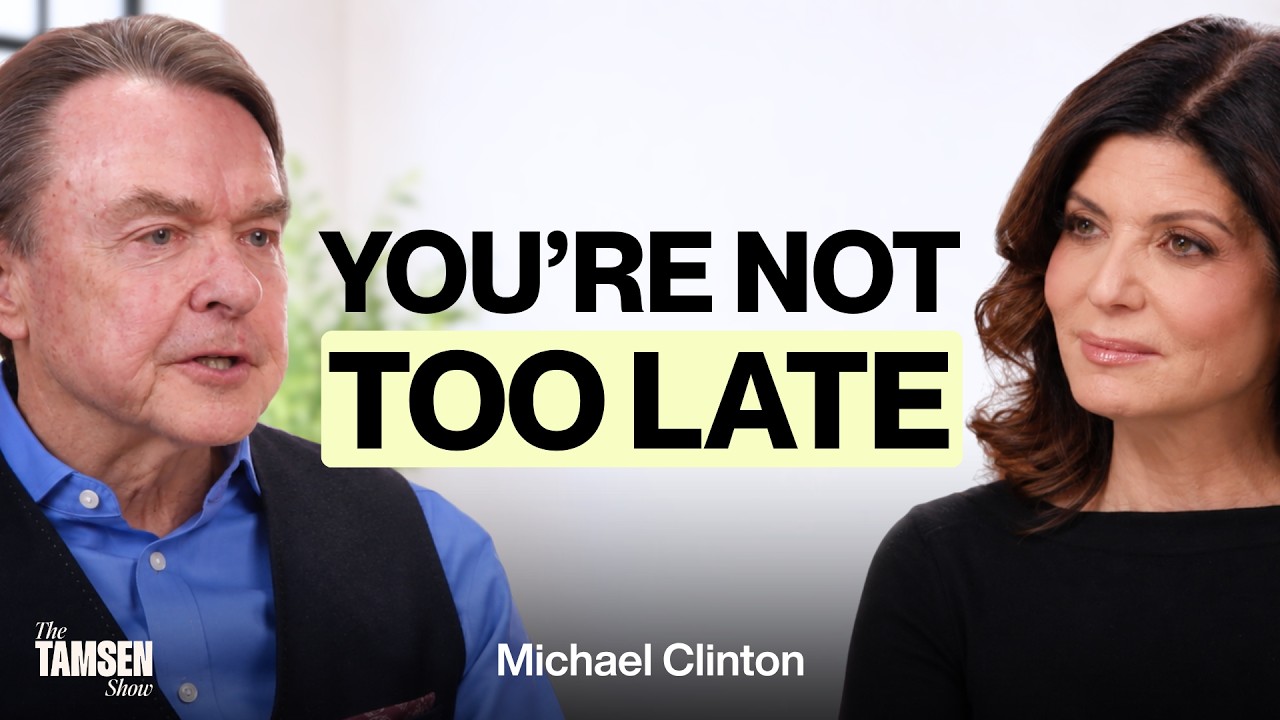
He built one of the first boutique hotel empires, helped scale Airbnb into a global brand, wrote multiple best-selling books, and stood on some of the biggest stages in the world. I think the question is like, why is this dude on your show? Let's just be honest. Chip Conley flatlined. He had nine near-death experiences in 90 minutes.
Then he survived cancer and came back with a completely different definition of success and a mission to change how we think about midlife. The key is to be age fluid. How old would you be if you didn't know how old you were? In this episode, he's going to share six raw powerful steps to help you reinvent your life from the inside out. You have a lot more life ahead of you. 10 years from now, what what will I regret if I don't learn it or do it now?
It's a powerful question. So, before we start, I just want to say thank you. Millions of you have now listened to The Tamsen Show. I still can't believe it. I am so grateful you're here.
If these conversations have helped you in any way, please hit subscribe and leave a review if you can. I read every single one and they help keep us on those charts so we can keep on bringing you real powerful moments. I am so excited for you to hear this conversation with Chip Conley. We're breaking down his blueprint into six steps that you can actually apply to your life starting right now. Honestly, step six might be my favorite.
So, make sure you stick around until the end. So, let's get into it. Chip, it's so good to see you. Tamsen, thank you. Every once in a while, you meet somebody and like their story sticks with you.
And I told you when you came in here and sat down, your story has stuck with me for a very, very long time. Thank you. So, I'm excited for us to get to to sit down while you're while you're here in New York. You know, I've had the honor of hearing your story before. It was it was about a year and a half ago.
But for anybody who has not heard it, can you share that with us because I think your story frames so much of what we're going to talk about today. Yeah. Yeah. So, I think the question is like, why is this dude on your show? Let's just be honest.
So, yeah, I was at a a a women's sex symposium workshop conference here in New York, and I told my story, and my story is this. I seven years ago found out that I had stage one prostate cancer. It moved to stage two and stage three. And so, two and a half years ago, it went to stage three. At that time, my treatment program went pretty aggressive.
And so, I had two surgeries. Ultimately, I have my prostate out. 36 radiation sessions, 19 months of hormone depletion therapy. Now, the reason they do hormone depletion therapy is because it actually reduces your testosterone to zero or close to it, and testosterone feeds prostate cancer. So, my prostate cancer, I metastasized to my lymphs. Long story short is when you do that to a man you end up having menopause, you have all of the symptoms of menopause except for some of the emotional ones because I I'm not stopping menstruation.
Sure. And you know and I'm not dealing with am I menrating menrating or not? So I had hot flashes, night sweats, brain fog, emotional roller coaster, bloating. I gained 20 pounds. What I ended up doing is starting to write on on my daily blog about my manopause experience.
And what was so interesting was both men and women were really intrigued by it. The men partly because oh wow now I understand what women Yeah. I understand what women go through. I you know I listen to my spouse and I don't listen well I really don't listen to my spouse and she complains about it but like now I know a guy who's gone through it and and then women really just appreciated the fact that I was being empathetic to what what they go through. I mean I I remember that story and I and I you you actually got rid of your you actually came there prepared to talk about something else, right?
You had like a script. I threw my script into the audience because when I got there and I was hearing all these women like tell their story and it was very unfiltered and I was like, "Okay, I'm not going to do my my my talk the way I was going to do it. I'm going to just tell people what it's like, you know, to have no libido, to feel like a unic to I mean, it was a really hard thing for a man and and you know, it tests your sense of masculinity and being being veririle and and so men do go through something called andropause. Of course, most men Well, of course, but most men 80% of men don't know what the word andropause means. So what andropause is is it's a much more tempered version of menopause but doesn't have some of the other consequences like you know men can still have babies or can make babies the rest of their life but they start losing their testosterone.
We start losing our testosterone around late 30s and about 1% a year. And so there's that. There's the viscous fat that happens in your gut. So men have this belly that starts to form. They have less energy and less sexual appetite and all these things are happening but men don't talk about it.
So you know you have made a big difference for women by helping women talk about this and men just don't talk about andropause and I think need need to know because I think women ask the question a lot don't men go through anything like this yeah well there's that and men you know men's you know the suicide rate for men I lost five male friends to suicide ages 42 to 52 between 2008 and 2010 and so men because they don't do a very good job of communicating what's going on and their vulnerabilities and Mhm. Men, women are so much better at making friends and keeping them. Men sometimes are around 50 years old and feeling pretty lost and bewildered. And sometimes at the end of the rope. I want to talk about that because I I do think that that that whole concept of friendship and community and what what you have created in this in this season of life is just really extraordinary really for for men and women.
I know before this, you know, you you had been tested even before what happened a few years ago. Can you go back and talk a little bit about that because you bring it up, you brought it up in your podcast and and I think it's important to share. Yeah. You know, so in I was a boutique hoteler in in San Francisco became the second largest boutique hotel in the US. 52 hotels around California. Loved it till I hated it.
I mean it was like there was no dimmer switch on this one. I was like I hear you. You know what I mean? I do know right. Like you know and it's hard and especially for you like the agism that goes on and the sexism that goes on in in you know media is crazy.
Well for me there was no agism or sexism but there was this awakening of like I'm starting to lose friends to suicide at a time when I was struggling with my own mental and emotional health and I ended up having an NDE a near-death experience. I died and went to the other side nine times over 90 minutes. And it was that that woke me up and saying, you know what, I can change this. I do not have to continue to have this identity of for 24 years of the founder and CEO of this big hotel company. I don't want to do it anymore.
I had a long-term relationship ending. I had a foster son who was an adult who was going to prison wrongfully. I didn't, you know, I had all this stuff happening and I all at the same time. All at the same time. It's like a life quake is what Bruce Filer, the author, calls it.
And a long story short is I I ended up making a bunch of changes in my life. At the time I didn't realize I was going through what some people would call a midlife crisis. What I now call a midlife cryis. Yes. The idea between caterpillar and butterfly is this this midlife stage.
And so that so it helped awaken awaken me to the fact that I could have a different life in my 50s and beyond. Did it really did that is that what reframed your idea of aging and reinvention and purpose do you think? You know experience I can imagine does that but maybe not to everybody oh my god when you die and go to the other side and sort of see what that's like you and what do you see yeah I do yeah can you share yeah and I know I know this partly because it happened nine times over 90 minutes and each time I'd come back from the other side I would say to the nurse or the paramedic or whoever's holding my hand this is what I saw and they'd say oh that's what you said like three minutes ago when you went flatline and so what I saw in the brief version. I was in a tall ceiling second floor like a living room in the Swiss Alps or somewhere. Lots of trees, beautiful skylight kaleidoscope of colors on the wall, beautifully frangapani tropically scented oil going across the floor that I could actually taste.
I could but I was flying. I was flying with arms but also like a bird. And I was surrounded by all of this these tweeting birds like 30 or 40 of them all speaking to me. I could understand bird talk. They literally were saying to me, "Chip, slow down.
Slow down. Beauty and awe can only be seen when you slow down." And so I was like experiencing sort of this ecstatic experience. And then the the birds all of a sudden the the 30- foot tall windows going outside opened and the birds all flew outside and they said, "It's time to go." And so I tried to actually fly outside, but each time I'd try to fly outside, I' I'd come back to life and you'd wake up again. And I wake up again in this big beautiful light filled room. And so that's that was my experience.
But yes, dying is an amazing organizing principle for living. So I'm not suggesting everybody go out and get an ND. That is not the message. You know, I made the best use of it. And I spent then my early 50s just figuring out how to be curious again because I'd been on a I'd been on a treadmill.
You know what that's like. I mean, I do know I I've been on a treadmill and I hadn't had any time to be curious and and give myself time to figure out what I wanted to do. You have written a number of books. Learning to love midlife is is one of my favorite. You've really gone through a blueprint that we haven't had and we we haven't and you know you mentioned Bruce but there's been a number of books out that have talked about the fact that there's not really been a study of midlife there was the the MIDA study but there there was the yes that that's the only one I know of but but that was a study that really kind of talked about people in midlife right we talked about the happiness curve it talked about this time in life where you do find some happiness but not everybody feels that right away and I think that that's there's quite a transition So, you really have done a a blueprint and there's a wealth of a wealth of knowledge.
I want to talk about the the steps that you see and then you can help people take because I get a lot of questions about how I went from and you you know my story was I was in news for you know 30 years and then making a a transition and knowing I was done but not knowing where I was going next and continuing to push up against this phrase of now what and that was all I kept hearing in my head like now what? What's next? Now what? What's next? So, let's talk about those steps, those steps that you have.
Yeah. If you were to still So, the the subtitle of learning to live midlife is 12 reasons why life gets better with age. But if you were to distill it down to six, okay, six steps, they would be the following. Redefine what aging means. Number two is embrace the in between.
Number three is stop chasing achievements. Start paying attention to what feels good. Number four is edit your life. Number five is build emotional strength, not just mental toughness. And finally, number six is find purpose by helping someone else.
Redefining what aging means to you. I I find that one to be so big, but you really drill it down so people can feel it. You know, aging and growing are the same thing, but when someone is 15 years old, you say, "Oh, look at Janie. Look at how much you've grown." You wouldn't say that to a 55year-old because you better not. Yeah.
No. Like because we get obsessed with the physical side of growth, but there's an emotional and a cultural and a relational and a spiritual side of growth. We're growing our whole life and we're aging our whole life. And so, Becca Levy at Yale has shown the following, and it's just an amazing study. She's shown that when you shift your mindset on aging from a negative to a positive, which is hard to do in an ages culture like the US, 100%.
But if you can do that in your mid in midlife, let's say at around 50-ish, you gain seven and a half years of additional longevity, which is more than any of the biohacking bros can do with any of the things they're doing right now. So, so this idea of shifting the mindset is really essential. And so learning that, okay, we can be age fluid. We don't have to be defined by our our chronological age. We can have a biological age and a emotional age and a cognitive age.
Because people are always saying, "I don't I don't feel like I'm 54. I feel like I'm still 27." That's right. I mean, you could feel as wise as a 75year-old and as and as you know, energetic as a 25-year-old. So, yeah. So, the key is to be age fluid, which means that there's this guy named Satchel Page.
He was a fa famous p picture and he said, "How old would you be if you didn't know how old you were?" Because he actually he he was born he was born in a time where he didn't have a gift he didn't have a gift certificate. He didn't have a birth certificate. And because he didn't have a birth certificate, he didn't know how old he was, but he was actually 47 years old pitching in in the major leagues. And so this idea of age just being a number, but not necessarily a number that has to define you is really critical. And understanding again the U curve of happiness research, which shows that 45 to 50, 52 is the low point in life satisfaction, although recent research now shows that frankly young adults are more unhappy than that.
But it gets better after that. So why do you think it gets better? Gets better because quite frankly as Bnee Brown who's a big fan of Modern Elder Academy Ma the program we started she calls it the midlife unraveling. She says it's around 45 or 50 that you start unraveling the definition of success you have. You start unraveling the expectations and obligations you have and you get a little bit more you become the screenwriter of your own your own life.
You have no more Fs left to give. Yes. I hear that so much nowadays, which I really like. Isn't that funny? I mean, it's one of the 12 reasons.
It's true though. It's especially for women because for a lot of women there has been a sense that you're a people pleaser. You're there's a way you're supposed to be and you're supposed to fit into some. And it's like at some point you say like, you know, I don't really want to do that anymore. And it doesn't mean you don't care about anything anymore.
It just means you're more judicious and discerning about what you do care about. So, and I think that's an important distinction. I think it's important that we're not saying you just give up. No, it's just that you're deciding what you're going to focus on and it doesn't have to be everything to everyone. No, exactly.
And so, so this idea of how do we help build a life that's great? You are, I think, 54 years old. 54. So, you're the average age of the person who comes to the Modern Elder Academy and 65% of the people who come to MEA are women. If you live till 90, Tamsen, and I think the chances are really good you will, you're you're halfway through your adult life. So you have as many years of adulthood 18 to 54, 36 years behind you as you have ahead of you.
If you live beyond 50, you're not even halfway through your adult life. And most of us think back to age 18 and say like that was a different person. But can you imagine that you have that much time ahead of you? And that's a really important part of of the aging process is to have longevity literacy to understand like you have a lot more life ahead of you. So you might ask a question 10 years from now, what will I regret if I don't learn it or do it now?
It's a powerful question because the longer you have to live, the more you realize, okay, I might learn Spanish now or I might learn to surf. And when I first live moved to Mexico, I had a mindset which was like, I'm too old to learn a foreign language. I'm too old to learn to surf at age 56 at that time because I'm 64 now. Long story short is when I put it in the framework of 10 years from now, will I regret that I didn't learn Spanish or learn to surf? Yeah.
Because anticipated regret's a form of wisdom. And I and I do hear that a lot though. I I hear that phrase a lot like I'm I'm too old to do that now. Like why would I do why would I start that now? Yeah.
But why wouldn't you start that now? If you realize that you have as much life ahead of you. I mean if you're 45 and you're going to live till 100, you have twothirds of your adult life still ahead of you. And scientists today say that in the developed world like the US over half of the kids who are being born today are going to live to 100. So we really need to rethink this map of life that we have.
Well and and that's what I I think too and I think it's really important to shift the story. But we still have a lot of people who are afraid of getting older. Yeah, we are. And h how do we how do we shift that? How do we start that shift now?
Because I think we we can really do you do it. How do we what? Yes, I'm very open about it. Okay. Okay.
Okay. I don't But I stopped the filler. I did stop the filler. Why'd you stop the filler? You know, I don't know.
I didn't I Well, first of all, it was too much work. It's too expensive. But I also think that like I said to myself this if I'm doing that at this age Yeah. What am I going to be doing in 10 years and 20 years and 30 years? So, I really like tried to pull back on some of that maintenance of Yeah.
I think here's the way I would look at it. We were issued a body Yeah. A rental vehicle at birth. Yes. We rent this vehicle and in the first half of our life, we want to make sure that rental vehicle looks damn good.
Shine it, you know, wash it every, you know, once a week and it's got to look good. But in the second half of our life, it's not about short-term vanity. It's about long-term maintenance. So moving to a place where we're more focused on what does it feel like inside the car, like inside of ourselves than outside, is an important piece. So yes, aging and aging is more cruel to women than men because we have silver foxes.
We don't have silver vixens. No. And there there's an element that you know the culture the culture punishes women for their natural process of aging. In fact, the whole anti-aging industry is really an anti-women industry. Let's just be honest.
I couldn't agree more. It is about making women feel badly about their natural process of aging. And so I, you know, from my perspective and and especially because we have over 7,000 graduates of MEA and two-thirds of them are women, I've really learned a lot about how do you think about midlife and beyond as a woman as well as a man and and it's quite different gender- wise. Yeah, I think it is too. I I want to talk about that, but I want to go back to one thing you just said.
You just said that anticipated regard is a form of wisdom. Can you explain that? Yeah. No, so wisdom I love wisdom. So MA is a the first the world's first midlife wisdom school.
So wisdom is a a thing. So understanding that you might regret something 10 years from now or 5 years from now if you don't do it is not something that a 20-year-old thinks about. Because at 20 you have a whole runway ahead of you. It's like if I don't do it now, I'll do it later. But as you get older, time becomes scarce.
Your body becomes a little bit harder. Your brain can't do things like it used to do. And your brain gets better in some ways as you get older. Wisdom was called crystallized intelligence. Arthur Brooks is you Frank's from Strength to Strength.
He's on our faculty at MEA. Oh, one of my one of my favorites. Yeah, he's he's amazing. He really is. Some things get better, but some things get worse.
And so as we get older, we got to start being really thoughtful about the things that we might regret if we didn't do it now. And and so that's why and wisdom, the reason why it's wisdom is because anticipating something is a form of wisdom. Okay? Because often when you're young, you don't have that. Yeah.
But but you know what what wisdom is really your metabolized life experience. You know your your painful life lessons are the raw material for your future wisdom. How do you recommend somebody live like they have decades left then? Because I think that that is is hard and I I guess you know I was when I was younger I would be like oh someday. It's what you're talking about.
Someday someday I do that and I'm like oh this is this is someday right now. And it's it's hard to put that into play. Sometimes it's a shift in in your mindset. And I would just say the number one thing is do the math. Do the math on how long you think you're going to live, what percentage is still ahead of you.
When you realize how much is still ahead of you, yeah, if if it's like 90% still ahead of you, then you might you might not care. I don't have to do that. But when you start to realize that you have like 50% or 40% or 60%. You get a little bit more judicious about like, okay, it it is time because it's not going to be easier to learn Spanish at 66 than 56. No.
Or to learn to surf at 66 and 56. You know how to surf? I do. I learned at 56 because down our our campus at ME in Baja is next to a surf break. So that was my I think that's amazing.
That's amazing. All right. I'm going to take you up on it. I'm going to be I'm going to be there with you. I don't know if I'm going to learn how to surf yet, but I'll I'll get out there.
I think we're going to have you think it's time to have you teach at MEA. I would like that. Okay. Step two, embrace the in between. And this might be one of my favorite of of the the list because that in between is so scary and you never fe you don't know whether to go back right or what's ahead of you.
So explain what embrace the in between is because I definitely live that between being a news anchor and where I am today. So there's a word called liinal. And the word liinal means to be in between something. And I love the word and I didn't know it until I started studying midlife. Adolescence is all about being in between, right?
I mean, you're at puberty and you're in between childhood and adulthood and and you're going through a lot. And most of the the transitions you're going through in adolescence are physical and they're visible to others. And you're doing it in a peer group. The difference between one person and another at 13 or 15 in terms of puberty might be two years, right? The difference between two women going through perry menopause could be 15 years.
Yeah. So when you're going through adolescence, it's it's it's visual. People can see it. It's you're doing it with a peer group and you have a whole social infrastructure to support it. Schools and guidance counselors and parents etc.
When you're going through middlelescence, which is the adult correlary of of of adolescence, you're going through all kinds of transitions, but a lot of them are internal and you're not doing it with a peer group that you're doing with all at the same time. And there's no social infrastructure to support it. So, long story short is the transitions we go through in midlife, the in between stages, are often normal and natural, but we don't talk about them. Like menopause, like empty nest, like men's androper, like you know getting fired or starting a new career or you know getting divorced or there's so much that's happening. What we need to embrace is the following.
There are three steps to any transition in that in between stage. There's the ending of something, the messy middle and the beginning. And so for you when you were leaving you know TV news you had like you know if we had spent some time together then I would have said like okay how are you going to ritualize the ending of this like what's the thing you do to help you say I am moving beyond that like you know in in the divorce world it be have a divorce party empty nest an empty nest party clear and literally having a menopause group that you sort of like get together and you sort of say like okay I'm beyond that now I go to the messy middle in the messy middle we need social support and we need to understand our through line. Where are we going with this? I mean, if you're getting divorced and it wasn't your idea to get divorced, that can be really painful.
And now you're single and maybe you're empty nest and so you have no one. You're living at home for the first time in 30 years. That's hard. And yet the thing you need to be able to say is like, "Wow, on the other side of this when I put my my my personal profile up there on match.com, right? I am going to have a better pair of glasses to imagine a partner because I have some wisdom.
I am, you know, my painful life lessons have been the raw material for my future wisdom." And that helps you get through the the crystallis mess stringing it through. So you have the direction so you can sort of feel like you don't get stuck because a lot of people in the in between space feel like they're like the circus performer going on the trapeze and they're like oh no I'm in between I don't have either of the trapeze bars and so you get unstuck by by actually having something definitive. You can see you can see where this is going and and the upside of it. And then the third piece is the beginning of something new and that in that ca in that case it's having a growth mindset. You are you and I both are becoming beginners at podcasting.
Yeah. And so what does that mean? And like how do we do that? And how do we have a sense of humor? Because one of the problems that shuts us down when we're becoming a beginner is feeling like we got to do it perfectly or I care serious.
It's very serious. Very serious. And I care what other people think. And like you know that's where the you know no more fs left to give is helpful. And so being able to just say like, "Okay, I'm going to go out and date and I'm going to like it's going to be weird and I'm going to have fun and I'm going to have have a sense of humor and I'm not going to do it very well at times and that's okay." Do you think that your near-death experience got you here?
Were you always like this when you looked at this being stuck? Because I went through a like time of everything was very serious and it had to be perfect and get it right and and and today I'm not quite like that and it's probably more age. Do you think it was near-death experience or the near-death experience helped because it helped me to see everything's a bonus. Every day is a bonus, you know, and that that that's a that's a great attitude to have. Yeah.
And I think also there's an element of realizing that what if I didn't have to have any more success in my life? Are there tools that really help during this process, this in between process? Because I know we get lists and lists and lists of things to to get get well, but there are some real tools that you drill down into that can help you. A couple things. This idea of these three stages, you know, ending, messy, middle, beginning, you know, that understanding that well, there's a on the there's a free resource I mean my book talks about it, but there's a free resource on the MEA website mawisdom.com called the anatomy of a transition.
It's at the bottom footer and I would just recommend people download that because it's free and it helps you to understand when you're going through a transition what are the different stages of each of these three three parts to a transition. Yeah. Tools like journaling, rituals, routines, or any of those important during this time so you can stay focused. Journaling is great. I I you know re recognize that there's a reason we go to coaches and therapists and best friends because they can see us objectively.
Yeah. And when we're in the midst of a transition, often sometimes we're obsessed with it and we don't realize that we're a good person. And so having whether it's a coach or a therapist, a best friend, a spouse, an MEA workshop, you know, these things can help you to see yourself in terms of how other people see you. Okay? And that's helpful as well.
I think nowadays a lot of people are very terrified of AI taking jobs because they've learned a certain skill and now they've got to relearn something. But I think that there's some there's this growth that we're talking about that can really take you to some some other level if if you're interested in AI is not going away and and let's recognize that human wisdom is the balance for artificial intelligence. So double down on what it means to be human because at this point and maybe never will we ever see AI be able to replace some human qualities, right? Ingenuity, creativity, innovation, empathy, literally in being in service to someone else physically. Touching exactly caregiving, you know, these are things that we should double down on.
And yes, AI is going to take a whack at the employment market both at the at at senior levels as well as as junior levels. So the key is to double down on what it means to be human and the qualities of being human. To the 45year-old listening right now who has built their career for years and all of a sudden is in the now what stage and wants to get out. What do you say to them? What I would say is first of all there are you may have something that you always wanted to do that this is the opportunity to do it's time to time to do it and that's the unraveling that Bnee Brown talks about the idea that okay I have raveled up a career path that was based upon my parents we have a we had a MEA alum a woman who's a litigator and so she's been a lawyer for 35 years her father was a lawyer she didn't really want to be a lawyer but she's been doing it for 35 years.
And at age 60, she doesn't want to do it anymore. But she wants to work another 10 years. So she thought she should become a litigation consultant. But when she came to a cultivating purpose workshop, what she learned was the following. She said, "When I was a kid, a teenager, I loved cooking pies with my grandmother.
It was the it was the thing. I can still taste them. I smell them. When I go overseas, I I look for the first bakery near wherever my hotel is because I want to sort of see in a different culture what kind of baked goods they have." So, she's decided, okay, I'm going to go to, you know, a bakery school, a baking school, and for 13 weeks, I'm going to do baking on Saturdays, and I'm going to see if I like it. If I like it, I'm going to become a bakery entrepreneur.
And that's what she's done. She's left. So, she could be 45 and have done that. But, she's sort of said like, "Okay, I want to go back to something that feels neglected in my life." Now, if you're, you know, in her case, she was able to move into that and know that initially as a bakery entrepreneur, she's not going to make anything like what she was making as an attorney. So, some some people can do that, some people can't.
But if you can like taking a step away from the success script you inherited in her case from her father is really valuable. Yeah, it's so important because I think we've all inherited some kind of script whether it's, you know, being a woman and thinking we have to do XYZ or or if it's from parents or peers. Okay, step three, stop chasing achievements. Pay attention to what feels good. Well, there we go.
I think I think we're here. I think we're here. I think we just did a little bridge there. But all I would add to that is you know, at what point in your life are you going to really invest in joy? It's a really important question.
And you know, as somebody who spent 24 years running a company about joy, Jadviv, my boutique hotel company, it's deeply wedded to how I see the world. And joy is different than happiness. So there's explain explain those two because I think that's important. Yeah. J JD Salinger, who wrote Catcher in the Rye, said, "Happiness is a is a solid and joy is a liquid." And what he meant by that is happiness is often circumstantial.
It's something you strive for. It's something you're on the on the treadmill to try to attain and then once you attain it, you look at it's like, oh, okay, what's the new shiny object to attain? Whereas joy actually comes from within you. And so, you know, one of the best things a person can do in terms of getting off the achievement treadmill is to just say like what would give me joy? How what would that be?
And how am I going to invest in that? For for women who are doing the classic, you know, sandwich generation, taking care of parents, taking care of kids, having a career at the same time, women are so much better than men at multitasking. I think, you know, one of my rules of thumb for women is often the following. Based upon how many kids you have, if you have kids, because if you have kids, boy, are you are you care caregiving them, you deserve a minimum of one hour of of joy per week per kid. So, if you've got two kids, yeah, you schedule and again, it should be more than that, but I but it's a good starting point schedule.
I think that would be hard for most women to try to figure out how to carve it out. How do I get my two hours? I've got two kids. And and so, it's your job. Your job is to invest in joy.
Your job is I mean, so what does joy look like? What can it look like? Examples like I don't even know what what joy is. Let's say that there's a woman who's 45 years old. She's got two kids at home.
She's got a job and and she also is is the primary caregiver for her parents who are in their, you know, mid70s. One massage a week, okay, for that person. So that's one that's one of the two hours. The second hour could be a literally a bubble bath with reading a book. It could be going walking in nature by herself.
With no one else. It could be listening to your podcast while not doing something else. You know, most of us listen to podcasts while we're doing other things, but it could be like making notes for the from the Tamsen podcast. It could be literally going out to to lunch once a week with your best friend. It could just be simple, but it's that quiet time.
Yeah. It it could be you taking up painting or drawing and and and doing that. So, so just know in my opinion, the more kids you have, the more hours you get. I love that, Chip. I think a lot of women are very I know it is.
Well, it's I mean, but quite frankly, it's not only hard to find the hours. When you're in that hustle mentality, it's hard to actually define joy. Again, it comes back to mindset. Mindset. How do you shift your mindset to say like, I I deserve this?
Yep. People talk about self-care all the time. It's great, but I also I don't love the term I've never loved the term self-care for some reason. For women who are worried about being selfish, it just sounds too much like selfish. Yeah.
And and so it's like investing in joy. That's a different way to look at it. Because it feels like actionable like another thing to put on your list, right? Well, and investing you sort of like, okay, you're building something. And so the idea of building joy in my life, I was like, okay, yeah, sign me up for that.
Well, I mean, I I couldn't agree more with it. I think that the shift can be hard. I think that we look at things and we're like, okay, what feels good is one thing, but I have to have achievements. Like, I have to succeed. I have to cross things off the list.
Make sure that I Where did that come from, Tamsen? I have the same thing. But like, was it your your parents? You know, I don't know. I I don't think it was par I think it was, well, maybe it was.
I don't know. I think it was just like I looked around and I saw what I deem success. I didn't grow up with money. I didn't, you know, so I was like, "Oh, to get to a next thing, I have to do that." So whatever that was and I it's called a success script. For many of us the success script came from our teen years maybe from college or or early early in adulthood.
For you like gosh the success script is very public. It is. Yeah. It's always been. Yeah.
Because okay. Oh, she's got she's growing and she's she's now the anchor and and what are you doing next? What are you doing next? Yeah. The now what?
I mean, that's why there's that now what in your head because like the world wants to know and and so for you it was harder because the fact that the world was you're witnessing all of this meant that there was a sense like you were doing this for your audience. And then and then the question becomes like okay well if I am the screenwriter of my own play here I spend time figuring out what it is that matters to me and I mean this is why we I mean literally part of the reason I created MA was because so many people could use some help with that. Well let's talk about that. So Modern Elder Academy when did you create it? Created it seven and a half years ago and and you know don't mind the the name of it.
It's like people like why do you call it Modern Elder? Well, that that became well, good. Some people have a hard time with the word elder, but when I joined Airbnb when I was 52, and I became the mentor to the three founders and helped them, you know, for seven and a half years run that company. And they were amazing. I loved them.
I learned as much from them as they did from me. But they started calling me the modern elder. I was like, "Well, you're making fun of my age, aren't you?" They said, "No, a modern elder is someone who's as curious as they are wise. They're not just dispensing wisdom. They are they are going out and seeking wisdom.
They're out go I was as much a an intern learning as I was a mentor teaching. And so that's how the name came about. And so yes, we have two campuses, one in Baja on the beach and and then a four square mile regenerative horse ranch in Santa Fe, New Mexico. And we do workshops year round. Okay.
People get stuck in midlife and in this hustle mentality and do not even realize it. How do you how do you help people get out of that? It's almost like a shadow self for some people. There's a little bit of a sense like they don't even see it. The blind spot.
Yeah. Working too hard. Yeah. You know, and and no one wants to be called a workaholic, but you know, a lot of us are that. And so, first of all, just recognizing it's like anything.
And and it's a bit of an addiction. And so, with any addiction programs, 12step program, it's like, oh, first you have to acknowledge you've got an issue. And that's the first step. And then the second step is to actually ask the question, how could I curate my life differently? And and know that there are options.
Most people don't have the options that they they really do have. And that's part of the reason at MEA the now what becomes like well maybe I can become a bakery entrepreneur or maybe I could go and become a marathon runner and maybe I could actually become a mentor to women who are 25 years younger than me who would love to have know in your case like what it's like to be in media. So there's a lot of different paths and the the key then is like, okay, well, you know, do how do I do that and make money doing it? And that's that's a that's a very personal question because some people need to make money and some people don't and or something's in between. So yeah, I mean I think it's really opening up to new possibilities.
So your step number four is edit your life. And this might be my favorite one. Maybe because of the media background, but also I have found this and my family makes fun of me, friends make fun of me. Every time I go through a big life shift or I'm stressed out about something or I'm trying to figure something out, I clean, I clean my closet, I edit my stuff, I get rid of things. I don't know if there's any correlation to it, but I definitely feel like I understand.
Is that what it is? Yeah, a little bit. Probably I just feel like I have to strip everything back so I can see what's going on and then move forward. Feel productive. Yeah, there there's a is that the editing your life?
No. So the editing your life is Yes, that can be definitely it. Edit editing can come up in any form. So we spend the first half half of our life accumulating. Yes.
We accumulate knowledge, friends, we accumulate people we date and ultimately a spouse and maybe two spouses and then children, a handful stuff. We accumulate stuff, obligations, responsibilities, career path, you know, jobs. By the time we get to around 50, we have accumulated way too much and it's time to do what we call the great midlife edit. The great midlife edit is when you start to ask yourself, is this serving me anymore? Yes.
It's sort of like Condo, Marie Condo. Marie Condo with her stuff. There's an element. Does this bring joy? Yeah.
And but what if you did is does this bring joy to everything in your life? Yes. Not just the stuff in your closet. You know, if you're on three boards, should you be on three boards? What about one board?
If you have a lot of friends, but some of them are like just friends you've had and they just sort of like hang around and right, it it's not very nourishing, like is it time to actually do a little pruning there? Is it time to actually look as your kids start to get to a place where they're no longer living with you to live somewhere else? You might be living in a ranch home with four bedrooms and there's just two of you, you and your husband, right? And it's time to look at where you might want to live and how to how to live differently. So, this idea of editing is really important because what editing allows for, first of all, it takes some of the pressure off.
You know, when you have accumulated so much, you're just carrying a lot. But most importantly, when you get to the place where you actually start to edit, you create new space in your life for for to be a beginner again or try something new. And that's really important. The letting go list, you went through some of those. It can be scary if someone knows something needs to go, but they're afraid to let it go.
How do you convince yourself of that? Because I think I think it's important. A lot of people feel if they have stuff, even even if it's people, relationships, careers, boards, then they're insulated and they're safe and they they they want to feel safe like I've I've succeeded. The first thing I would ask someone in that situation is, how's it working for you now? You know, the thing we often say to each other is how busy we are.
Yes. How much we have going on. And the truth is that that's the starting point. And the reality is 98% of us will say around age 50, I just got too much going on. I have too much.
I have too much stuff, too much thing like. And so if that's true, you you have to edit. But you don't have to edit the things that you love. You just have to edit the things that you don't love. But it may take a while.
Like for example, you're taking care of your ailing mother. Your father's passed away. Your mother needs you. You know, it's not like, okay, it's it's yes or no on that one, but could you actually diminish it a little bit such that instead of giving 40 hours a week or 20 hours a week to your mom, could you hire somebody to help with part of it? Could your siblings who are sitting on their butts not doing anything, could they do a little bit of it?
And could you and does your mom need as much as you're giving her? Right. Right. So, so those are the kinds of questions that you need to ask. Did you edit?
Oh my god, I added some friends. I I you know, some friends who I love them and it's not like I wouldn't see them anymore. But I didn't actually find like we were having deep and meaningful conversations. When you when you're doing that with friends, if you want to have deep and meaningful conversations, start by trying to have those with your friend. And if they're not going to go there and that's what you want, then yeah, then you need to start doing some editing.
Do you do it little by little with that? Yeah, for sure. I did that. And then I also edited some of my aspirations. You know, I I thought at one point I was going to be mayor of San Francisco and I I was asked at one point by Gavin Newsome who was the mayor of San Francisco at the time and was becoming lieutenant governor like there was some possibility that you know I was going to be mayor and it's like nope.
You know I was at an age at that point where I was like uhuh I don't want to be mayor of San Francisco. Yeah. But it would not have been a vote. Yeah. And from from age 12, I always wanted to be in government and in politics at some point.
And so, yeah, that was something I had to edit. But I think that's a big move and like a big growth move because sometimes it's very scared scary to let those aspirations go because you think like am I giving up? Am I not, you know, doing what I'm supposed to do? But wow, the relief that probably came with that. Here's the thing, Tamsen.
When especially if you're if you listening in on this or watching this are sort of like the two of us. I promise you once that aspiration goes away, a new one's going to pop up. Chip, you're so right. You're so right. You're just creating space for a new one that may be more relevant to you today.
Yes, absolutely. Then something you think you need to hold on to. If you meet somebody that is stuck in that past and does not know how to move forward, is there one piece of advice? They can do today. The thing that we do and find a friend and do this with a friend.
Write on a piece of paper those mindsets or limiting beliefs or things in your life, people in your life even that you're ready to let go of and you and your friend read it out. Read out what it is and then throw it in the fire. Have a collective ritual such that both of you can sort of be accountability buddies for that. Yep. You got to witness.
Yeah, witness. Witness is helpful. All right. Step five, build emotional strength. Not just mental toughness.
Yeah. Explain. Yeah. I mean, grit is beautiful and I I'm a big fan of gritting it through. When someone once said to me, "Chip, you have tenacity and grace." And I was like, "Oh, I like that combination.
I think you do, too. A good combination." I think you too, too. You and I know the problem with with trying to power through is often we don't realize the toll it's taking on our body and and our psyche. And so yes, sometimes you have to do it. Sometimes you have to be willing to just power through, but then so resilience will buy you time, but adaptability will buy you a future.
And so resilience is a form of mental toughness. I can get through this. But if you spend your life in that mentality, it takes a toll. That litigator that litigator who said at age 60 I can't do this anymore I've had to be mentally tough and and her point of view was like I I still want to be like use this career but what she really needed to do is adapt and the adapt adaptation she made was something very different as a career this idea of of being emotionally aware is really critical because when you're in the resilience mode the grit mode often you're not taking you're not taking an inventory of your emotions or your body. What you notice at the end of the week or at the end of a year is just literally how much your shoulders are right next to your neck.
That's right. And how much you're stressed and everybody can see it in you, but you've gotten so used to it. And so for a lot of people, what they really need to do is just take the toll and and they don't really I'm sorry, take the toll, take the inventory. A lot of people don't want to do that because like what if I really find I'm just deeply unhappy. Yeah.
I don't want to go into that dark hole. I am out trying to outrun my emotions. And I know a lot I I I've done that. I think one of the things that people need to do and this gets back to the fourth one too is we do New Year's resolutions. But we don't do New Year's editing.
No. No. We just Why not at New Year's just say like, "Okay, I maybe I'll have some resolutions and these are things I'll do, but I got to let some things go too." and and that requires a certain amount of self-awareness. And so this one, number five, is really just about how do we help ourselves be a little more self-aware. And you know, I I'm a big fan of personality te tests as well.
There's this thing called the enagram and it's called spelled na g r a m. And when I learned about that like 40 years ago, it totally helped me to see how I fall into traps. I think you're the same as me. Okay. Which is a three on the nine scale.
And you know, I'm doing this like in a half an hour. You're doing it in a half hour and you're probably three, which means you're a success motivated performer. You you are very good at like holding together. The US is sort of a a three culture. Okay.
But then you have a wing potentially a two or four. The two the two is the helper. The four is the artist. And so for me once I understood my personality type it really helped me to see the traps that I fall into and and so yes. Why do you think you fall into them?
Do you think it's because we compare a lot with other people? Well foration for threes we do threes are social comparison is a huge part of it. So, but a one on the other hand is somebody who's a perfectionist. And so, it's not less less focused on the social comparison, more focused on their own definition of what is right. Okay.
And so, so once you understand these personality types, it helps a lot. All right. Step six, find purpose through service. Yeah, that's probably my favorite one. But I wouldn't have said that 10 years ago.
I wouldn't have. I was just working, working, working, working. But what I have seen happen in the past two years because I didn't go looking for it obviously it just found me and every time I heard someone say that I went okay yeah I get whatever but now I really understand that yeah one of my favorite quotes of all time is from a an Indian philosopher named Robin Dranath Tigor and he said I slept and thought that life was joy. I awoke and saw that life is service and I truly awoke and I saw that service is joy. And so the idea that you can find joy in service, now this is one for a man like like like a revelation for a woman, women have been in service Yeah.
In a lot more ways than men. So I sometimes am very careful about saying this in in you know amongst women because oh you need to be in service and I was like well hey dude I've been in service my whole life. But I think the the main point here is this. In the first half of your life, you, as David Brooks would say, you're climbing that first mountain, which is often the mountain of success. And in the second half of your life, you're you're now climbing the mountain.
And I don't like the mountain analogy because I think you're like you're just hanging out by the the river in the valley. But you're in the second era, you're moving toward purpose. And and you there's lots of different purposes. There are big P purposes. Often your career is a big P purpose and there's a lot of small P purposes.
You know what people you'll see in an obituary is the big P purpose. Okay, this person did all these things. What you'll see at someone's eulogy and here is the small P purpose. And so some of these small P purposes are really important. And we have a bit of per purpose performance anxiety.
Yeah. In the US we are so wrapped up in in saying, "Oh my god, everybody has a purpose but me." As if it's like a Birkin bag that I do love your analogy. They speak to me. We all have we all have purposes. They can be big P purposes and small P purposes.
The bigger question is not so much the noun of purpose but the verb of being purposeful. What is something in your life or what are the things in your life that give you a sense of purposefulness? It's usually something that excites you or agitates you or something that you're curious about or something that feels neglected. But for me in my life it is very much being in service. I people were in service of me.
I've been mentored I was mentored by people. I'm now mentoring people. I don't pay myself a dime for you know for doing MEA partly because this is my way of giving back. And I I love that mo couple movies. Schindler's List.
At the end of Schindler's list, there's, you know, everybody goes by Schindler's grave, and these are all the descendants who would not be living if Schindler hadn't done what he did in Germany. But the other one that I like even more is, it's a Wonderful Life with Jimmy Stewart and George Bailey. And he ends up, you know, Jimmy Stewart, George Bailey ends up at the bridge ready to jump in and and take his life. And Clarence the angel comes down and says, "Let me show you what Bedford Falls would look like if you never existed." Mhm. And he's able to see and I wish I wish we had a like a a technology.
This would be the most important technology we've ever created. A technology that allows any person in their life, especially in midlife or mid to later life to see what the world would have been like with like without them. Yeah. It kind of takes my breath away. That technology would allow us to see what we have offered the world.
Yeah. In service. And and some of it's usually tangible. It's like you have kids, you can see that. But of course, your kids don't necessarily show the gratitude.
Thank you for your purpose, Mom. Thank you for being of service. Do you find a lot of men are looking for purpose as they get older in midlife? Or are they looking to have companions, be busy? Men are lost.
Oh, okay. Okay. Well, that answered that. Men are lost for a couple reasons. Around 50, men realize that their their friendship muscle has atrophied.
Yeah. And they're in a place where they are feeling stuff vulnerable for the first time in their life, especially if they're a straight white male, they're feeling they're seeing a form of demographic. You know, if you're a woman, you've had some sexism. If you're LGBTQ, you've had some homophobia. If you're a person of color, maybe some some racism.
And but for a guy in his 50s who's been top of the world, like all of a sudden, agism is creeping in. And so men really need to learn that friendship is a practice. My co-founder and MA Jeff Hui says this. If you think of friendship as an intentional act, something you do for the sake of getting better at it, then you're going to do it better. And so for men, we women have been doing that for 20s, 30s, and 40s, but men need to do that.
Secondly, the other piece that you asked about with purpose is that retirement is really hard for men, more hard than for women. Why? Because women tend to have a lot of roles, a lot of identities. So when they let go of one identity, they have other identities. Men have had for many men have had two identities.
Bread winner. So I'm taking care of the family and making sure and then this career thing that my business card defines my life. And so long story short is, you know, men need MEA more than women. Women come to MEA more. Couples love coming to MEA because frankly they're going to learn from each other because the gender issues around, you know, in in your 40s, 50s, 60s and beyond are sometimes really different.
Do you feel like there's so much more hope for people in midlife now than you've ever seen before and that we're still learning? I think so. I I think it's like with menopause, you know, to take it back to Yeah. You know, I mean, midlife had a bad midlife midlife has one word attached to it and it's a bad brand. It's crisis.
And when you start to realize that midlife is a cryalis, yes, in the middle of midlife, you may actually have a low point. The U curve of happiness research shows that, but you when you realize that it gets better after around 50 and that Becca Levy's work shows that you actually live longer when you shift your mindset, people start to actually see that that that their 50s and beyond may be the best time of their life. I love that. What what is next for you? Well, I have a new book that just came out so the learning to live love midlife came out last year, the midlife manifesto.
And I'm teaching a lot. I love that. And I have two sons. I have sons, biological sons, 13 and 10. And I my 10 my thing about 10 years from now, the the sons don't live with me.
They're they're I was the suburban donor to friends who are lesbians. And but because they had two boys, I'm in the boys' lives. So my tenure thing is 10 years from now, what will I regret if I don't learn it or do it now? It's how do I spend time in Houston with my sons just to show how much I love them. But partly because I won't get adolescence with them over again.
Wow. And how old are they? 13 and 10. Wow. That's amazing. That's really amazing.
What are you learning from them right now? Oh my god. Just discovery and curiosity, you know, just the idea of trying new things and being open to being bad at first, you know, it's really important. We all need that, especially in midlife. Chip, where do we find you?
Ah, you find me at MEA wisdom is the the Modern Elder Academy MEA website. Chipconley.com. And I do a daily blog, which you'll find, and and a weekly podcast. You'll find those in the free wisdom section of the MEA website. Thank you so much.
What a pleasure. I learned so much. Thank you. Thank you. I love that Chip broke this down into six clear practical steps because sometimes when you're in it, you really just need a road map and some clarity.
He sure gave us one. If you're in that in between place or questioning what's next or now what, please remember you are not lost. You're in a transition and there's a big difference. A big thank you to Chip Conley for laying out such a powerful blueprint. And if you haven't yet, go check out his book, Learning to Love Midlife.
So if this conversation helped you, please share it with a friend. You can subscribe, follow, and leave us a review. And you can always follow us at The Tamsen Show on social media. By the way, if you have a topic or a question you'd like us to talk about, my email is in the show notes. Thank you so much for being here, and I'll see you next Wednesday.
The Tamsen Show is an original production by Authentic Wave. Executive producers Scott Weinberger, Kevin Bennett, and Rebecca Greersonen. Brand director Johanna Offnik. Our line producer is Sabrina Sere. Editing by Zach Smith and Marquee Harris.
The views and opinions and information shared by guests on The Tamsen Show are their own and do not necessarily reflect the views of Tamsen Fadal or the production team. This podcast is forformational purposes only and is not a substitute for professional, medical, legal, or financial advice.