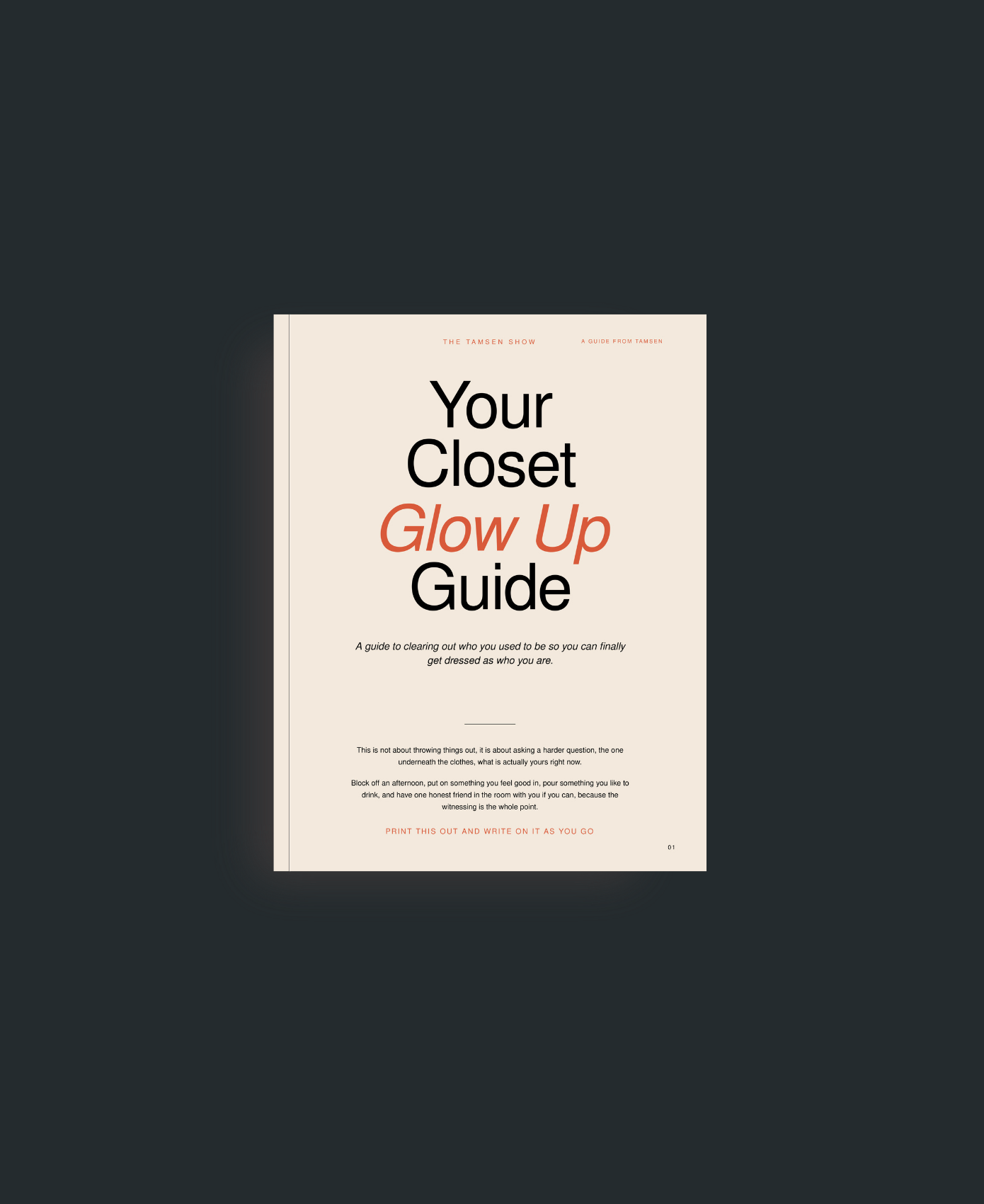
On the surface, that is what it was. But, it has spiraled into being one of the most transformative practices I've done in a really long time. I think the reason it resonated with so many of you is because deep down you already knew. You knew this was about more than just clothes in a big way. And I want to make you a promise right at the top of this episode.You can do this, too. You can walk into your own closet and take back a piece of your life you didn't even realize you had given up. Because the truth is, you cannot build your next chapter while old crap is still hanging in front of you every morning, looming over you, taking up space where the new woman is trying to live. And that woman is in there. And we're going to try to make room for her today.I hired a stylist who was referred to me through a friend of a friend. She is very private. And since so many of you asked, I'm trying to convince her to come on and do an episode with me. And maybe we'll do some stuff for social specifically for you. But, today, I want to talk about the why behind it.Answer your questions and walk you through how you you do this for yourself. So, I want to be clear before I start. You don't need to hire a stylist to do it. You can grab your best friend. You can FaceTime somebody in your family.You can watch some of these pieces of advice she gives me. But, honestly, the best piece of my advice is just to get somebody to help you and do it alongside you so you have another opinion. Because trying to do it alone is where most of us get stuck, and that's where I got stuck for a long time. I'm going to explain why in just a minute. The questions you are all asking me are almost identical.Why did I do it? How did I do it? And what did I learn from cleaning out my closet, which sounds like such a bizarre thing. So, this is what we're going to do today. I'm going to answer all three of those questions.And first, I want to get into why I did it. So, I have to be honest about the why because I don't think originally I was being honest with myself about it. The version I have been giving people when they ask is a short version. The short version is I needed to just kind of get organized. My closet was a mess.I wanted a system. But, I don't think now looking back that's really why. The real reason I did it is that I have been getting dressed on autopilot for I do not know how long. My uniform had been narrowed down to almost nothing. The colorful suit, the matching vest set, the leisure outfit I throw on almost every day because I felt okay, and I knew what I was doing.
It was like easy and safe, and I knew what fit. And then I had this same handful of pieces in rotation over and over skipping over everything else in the closet. And by the way, there's nothing wrong with any of it. I felt fine in all of it. I just didn't feel like me anymore.
I feel like I was going through these motions. I wasn't picking out what I wanted to wear. I wasn't having fun with it. I was picking out what was the easiest. And I used to joke like, I need Grananimals.
I just want the things to match together, and that's it. Just make it as simple as possible for me. And one morning, I caught myself doing it. And a small voice in the back of my head went, "When was the last time you actually liked anything you put on?" And I didn't have an answer for it. And it's so crazy to me when I think about that.
I had this big closet that I dreamed about my whole life stuffed with clothes and shoes, and there I was walking out the door in the same workout set every single day, and I knew I had to change something. And honestly, it had gotten worse without me noticing. I'd standing in the closet at 6:00 in the morning looking for something, and I'd grab the same outfit I'd worn three times over and over, and I'd catch my reflection on the way out, and I'm like, I don't even I don't even see myself anymore. Like, I don't even know who I am. I'd see this woman who looked acceptable enough for whatever I was going to do, a speech, a dinner, whatever it was, and that was the bar.
It was like, fine, that's just enough. And I hadn't realized that's what I kept lowering it to. And that's the part nobody really talks about. By this point in life, we have been getting dressed for everybody else for so long that we forgot what dressing for ourselves even feels like. We dress for the day, for the room, for the camera if that's part of our job, and somewhere in between we stopped dressing for ourselves.
So, when I tell you I hired a stylist, what I really was doing was inviting somebody into my house to help me figure out who I was again because I had genuinely lost track. I used to be the person who had fun with clothes, and I loved it. And I got that from my mom, and I got that from my grandmother. My grandmother managed women's stores since I was very young. I remember like playing with the hangers.
Like, I got to put the hangers on the racks. Like, I had been around clothes and fashion for my whole life. So, the closet was the piece that we agreed to start, but the question I was actually asking was bigger than that. The question was, who is this woman standing in her own closet, and what does she want? And I think this is why so many of you wrote about this to me.
Because most women are doing something like this, walking into a closet full of clothes and saying, "I don't have anything to wear." And doing the easiest thing possible, throwing on the thing maybe you had on a few days ago, and not even caring. And when you do that long enough, you start to disappear inside of your own life. And to the women listening, this part is hard to come to terms with because we all have a million excuses why we're avoiding things. Maybe it's our weight, maybe it's not to face the reality of what's going on in our lives or how we've changed or things we didn't sign up for and it could be all of it or none of it. But, avoidance itself is usually part of what keeps us stuck.
So, now to the practical part of how I did it because a lot of you asked how it all works and I didn't even know myself at first. So, first let me tell you why I hired somebody instead of doing it all myself. I've tried to do it myself many times. We all have. You go in on a Saturday with the best of intentions.
You have like a garbage bag, a place you're going to put your donations, the other pile for this and that. You pull out a few things, hold them up and then say like, "Oh, maybe I'll wear this someday." And you put it right back in and you move on. 2 hours later you've made no progress and you're tired and you give up. I don't know if that sounds familiar to you, but I did that for years. The reason it is so hard to do it alone is because you're negotiating with yourself. And you're the only one in the room who actually has to live with the decisions that you make at the end of it.
So, you cheat. You keep the thing you haven't worn in 5 years because what if? Or you put back the blazer that doesn't fit anymore because you used to love it. You might decide to keep a dress with the tag still on it, by the way, because you spent the money on it anyway. Alone you can talk yourself into anything.
With another person in the room or on FaceTime, that all ends. You can ask a friend, you can ask your daughter, just have somebody who's going to be honest with you. The point is having a second pair of eyes that loves you, but is not emotionally attached to that cardigan from 2008. Somebody whose job it is to look at the outfit and not the memory of when you bought it. The mechanics were simple, but they were non-negotiable.
So, she had me try on every single item in the closet and I thought I was going to get to cheat this. Like everything, down to basic t-shirts, down to thing like everything. Things that I had not pulled out in like I had a It was like this has dust on it now. And that was the part I didn't expect, but it was the most necessary part of the whole day. And let me just say something.
When I say everything, I'm saying every tank top that has a rip in it, every pair of jeans that maybe you still can't you get fit into right now, every pair of shoes that makes you miserable because trying everything on you cannot lie to yourself when you see it on your body. You just you just can't. So, we went one piece at a time. I tried it on, we looked in the mirror, then she looked at me, and then I had about 10 seconds to decide whether or not it was still mine. 10 seconds, not 10 minutes. It wasn't a negotiation.
Not, let me sleep on it and I'll put it in this pile just in case I didn't have a just in case pile. It was like, yes or no. Because in 10 seconds your body already knows. The first reaction is the real reaction. Everything after that is your brain coming in with excuses about why you should keep it.
And I know you're like, "Tamsen, but we're talking about clothes in a closet." But I am telling you this has moved into every other part of my life. It is helping me make decisions on another level and I I it's blowing my mind, too. So, once we made the call on each piece, we sorted things out into four piles. Keep it, donate it, toss it, or sell it. And then we also had a pile for tailoring.
So, I didn't put things back in the closet that had a rip or a missing button or a broken zipper or whatever. So, having those categories made it so much easier because it took the open-ended pressure off. It wasn't just yes or no. It was, "Where does this still belong now?" If I threw something out, it was for the stuff that was stained or worn out because nobody wants that. If I sold it, it was for a higher-end piece that I had spent real money on and I was like scared to get rid of for all these years.
And actually worked with a consignment service for those. And then the rest got donated. Within the first hour, I realized I was not editing a closet. I was editing myself I was editing a person. Each piece I held up was like this small question of who I am now.
And most of the time the answer was, "That's not me anymore. What What When did I pick that out? And who was that?" And I'm allowed to let her go. It took close to a full day, almost 8 hours including some breaks, because even before we started my stylist told me to make sure I ate and drank and stayed hydrated. She actually said that the day before and I laughed.
I was like, "Oh my gosh, I don't need to get hydrated to go through my closet." And by the end of the day I was exhausted. I sort of just rolled my eyes cuz I thought this was going to be done in a couple of hours and I was going to fly through it and have the rest of my day for free. 8 hours later I had two Joe & the Juice sandwiches, chugged water all day long, had coffee break, snack breaks, because honestly it is freaking exhausting, but not physically so much as mentally. By the end of that I had a pile that filled half of the hallway and I was wrecked. Not in a bad way, like the way that you're wrecked after a good cry and you just feel like I'm a little bit raw right now. There going to be moments where you don't want to do it anymore.
When you put on a pair of jeans doesn't fit, that you're like trying to squeeze them over your stomach and you're like, "I'm not doing this to myself." And I thought, "Why am I putting myself through this? Why I know these don't fit." But that's exactly why you need that person in the room with you, because they're not going to let you quit. Mine wouldn't. Almost every time I did, and there were several times that I wanted to, I'd come across another piece that really surprised me. A shirt I thought that I'd tossed that turned out to be the most important thing to me or a blazer that I thought was a keeper that I couldn't get off my body fast enough.
And the surprises kept going and they taught me that I didn't actually even know my closet anymore. I walked in and out and like looked at the rack all as like one piece that I just ignored completely. I've been operating off this muscle memory and assumption and almost everything I had assumed was not right. So this part I want to spend the most time on because this is where it stopped being about clothes and I'll probably get I could get a little emotional talking about some of it. It's crazy that clothes are emotional.
But some of these things brought up memories that I forgot about and I didn't know I was carrying. There were three sections in my closet that broke me and I want to walk you through each one of them because I think everybody listening has their own version of this. I'll start with this section first, the news dresses. That's my career section basically. I was a news anchor for almost 30 years.
So, I had collected a lot of clothes from that time in my life. I was given clothes, I bought clothes. I had to be on camera every single day. So, that whole section was like like an Easter egg basket of clothes. It was every color you could imagine.
Dresses I'd worn at the news desk year after year. Long sleeve, short sleeve, long, short, tight, not tight. I left that career almost 3 years ago now, which is like mind-boggling. And I had not touched a single one of those dresses. Every time I would pull one out thinking I was going to wear it, I'm like, "no, I'm not going to wear this." But I couldn't throw them out either because I remembered everything I did I remembered stories I had done with some of these dresses.
It was crazy. And it was honestly hard for me to let go of the fact that I'm not a news anchor anymore. And I made the decision myself. But it had been my identity for such a long time. Tamsen, the news anchor.
And I think a lot of us have that in our careers. Like, we identify with that chair that we're sitting in, whatever that is. The corner office chair, whatever the job is, we kind of really identify with. So, I was thinking if I got rid of these dresses, it felt like I was getting rid of a huge part of myself. And when the stylist asked about them, she's like, "What is this section?
I've like never have seen you wear any of these." I tried to make this practical argument that maybe I would need them someday. And she just looked at me and I'm like, "I know I know that I'm not keeping all of these." I just knew I was hanging on to those because that version of me who wore them wasn't fully gone. They were kind of like a placeholder for an identity that I wasn't ready to admit had ended. So, this was a grief of some sort. And even though when I walked away from my career, I was walking into something that I felt was so important to me and I'm so happy I did it.
But I was still holding on to that career version of myself, this woman who had walked in the studio every morning at 4:00 in the morning, who had a whole identity tied to the role, a role I had done starting in like my 20s, and I had not let myself mourn that because I'd moved into a life I love so quickly. But love for a new thing does not cancel out the old thing, and I didn't know that. Both can be true at the same time. And those dresses were a place I had quietly been storing all of it. And by the way, that section is very narrow right now.
So, I think this is something a lot of you need to hear because so many of us are in some version of this, whether it's a career change or it's empty nest or it's a marriage that's different now or whatever it is, it's a version of yourself that you have moved past or that's moving past you, whether you choose it or not. We've been told to celebrate the next chapter and we should do that. I'm the biggest cheerleader of that. But we don't always let ourselves grieve what came before. And what I learned in those few days in the closet with that stylist is that you can be grateful for where you are and still grieve who you were at the same time without contradiction because you have not lost that person.
My stylist actually had me keep a few of the dresses. I definitely got rid of a lot of them. I donated other ones. But here's the thing, right now the ones that I got rid of, they're going to women who I think can really use them and I really, really like that. And the ones I kept, I look at in a completely different way.
She taught me I can dress them up, I can put them with boots, I can do all sorts of things. They're not just go to do the news anymore. They're just dresses, but I could not separate those two things. And I couldn't see them that way until we got rid of all the clutter around them. Next there's the body section of my closet.
You probably know what I'm talking about. Jeans, pants, dresses from years and years in a lot of different sizes. And I really want to take a moment to talk about this one because so many of you have reached out about this part specifically, and I know it's because you are living right here, too. My weight has been a absolute roller coaster for the last 10 years. I've been through a divorce, perimenopause, I've been through menopause, I'm now in postmenopause, and my body has shifted oh, and COVID, and my body shifted at every single one of those stages.
So, by the time I walked into that closet, the honest truth, I had no idea what to keep, what to let go of, or how to dress my body anymore. And I had been afraid to let things go because what if my weight goes up, or what if it goes down, and what if I get rid of these things and 3 months from now my body is different again? So, then I wasted all that money, and I'd been keeping clothes in three different sizes at least, just in case. And she noticed it, too. She was like, "Tamsen, there's so many different sizes." And I was like, "Yeah, because there's so many different versions of me over the years, and not a closet full of clothes for me where I am today." So, we tell ourselves we're being practical, or we're going to lose the weight.
Why throw out perfectly good clothes? And I would tell myself it was motivation to fit into pants that fit me in my early 40s. Like, "I'm going to get into these again one day. I'm just going to keep them in there until I get into them." And what happened was it turned into a really a a crappy judgment for me. Every time you open your closet, those clothes are saying, "Hey, you used to be this size and you're not anymore, and we're waiting for you to fix it." That is not motivation.
That is like a form of bullying. And I had to admit, standing in front of all that, where I'd been at war with my body for years over a number that doesn't even mean anything anymore, my body has changed. That's what bodies do at this stage of life. And keeping a wardrobe that only fit a previous version of me, it was not a strategy. It was a refusal to accept the woman I actually am right now, and that's where I stopped it.
And I didn't even know I was doing it at the time. So, I want to say this to you. If you are still in that war, because I know so many of you have told me you are. You've been told your whole life that your body is something to fix and something to control or apologize for, and then this hormonal transition hits your body changes in ways that I mean, nobody warned us about. And the message you've absorbed your whole life gets louder.
Lose weight, get your body back, look like you used to, look like you did before when you were younger, and it sucks. Most of us are carrying it around like it's normal. It's not normal. It's a weight on top of an already heavy stage in life. And one of the things that closet day, those two days did for me, was to put it down.
When I finally put all those clothes in the giveaway pile, I swear I swear to you I was so relieved I cried. Because I wasn't getting rid of pants, I was getting rid of that conversation every day when I walked in my closet like, "Hey, these don't fit anymore, but maybe they will one day." You are allowed to take up the space that you need to take up. Whatever size you are 6 months from now, we're going to dress you for that, too. There was one piece that day that went the other way. Not everything in the closet though was about letting go and throwing it into piles.
Some of it was about holding it on for the right reasons. At the back of one of my drawers, I have these like baskets, they're like kind of drawers, and it was piled under another pile of stuff. I hadn't touched it in years. It was a red zip-up sweater. Nothing fancy, just something I would not have thought twice about.
But when I pulled it out, it stopped me in my tracks. It was from my dad after my mom had died, and my dad was on his own for the first time in his life, and he had never been the one to like buy gifts or clothes, like that was always my mom's thing. But that year he wanted to get me something and didn't know what to do, so he bought me this like sweater that was a Ralph Lauren, I don't even know what it was, like a zip-up, and I remember he was like so nervous but so proud, and it broke my heart. And I pulled it out of that drawer and I just cried. Because that sweater is not It's not a sweater.
It was I don't know, it was like my dad trying, it was my mom not being there. I'm going to get emotional again. But just to say, there are some things in your closet that you do not have to get rid of. There are actually some real memories there. So I'm always keeping that, and the stylist said she's going to try to find a way to style it.
I don't even know if my dad remembers it. Like I'm sure he does and he's going to be like, "I don't know what you're talking about." But I remember. So, there are some things in your closet that are not weighing you down. They're holding you up and part of doing this work is learning the difference between those two things. So, those three sections taught me this.
My closet was not full of clothes, it was full of versions of myself that I was afraid to release. The career version, the body all over the place version, and then the the emotional version. Every hanger was a date stamp of a former life that I've been guard It was like a museum that nobody was visiting any every morning. Why was visiting it? I was visiting every morning and then not finding anything there.
I'm not afraid of getting older. I talk about it a lot. I've said it for years and I mean it. But I was really stuck with this and I had no idea. I was holding on to every former version of myself so tightly there was no room for the woman that I am today.
So, let's talk about what I'm doing a little bit differently now because I'm still figuring this out in real time. I didn't walk out of that day with a perfect closet and a perfect sense of self and like I'm so happy with everything. But things have genuinely shifted. I have less, so much more less than I used to. I'm wearing what I have now and what's left I really like.
And when I walk into the closet or open my suitcase, I see like this smaller, sharper collection of clothes that all belong to who I am now. And that decision of what to wear takes 30 seconds instead of whining to Ira for 15 minutes and then being paralyzed by what to do. And that alone has changed my mornings. And it sets me up for my day and my days feel better as a result. It's I'm telling you it's crazy.
I've also started asking what I want to wear before I leave the house too instead of grabbing whatever requires the least thought. And that sounds small but it's like this daily practice of pausing, asking what I want in that day, what what to look like, how I want to feel. And I think once you start doing that, you start doing it with everything else, too. So, I have given myself permission to keep buying things, but only for who I am today, not for who I want to be, not for an event I might have one day, but the woman that's standing in my closet right now. And that's been a huge shift for me because it means I'm dressing forward, not backward.
I'm not chasing the trends. I'm not spending ridiculous money on things that, I will never wear because, I don't know, some celebrity had them on and I thought it looked cool and hopefully one day I can fit into it. And my stylist is still working with me, helping me add new things back slowly, things that are for the woman I am now. And we're figuring out this next chapter of style together. And it feels intentional, like some of the things that she told me I should wear, I'm like, "Oh, I can never wear that." And then I look and I go, "Oh, I used to wear those.
I liked it, but I couldn't wear it because I got a size two sizes too small." Every piece that comes in now is chosen on purpose, not just off the rack cuz I needed something real fast. And that has changed how it feels to get dressed every single day. And honestly, it started bleeding into everything else. I noticed it with my kitchen. I was opening cabinets and getting rid of bags of stuff, things that I just have been living around for years and not paying attention to.
And asking myself, "Do I need this? Do I want it? Do I Am I using this? Is this for who I am today or who I used to be?" And I'm not telling you to clean out your kitchen. I'm telling you that once you start that question in one place, you cannot un-ask it anywhere else.
So, consider that a fair warning, by the way, because that whole weekend after she left, that was like a Wednesday, Thursday we did that. Saturday and Sunday, I cleaned like went from my makeup drawer to my purse, like everything. I would have cleaned out Iris's closet if he'd let me. He won't let me anywhere near it. Here's what I want you to take from this.
Here's where I land. If you have been avoiding your own closet, you're not alone. And I want you to know why. It's not cuz you're lazy or disorganized, it's because some part of you knows what's in there and it's going to take a lot to open it up and get this done. You're not avoiding the clothes, but you might be avoiding a conversation with yourself that the clothes are going to start.
And the conversation goes something like this. Who am I now? And where did the woman who picked out all of this stuff go? You don't have to hire a stylist, you don't need a system, you just need a trusted person in that room or over FaceTime with you who is not emotionally attached to that stuff. And you need to give yourself 10 seconds per piece once it's on.
What's on the other side of opening that closet like this is not lost. I know it feels like it, but it is not. What's on the other side is a woman who's here right now. It's a lot of clarity. It's a lot of decluttering.
It's a lot of I don't know. It's just It's really giving me a lot of lift and a lot of ease. She has things to wear, places to go, a life she wants to live, and she just needs you to make room. So, consider this your permission slip to go and find her, please, and let me know how it goes. I really do hope this episode gives you something to sit with and think about.
If any of this hit, let me know. Send me a message. You can text, you can call, whatever you want. And maybe tell me what you found in your own closet that was really meaningful. I'd love to hear from you.
You can email me at podcast@tamsenfedel.com or leave a voicemail or text. The number is 917-382-4277. That's 917-382-4277. We love to hear from you here. And if you have a second, if you could please leave me a review cuz it really, really makes a difference.
We read all of them and I really do love to hear what you think. There is a whole team of women behind the scenes here building out these episodes and your review is what helps them keep showing up each and every week and giving you what you want. I can't wait to hear what you think of this one. Make sure you subscribe so you don't miss any of the upcoming episodes. We have so much more coming up for you.
I can't wait. I am here to make sure your next chapter is your most confident one yet. I I love you guys and I'll talk to you in the next episode.