I just want to start by saying thank you. Most men never get this far. Not because they don't care, but because no one's ever told them that this matters, but it does. Because if there is a woman in your life, your partner, your wife, your sister, your best friend, and she's somewhere between her mid30s and mid50s, there's a good chance she is in pmenopause or menopause right now. And what she's going through, it's real.
Even if she hasn't been able to explain it. Even if her doctor has brushed her off, even if you've been thinking something just feels different. So maybe she's saying, "I'm so tired. I can't sleep through the night." Maybe she's getting up at 3:00 in the morning. Maybe she's snapping at everybody and then apologizing because she doesn't feel like herself.
Maybe her body is changing in ways that just don't make sense. Or she's dealing with anxiety that came literally out of nowhere. And you've probably noticed it, too. The woman you know and have known all along, strong, capable, handling everything, suddenly seems overwhelmed by things that never used to bother her. And you want to help, but you don't know how to help.
Well, this is the moment where you start to understand what's actually happening. And I'm going to tell you something. It's going to make you be a better partner, a better friend, a better human. Here's what most people don't understand. Menopause and pmenopause is not just about hot flashes.
We're talking about a biological shift that affects her brain, her sleep, her metabolism, her confidence, her sex life, literally every system in her body. And she's probably just been told it's stress or it's aging, you're getting older, when it's actually something much more specific. So again, thank you. You're about to hear directly from the doctors I've interviewed for my book, How to Menopause, for my documentary, The M Factor, and for this very podcast, The Tamsen Show, some of the smartest people on the planet we've brought in here to our Soho studios when it comes to women's health. These are the experts who actually understand what's happening and also what can be done about it.
Because when you understand what's really going on, everything changes. I promise you that. Not just for her, but for the both of you. So, where do we start? With the basics you probably never learned, cuz I never learned.
If you're like most men, nobody ever explained what's actually happening to a woman's body during this time. And without this basic foundation, without just understanding a little bit of the science behind what she's experiencing, it's impossible to show up the way she needs you to. So, we're going to go back to school just for a minute. It's a class they should have taught us, but they didn't. Did you know that menopause is just one day?
It's the 12 month anniversary of her last period. That's it. One day. And what really affects her physically, emotionally, neurologically is the 5 to 10 years before that. That's pmenopause.
It's kind of it's the in between and it can start as early as 35 years old. So imagine that. I want to break it down for you though with a visual to make it a little bit easier. If you want to imagine her hormones, they're like a thermostat. For most of her adult life, that thermostat keeps things really steady and pretty well regulated.
Up a little, down a little, same rhythm every month. But during pmenopause, that thermostat starts shortcircuiting. Some days it blasts the heat and you can see she's sweating through her clothes, her heart is racing, she can't sleep, she's overwhelmed, frustrated. Other days it crashes. She feels exhausted, low, maybe detached, anxious, like her brain has been replaced with fog, like you're on the outside looking in.
This isn't a slow fade, though. That's what's important to remember. It's unpredictable surges and drops in estrogen and progesterone. And since those are the hormones affecting everything from her brain and metabolism to her sleep or skin or stress response, it can make her feel like she's coming literally undone. That's how I felt.
And it came without warning. Okay, so imagine trying to go to work like that. Imagine trying to show up for your kids like that, trying to stay connected in a relationship while all that's happening every day. Most women have no idea what's going on because nobody teaches it again. Not to them and definitely not to you.
So I get it. On a recent episode of The Tamsen Show, I asked leading OBGYn Dr. Mary Clara Haver to break it down based on real data. What symptoms are showing up most during perry menopause? Here's what she said.
Dr. Marclair, what are the most common symptoms of pmenopause women should be looking for? So, interesting you asked because I recently asked my followers to submit testimonials for the new book and we went through a laundry list of symptoms with them. So, I compiled everything. The five most common symptoms.
Number one, hot flashes and night sweats. Everybody knows that. Number two, so that's 85.9%. 82.4% 4% weight gain and redistribution, so new belly fat. 82.3% anxiety, depression, and panic attacks. 81.7% sleep disturbances. And then 80.6% fatigue. Gosh, now we're still in the 70s.
Sexual dysfunction, gastrointestinal problems, bloating, digestion issues, brain fog, migraines, dizziness, memory problems, joint pain, muscle aches, osteoporosis, heart palpitations, irregular heartbeat. That was 51.8% 8% for palpitations in our survey. Wow. Skin, hair, and nail changes, 46% dry or itchy eyes, 39% burning mouth sensation, taste changes, urinary dysfunction, allergies, body odor changes. This is pmenopause.
We're not even through the transition yet. And that's 4 to 7 to 10 year transition. So, this isn't just aging. It's not just mood swings or weight gain or stress from work. It's a biological shift that hits almost every part of her system.
And she's probably being told it's everything except what it actually is. Can you imagine that? So maybe your partner's been saying, "I'm so tired or I can't sleep." Or you can feel her waking up 3:00 in the morning and not getting back to sleep. Or the big one, I don't feel like myself. My body's changing and I just don't understand it.
And her doctor says, "H everything looks normal or you're still getting your period so it's probably not hormonal." or worse. Maybe you just need to relax. Here's what's really going on. Her hormones are fluctuating constantly. Estrogen and progesterone rising and crashing like a roller coaster.
One day her brain feels sharp. The next day she can't remember what she walked into the room for or forgets like mid-sentence while you're talking. Her nervous system feels overrev. Her gut is off. Her sleep is destroyed.
And she's thinking, "What what the hell is happening to me?" So, when I sat down with OB/GYN and menopause specialist Dr. Sharon Malone, who's been treating women through this for decades, and asked her why is permenopause still so misunderstood, here's what she told me. I think pmenopause is the most confusing of these stages because permenopause just simply means around the menopause. And it is also called the menopausal transition where you go from your peak fertility years to no fertility. And it's that gap in between.
And for most women, that can last anywhere from 4 to 10 years. If you're African-American woman, your symptoms and that period last more closer to 10 years than four. It is characterized by a lot of things, but the one thing that it is not characterized by is a lack of periods. And we think of menopause as being okay, that's when my period stops, right? Well, in pmenopause, you may be getting your period regularly.
It may be different, it may be heavier, may be lighter, they may be closer together, further apart. That's sort of the first signal that there's really something going on. Is there changes in irregularity? And if you don't understand that the presence or absence of bleeding is not a defining feature of permenopause, then you'll think, "Oh, it's not. It doesn't have anything to do with menopause." But all of those symptoms that we talk about that we associate with menopause can start during pmenopause.
And the reason why it's not helpful to get blood work during pmenopause is because your hormones during pmenopause are fluctuating. They may be too high one day, too low the next. And it is that sort of erratic hormone production that really produces a lot of the symptoms that women have, particularly the brain fog, the irritability. Imagine it's like having PMS every day. That is sort of what permenopause is like.
And for a woman to come in with all those any combination of the symptoms that we talked about, but you're still getting regular periods and you go see your doctor, you're like, "What is wrong with me?" and your doctor says, "Well, when was your last period?" If that's your first question and you say, "Two weeks ago," and they've immediately taken anything to do with menopause off the table, that is not correct. And I think that's where there has to be some adjustment with doctors. So, they understand that permenopause and menopause are different things and they occur at different times. And it's not a blood test. You don't need a sonogram.
You don't need a soothsayer. You don't need anyone to tell you, you know, who decides. So, all those things are now available, it seems, out there in menopause world. You don't need to pee on a stick. You don't need to do any of that stuff to tell you if you're permenopausal.
Perry menopause is defined when you say it is when you are having symptoms and you are between the ages of 35 and 45. That's sort of typically when pmenopause starts. But because it there's no bright line that signals the beginning of it, that's where I think the confusion is. Then menopause. Menopause is when you've gone a year without a period.
Is that right? They define menopause as once you have had your final menstrual period. Well, how do you know? You don't know until you look back. It's just confirmed when you've gone a year and you haven't had another one.
Because when you're even when you're permenopausal, you can have a period, not have one, think, oo, I'm almost done 6 months later, and then have another period. That's not abnormal. But you can officially say, I'm done when I've gone 12 months. But that has nothing to do about treatment options and when to initiate therapy. You initiate when you are symptomatic and when you decide, okay, this is enough.
I need to be treated for whatever my symptoms are. You have a a line about suffering that I I always appreciate. But can you talk about that because we do know that you don't have a choice when it comes to menopause. You do not. And you know what?
I always say menopause is inevitable. Suffering is not because you know I think that that is something that we as women do. We accept a certain baseline of suffering that just comes with womanhood. Whether we're talking about cramps or child birth or pregnancy or PMS or depression, that is sort of what we think comes along with being a woman. And you know, and I'm here to say no, it does not have to be.
So the one message I want to leave women with, Tamsen, is this is that you do not have to suffer. But by the same token, I don't want you to think that, oh, here, take this pill and it's all going to be fine. There is a lot of work that you need to do on the front end. And I don't care whether you're talking about menopause or whether you're talking about cancer prevention or whether you're talking about decreasing your risk of cardiovascular disease. Healthy lifestyle matters.
So, yes, this is a both and. Yep. Not an eitheror. Mhm. So do the things that you need to do on the front end and when you've done all those things and you are still suffering do not feel as if you have failed.
You have not. You are going through an experience that all of us if we live long enough will. And 80% of us will have some degree of symptoms that may need to be addressed. Whether the woman in your life is in pmenopause or menopause or what's referred to as postmenopause, meaning after menopause, she needs support, not dismissal, not just get on with it. Real informed support.
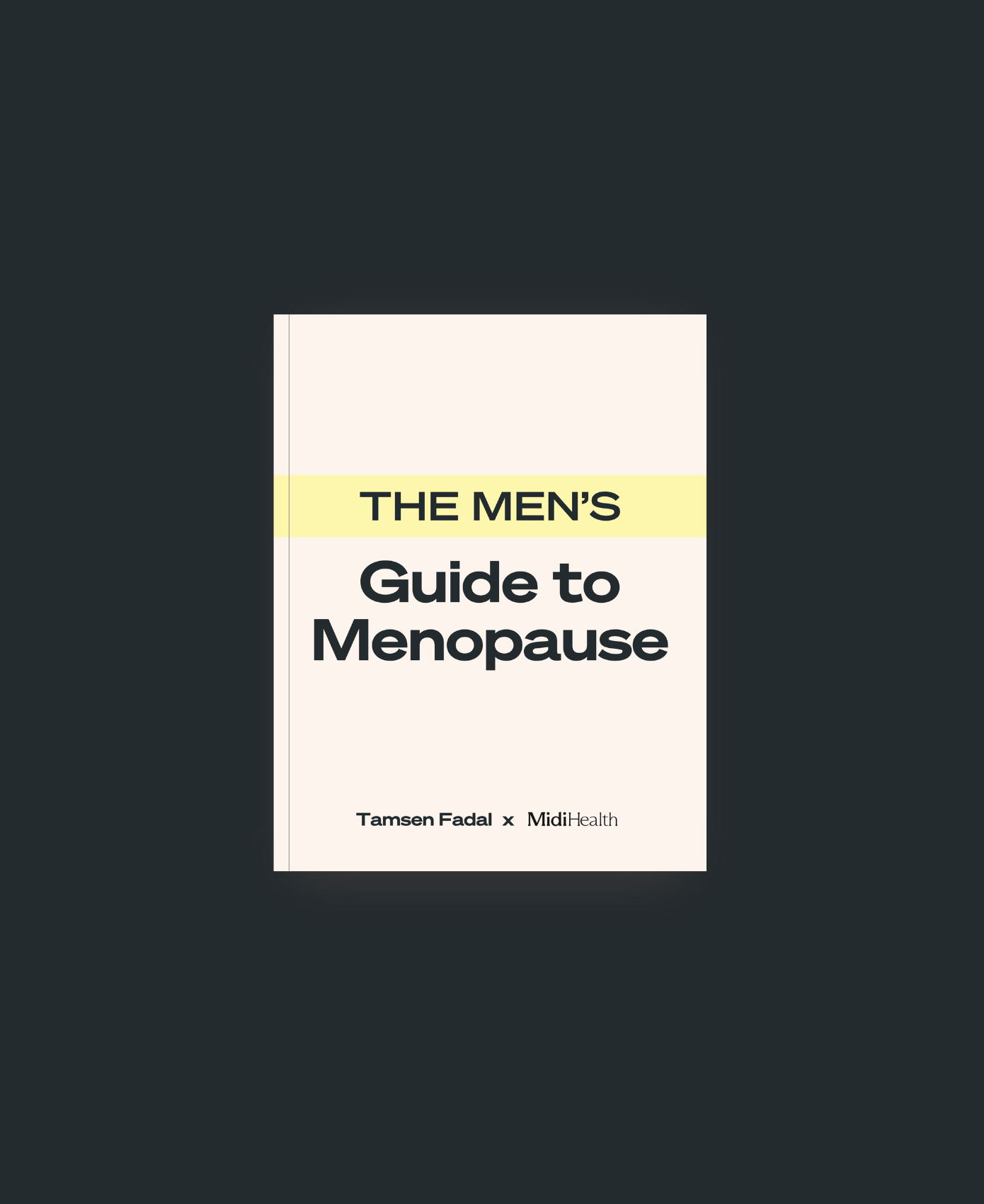
And that's what we're going to give you in the rest of this episode. Because I promise you, once you understand what is actually going on, you're going to be able to show up differently with more patience, more empathy, and a whole lot more clarity. And if you want more after this, I did put together a free downloadable men's guide to menopause. It's linked right in the description. You can print it out.
You can highlight it. You can leave it on the kitchen table. Show the woman in your life that you care enough to learn. There is no better feeling than being truly supported. And now you're going to know how.
Let me ask you something. What happens when your partner finally decides to ask for help? Okay, she goes to the doctor. She lays it all out. I'm exhausted.
I'm gaining weight. Nothing's working. I'm working out. I'm eating the same. I'm eating better than before, and I'm still gaining weight.
My heart is racing out of nowhere. I don't feel like myself. And the doctor says, "Everything looks pretty normal." Or worse, maybe you're just stressed. Now, that might sound like a one-off, but it is not. I have interviewed dozens of experts for my book How to Menopause and for the MFA documentary and now for this podcast, The Tamsen Show.
I've talked to Dr. Mary Cla Haver, Dr. Sharon Malone, Dr. Kelly Caspersonson, Dr. Heather Hirsch.
They all said the same thing. Most doctors never learn this. I want that to sit with you for a minute. Doctors did not learn about this in medical school for the most part. And if they did, it was just a little bit of education.
Even OBGYNS, the people you assume know the most about women's health, right? They're getting an hour of menopause education in medical school, maybe a day if they're lucky. To dig into this more, I sat down with menopause specialist Dr. Heather Hirsch. She ran the menopause and midlife clinic at Harvard's Bighgam and Women's Hospital.
And now she trains physicians all across the country to recognize what they were never taught. And I have got to share with you what she told me. Listen to this. What do you find that you're teaching clinicians most? And is it OBGYNS?
Who are you teaching as a general practitioners? Yes, I'm a wide range of clinicians. So, you know, I have a lot in my courses. Is I have OBGYNS, internal medicine, family medicine, some urologists as you know these urologists are like this topic is so important and I I really need to learn this cuz I didn't get this in any of my training. I have actually some psychiatrists so some mental health providers in my courses even emergency room doctors they're seeing you know urinary tract infections they're seeing panic attacks we were talking about the heart I was like there's more there they're seeing all these things and they're thinking this could be menopause how do I even explain this to a patient and it's for MDs and DOS's as well as physicians assistants and nurse practitioners I I think it's really fascinating and so important that we're talking about all these different disciplines too.
Most of the time we talk about menopause, we think of OBGYNS, but there's no way to cover what we need in this country more or less world with the number of OBGYNS we have even if we tripled that number. Exactly. And you know think circling back to my story starting an OBGYn I I do find that of course you know the training is so heavy on really important topics obstetrics and surgery and it's really hard to also have all this knowledge to be able to sit down and talk about menopause. Not that it cannot be done, but I actually think that those who are doing real primary care in internal medicine or family practice, I think being able to manage menopause is something that is really right up your alley, right? Because you are talking to patients all the time about, you know, chronic things.
Now, we don't want to call menopause a disease or a syndrome or symptom. But it is something that it's part of your physiology and it's going to stay that way for the rest of your life. And so I think those, you know, clinicians in primary care really, you know, this is a great thing for them to either learn or relearn because it's going to benefit their patients so much. Are there courses right now that are mandated in the area of pmenopause or menopause or that's just up to the discretion of the school or the of where they're training? Yeah.
So, you know, I was going to have a one-word answer which was no. But fair. The the American College of Graduate Medical Education or the ACGME is really who we need to almost lobby to get more time allowed for medical students and residents to understand the the lifelong impacts and physiologic changes of pmenopause and menopause because I do think the statistics are really true. It's about an hour of, you know, education. Go, which is not only just I could spend three hours sitting here asking you about, you know, a sliver of what we need to know.
Exactly. It's it the the pyramid's completely upside down. So, if your partner's been dismissed, if she's been told, it's just stress. Everything looks fine. She is not alone.
She is not crazy. The system is been behind. The information is out there. And that's why this movement is happening. If you're saying, "Okay, my wife is at this age right now, or somebody I work with might be dealing with this.
I really want to get into the mood part because this is one of the most misunderstood and most relationship shaking parts of menopause and pmenopause. This shift affects how she feels, how she reacts, and how she sees herself. And if you don't know what's happening, it can actually feel like everything is unraveling for no reason, and you don't even know this person anymore." I sat down with psychiatrist and neurologists from my book, How to Menopause, because the emotional toll of this transition can be just as intense as a physical one. And trust me, I have felt it myself. For me, it started like anxiety that I I couldn't name.
I'd wake up in the middle of the night. I'd feel my chest was caving in. My mind wouldn't stop racing. And then came mood swings. I'd go from zero to crying in 60 seconds for no reason, like over nothing.
I didn't feel like myself. And I didn't know how to explain it. It wasn't until I learned how deeply hormones affect the brain that everything started to make sense for me because this isn't just a body shift, it's a neurological one. To break this down further, I'm bringing in leading neuroscientist Dr. Lisa Moscone.
I have learned so much from her. She is the first researcher to look at the female brain like this. So, there are many different reasons that the person may have this feeling of brain fog. One of those being menopause. Now we know that up to 62% of midlife peri and postmenopausal women report a decline in memory, attention and language performance which can be exceptionally scary.
Yes. And can range from very mild to you know something that you do notice in conversations. Right. So for those women, it's really important to realize it could be just menopause if you will. Otherwise, let's do other testing.
And we always recommend getting a good baseline because then if things improve, great. But if things do not improve or get worse, then you have your own brain and your own body to refer to in terms of we don't want to compare you to other people your age necessarily. We want to compare you to you a couple of years ago so that we can get a better sense of what's happening and why. Do you recommend if a woman is dealing with pretty debilitating brain fog to come and get a a brain scan? That's what I would do.
I don't I can't necessarily recommend it because it's been done for research, okay? But there are also specialized Alzheimer's prevention clinics and memory clinics that people do have access to. Okay? If your concerns are serious and if the brain fog is negatively impacting your quality of life and just your dayto-day, then for me, I would I would I would want to be tested. I would want to know is this something that will just go away in a couple of years?
Is there something I can take that makes me feel better? Mhm. Right. Is there should I start thinking about long-term planning? I'm I'm a very practical person.
So, I think it depends. I know you're a scientist. It depends. Yes. But I want to go through these that you're looking at.
Yes. It's the number one statement. I don't feel like myself. And that is here. Absolutely.
I think first and foremost, and then it's everywhere else. Absolutely. It's not even the hot flashes. No, no, no. Sometimes I think women can handle many women can handle a hot flash.
The hot flashes are very debilitating and really do need clinical attention and care. But it's the brain fog that worries you the most. Yes. We don't talk about it and because I don't think that there's a a real definitive answer, right? Because you just don't really know what you're dealing with.
And I think it's something weight gain is one thing, not sleeping is one thing, but brain fog's not if you haven't gone through it before, and most of us haven't, it's very scary. It's Yes, I'm told that it's really, really scary. It happened to me once after Lilia was born. Oh, it's my only example. Mommy brain mommy brain was the same.
Which is the same. Very similar. Okay. But I'm told is a very similar experience. Okay.
So, let's see what are we what are we looking at here? Because these are the scans that you did. Yeah. So, see, here's the thing that people would say to me, "Well, whatever you see in women who are after menopause, it's just age because they're older than women who are premenopausal." And they're like, "Yes, but I'm matching them to men of the same age. If it was just age, then the men will show the same things." They're like, "No, because they're men." I was like, "Okay, you know what?
We now have women who are exactly the same age. These women are all 50 years old. This woman has a regular menstrual cycle. This woman is permenopausal, skipping periods. And this woman is postmenop early postmenopausal just a few years after the final menstrual period.
And can you describe what we're seeing in each one? Yes. So these are brain scans done with FDG PET, which is fluoridoxy glucose positron emission tomography. And we're looking at brain energy levels. We're going to look at the premenopausal woman first where you can see a lot of red.
There's red at the top of the brain to the side of the brain and here in the middle at the bottom. This is exactly what a healthy brain looks like from a metabolic perspective. You want to have a lot of red, some yellow and just a little bit of green in the middle of the brain which is perfectly normal. And then we have these areas in blue which is fluid. There is fluid inside the brain.
It has to be right. It's a cushioning support mechanism. Now what happens at the per menopausal stage? If you look at these lines that connect the three different brains, you can see I think how the red especially here is turning yellow. Everything is a little bit yellowower than here.
And then at the post-menopausal stage there's the big drop where the yellow with the red turns yellow and the yellow turns green and everything is much darker in some ways. Can you see it? So there's less energy. There is less energy. Do you see this big red blob?
This is the temporal cortex which is very close to the memory centers of the brain. And do you see how it's yellow here and it's completely green over there? That's a 30% drop in brain energy levels in that part of the brain. What does a drop in? And by the way, as we're looking at these, we're going to put a link to Dr.
Moscone scans in the show notes so you can take a look at her scans as well. So, just be aware of that if you're listening to this and don't see it yet. We'll make sure that it's in there so you can you can share what we're looking at. Does that ever recover? What does the lack of brain energy mean?
Is that where the brain fog comes? Is that where the So, we're trying to understand what this means behaviorally. And I, you know, this is something that always comes up when we talk about brain scans that people just assume that because something is happening in the brain that would immediately translate into something that you can see in a person's behavior or that's not always the case. This is something that happens at the tissue level, but it does correlate with memory function. Mhm.
So the lower your energy levels in the brain, the lower your memory, attention and language capabilities within normal limits. So these changes are not in any way, shape or form the sign of a deficiency. It's just something that happens in the brain as part of the transition to menopause. For some women, at least for some women, it could be something more serious. But we do believe that this is a sign that the brain is kind of switching gears because estrogen, especially estradiol, is a neuroprotective hormone that also energizes the brain.
And if you will, it it kind of pushes neurons to burn sugar faster. It's like estrogen is almost to the brain what fuel is to a car, what gasoline is to a car. It gives you that extra, you know, speed in a way. And after menopause, estrogen production, estradiol production remains minimal. It doesn't completely stop from the ovaries, but levels are very, very low.
And another form of estrogen is being produced a little bit more than before. It's called estrone, which is our backup estrogen, but it's not nearly as impactful in the brain as estradiio used to be. And so there's a there's a there's an overall change. And so we really see, you know, for people who are listening, we see the premenopause scan with a lot of red, a lot of brain energy. Pmenopause and in between in between post-menopause, we see a lot more green and blue, but not as much red, which is a brain energy.
Now, does that come back after we are in postmenopause, after we've hit menopause and postmenopause? Because I have to say when you and I first met, which is a few years ago now, I had really debilitating brain fog to a point that I'd be very nervous. I didn't feel my confidence like it used to be because I didn't have the memorization skills that I used to have. Over the course of the past maybe 6 to 8 months, I felt those coming back. And I and I have really felt them.
And I I was like, am I imagining it? Am I just wanting to feel them? But I definitely feel them. I definitely feel that I don't hesitate, right? I don't hesitate when I'm speaking.
I don't feel like I need cards. I mean, I I was to a point where I would put notes on the top of my computer because I would be nervous that I would forget something. And so, that's very nice. But, is that what happens? Is there a a bounce back after you've been in menopause for a little while?
So, you may not be surprised to hear that there isn't a lot of research done on Dr. Lisa Msone. I'm shocked by this breaking news. And if your partner's saying things like, "I'm snapping at everyone. I don't feel like myself." That's the big one.
Or even, "I think I'm going crazy." She is not going crazy. Her brain is literally trying to recalibrate without the hormones that she's used to depending on. Here's the thing. This is when she needs your support the most. Not to be fixed, not to be avoided, just seen, understood, and met with care.
I'm going to make you uncomfortable now. So, just be prepared for it and know I said it. We're going to talk about something that makes a lot of people uncomfortable. Sex in midlife. And I want you to stay with me here because if your partner has started to pull away or if intimacy feels different or if she's not herself anymore when it comes to sex, there is a real reason.
This is not about her not loving you. It's most likely not about her losing interest. And it's not something that gets fixed with a weekend away or a bottle of wine. It's physical. It's hormonal.
And for many of us, it's painful. Literally. You may not realize this, but during pmenopause and menopause, a woman's estrogen levels drop. And when they do, it doesn't just change her mood or her energy, it can change her anatomy. I'm not even being dramatic when I say this.
I mean, the actual structure of her vagina can change. The tissue thins out. Things dry out. The elasticity is gone. Pleasure becomes harder to access.
And in some cases, certain parts of her body can actually disappear. I know how that sounds, but when I sat down with one of the top urologists in the country, Dr. Kelly Caspersonson, she told me something I will never forget. Our labia minora that's a part of your vagina fellas that can literally vanish absorbed gone because of hormone loss. Listen to this.
Labia minora is the inner lip. So nonhairbearing genitalia. So the the area with hair that's labia majora. On the inside before you enter the vagina are these little h I hate the word flaps but they're pieces of tissue as labia manora and they're incredibly responsive to hormones they're there because you went through puberty and you had huge surges of testosterone and estrogen pmenopause birth control postmenopause these hormones are blocked in the pelvis and so the hormone responsive tissues can resorb go away atrophy whatever horrific word you want to use, but many women, they'll say it's just it takes a lot longer to get turned on, to get aroused. The clitoris has some skin that goes over it, kind of like a turtleneck.
That can become kind of stuck to the clitoris. We call it fimosis or adhesions, making orgasm a lot more challenging, right? And to be fair, women are not examined. Like, they come in complaining of this. They're told, "Oh, everything looks normal down there." or they're just like drink a glass of wine of like there are anatomic biologic things that happen when hormones leave the body we must get an education about this because every time women freak out about their labia minora on Instagram I'm like we didn't get a good sex ed and what does the labia minora do number one there's nerve endings erectile tissue incredibly responsive for arousal it's how we feel pleasure also it's protective to the inner workings of the urethra helps it prevent it from having micro trauma.
Maybe it helps recurrent UTI. It's just a protective right structure as well. So sexual and protective goes away. The sec the next question is can it come back with hormones? Probably.
There's no studies on this. You think anybody's you think the NH is researching like getting your labia minora back after you weren't on hormones for a while? I mean we got so many other things to focus on. I that's probably the last thing on the list right now, right? It's extra, right?
It's extra. Women really do care about it, of course. You know, that's why the people like me, the female urologists who care a lot about GSM, we're like, why don't we just be starting vaginal estrogen around age 50 so we don't have to play catchup once you've suffer suffered enough. This is real and nobody talks about it. We're told to relax or just use some lube, but that doesn't fix what's really going on beneath the surface.
And we're not making this up when we say no, we're not interested in sex. We're not exaggerating. There are treatments that can help. But too many women suffer in silence because they've been made to feel like this just how it goes. And they're embarrassed to talk about it.
I have to be clear. Pain during sex is not normal. It's common, but it's not something we're just supposed to live with. And for many women, what helps most is something no one ever tells them about or talks about. Vaginal estrogen.
The biggest fear people have is breast cancer and our breast cancer survivors. We have new GSM guidelines that say it's safe. Just let your oncology team know. If you're a rare condition being actively treated with hormone blockers, still probably pretty safe, but you know, you want your team to know. But we have over we have studies of over 55,000 breast cancer survivors looking at the safety of vaginal estrogen.
This is not a we don't have enough research. We have plenty of research. It just isn't getting out there. So to us, we're we're always saying there's not enough research. We have enough research.
We have so much research. We have guidelines now. Explain what GSM is. And then vaginal estrogen and you know every woman can take it now. Is that what we're saying?
Pretty much there is a rare like I would say every woman can take it. Asterisks. If you're being currently treated for breast cancer, check with your oncologist. Just let them know you know that you're on it. Here's the thing.
I use vaginal estrogen. I talk about it on social media. I used it along with estrogen, progesterone, and testosterone. For me, that combination changed everything. But it did not happen overnight.
I started to feel like myself again slowly. Not just sexually, but mentally, physically, emotionally. I'm not saying everyone should run out and take hormones tomorrow, but I'm saying we deserve to know what's available, and we deserve to have doctors who aren't afraid to have that conversation. If you're in a relationship with someone going through this, you deserve to know really what is it going on so you can show up differently. You don't have to fix her, but understand her.
So, let's talk about something I get asked about constantly. Testosterone. Yes, women take testosterone. Halib Berry told me on this show she takes testosterone. So, keeping my lean muscle mass on is important.
I started taking testosterone, which I never thought I ignorantly. I thought I'm not trying to grow hair on my chest like you know. Do you notice a difference with it? I do. Me, too.
My libido is Yeah, I know. And I have more. I found it again. I found my libido, right? Isn't it good when you find that again?
It's really good. It was MIA for a little while. Testosterone works, but the problem is so many people think it's just the magic solution. That libido is just about boosting that one number and everything else is going to snap back into place. It's not quite that simple.
Take a listen to what Dr. Kelly Casperson has to say about it. People will say this all the time on my Instagram. They'll be like, "I'm on testosterone and my libido is not better. It's not a onetoone." Right?
Libido is incredibly complex. Like, you know, you're working 80 hours. Your relationship's on the rocks. You don't feel safe at home. They, you know, you got all this stress.
A testosterone level increase is not going to make you horny again. No. And so, really breaking that down for people to be like, libido's complex. Testosterone can help, but I mean to tell you the truth, I have plenty of women we put on estrogen and they're like, I am good to go. I am loving sex again.
So, it testosterone kind of gets stereotyped as the libido hormone, but estrogen also is lovely. And libido at the end of the day is incredibly complex. If you take anything away from this, let it be this. Libido is not just about hormones. It's about stress.
It's about connection. It's about feeling safe. And yes, for some women, testosterone helps. For others, it's vaginal estrogen. For others, it's that emotional piece that matters most.
But if you don't know any of this, if no one explains what's actually happening, you've just been left guessing. You take it personally, and then your relationship starts to feel like it's falling apart for no reason. And that's really why I'm doing this. Because when women understand their bodies and when their partners understand too, everything can really change. Sex doesn't have to end.
It can get better. Connection doesn't have to fade. We've got to stop pretending though that this is about effort and start treating it like it's a health issue. It is. Okay.
If you're loving this information and following along, please, I would love to hear a review and download that men's guide to help you out. Let's talk about how you can actually help. Not by fixing anything, not trying to solve it all. I'm not putting that pressure on you. By just being there, paying attention, asking questions, listening, because here's the truth that most women won't say out loud.
When she feels off or overwhelmed or unlike herself, she's probably not just wondering what's wrong with her body. She's probably wondering if she's still lovable inside of it. And you don't need a medical degree to make a difference. You just need to be someone she can count on. And start with one thing.
Start with her sleep. That might sound basic, but sleep is the thing that I think really holds everything together. It's that foundation. Because when hormones shift, it's usually the first thing that falls apart. I'm not exaggerating.
When I was in the thick of pmenopause, I would wake up at like 2 or 3:00 in the morning wired, anxious, drenched in sweat. I didn't know if I was sick, if I had a fever, what was going on. No matter how tired I was, my body would not let me rest. When you're not sleeping, everything feels worse. Your mood, your memory, certainly your patience, and your ability to cope.
So, if you want to help, start there. Help her protect your sleep. Maybe turn the lights down earlier. Maybe keep the bedroom calm. Help her create some kind of routine that gives her a shot at real rest.
Do it with her. And to explain why that matters so much, I spoke with Dr. Shelby Harris. She's a clinical psychologist who's worked with thousands of women on sleep during pmenopause and menopause. What are three small changes people can make today to start improving their sleep?
So the first thing I always say is to really consider consistency with your sleepwake timing. So same bedtime, same wake time. So really trying to stay there will be helpful for a lot of people. The second I would say is really thinking about the compensating during the daytime. So are you someone that's trying to either exercise a lot, do a lot of things to put a lot of effort into trying to force sleep to happen at night.
So maybe do a little bit of an audit of like how much are you really trying to think about sleep because it's that effort that's part of the problem. Should you be thinking about it? I mean you're going to think about it a little bit but not too much. Like if you become really rigid with your like sleep routine at night, that's probably a problem. Okay.
Yeah. And then the third thing I would say is if you're because a lot of people are doing all the sleep hygiene things right. They're limiting the alcohol, the caffeine, they've heard about it. If that's not working after 2 weeks, then I would say 100% go get an evaluation for sleep apnea or insomnia or something and there's better treatments out there. She nailed it.
So you're probably wondering, "What else can I do?" Okay, here's what else she can do. When she's fighting with you over the thermostat, put something on. Put an extra layer on because I promise you that's going to happen. But just be understanding about it. Let's make this simple.
Start by asking her what she's feeling. Not just physically, but emotionally. Not in a what's wrong with you kind of way, but in a how can I show up better for you kind of way. Here are a few ways in. Hey honey, is there anything you've been dealing with lately that I haven't noticed?
Or I saw in this video this girl and it made me realize I have no idea what this stage is really like. Can we talk about it? Or is there something I could be doing that would make you feel more supported right now? Or you could say something like, "Hey, I got you a gift. I got you this book.
I heard about it, How to Menopause, and I don't know. I was looking through it, and maybe this can help both of us." If she's not sure how to answer, though, that's okay, too. Just letting her know you're open to the conversation already means more than you think. Then educate yourself. Don't wait for her to hand you a manual.
We've already made one for you. You can get the book, How to Menopause. Watch the M Factor with her. I mean, have a date night or something with it. It breaks down all of this through real women's stories.
And you can, of course, download the men's guide to menopause. It's linked below and covers the key things you need to know. Printed, highlighted, stick it on your refrigerator. And if you want to keep learning, I've got more for you. Every week on this podcast, The Tamsen Show, I sit down with doctors, with researchers, with real women to talk about menopause, hormones, relationships, midlife, brain fog, sex, sleep, all of it.
And trust me, we have a few episodes in there for you, too. If this conversation, though, helped you understand what she's going through, there are a few episodes I really want you to watch next. I interviewed one of the leading experts on menopausal hormone therapy, Dr. Sharon Malone about what the options are, who it's for, and how to have that conversation if she's considering it. I sat down with Dr.
Heather Hirs to break down everything about perry menopause, about what doctors do and don't know, when pmenopause starts, what it looks like, and why it's so often misunderstood. And I spoke with worldrenowned neuroscientist Dr. Lisa Moscone about how menopause impacts the brain from memory to mood to focus. If you're trying to help your partner find a doctor because she's been dismissed by doctors, we have all of that information in the show notes for you that can help you out because I know it's not easy. Whether you're trying to look for a doctor who's in person in your area or you're trying to look for a good telealth company, I have my personal recommendations in the description.
You can watch all those videos right here on my channel or listen to The Tamsen Show wherever you get your podcasts. And if you want to keep learning, keep growing, keep showing up for the women in your life, make sure you hit subscribe. I promise you're going to come away from every video knowing something you didn't before. Because when women go through this, they're not just looking for answers. They're looking for someone to walk through it with them.
So many women have told me, "I just want to feel like I'm not doing this alone." That's it. That's the assignment. You don't have to be perfect. You don't have to say all the right things, but you do need to be present and curious and willing to learn. And the fact that you're still here with me right now, still listening, tells me that you are.