Back then we were saying, okay, you have a single digit, like 5% chance of success. The fact that anyone went out on a limb, and for sure it wasn't covered by insurance back then. And now we can say, okay, there's about a 60 to 70% chance of live birth when I'm transferring this embryo. After today's show, I'm going to go do three transfers, and I would not be surprised if next week I'm calling them all with positive results. Now, of course, there are still challenges, but we've come a long way in such a short period of time.And that to me is fascinating, even from a scientific standpoint to see those types of advancements happening at breakneck speed. Why are they happening at breakneck speed right now? Because we're finally paying attention to this conversation. I think it's actually breakthroughs in the lab. A lot of people don't realize how important the IVF laboratory, the techniques, and all of the advancements are.
And we started out doing this miraculous thing, IVF, which was such a medical breakthrough, but we weren't very good at it. So, we had to put back multiple embryos at a time into a woman's uterus to give them a hope of getting pregnant. And as a result, sometimes it worked too well and you had, you know, twins, triplets, or even worse, quadruplets or more. And that was really high risk. Sure.
Women were going to the hospital with hyper stimulation syndrome. That's a syndrome where you get really swollen and you have fluid overload. So now we have different medications we can use. We've just learned so much along the way because guess what? Fertility issues are actually quite prevalent and and people are willing to do anything that it takes.
And so even when things are kind of viewed as experimental or we're pushing the envelope, women will sign up and want to try because it's just innate that this is what they want for themselves. And so we've been able to push the science forward because we're constantly re-evaluating, okay, did that work in the lab? What are we doing differently? We're growing embryos out to day seven now from egg retrieval. We're able to do way more than we ever were before and that's allowed it to be safer and more effective.
High-profile people speaking out about it and I think that that that shines a different light on things whether whether whether we like it or not. You know, there is a there is a a lot to say about people that are high-profile speaking out and I know Jennifer Aniston for one is one of those. Has that helped shine a light on things so people are more open to these conversations and willing to talk about it? Definitely. I think it's a double-edged sword when it comes to celebrities and headlines.
On one hand, people will see Janet Jackson or other celebrities having kids in their 50s and the whole story is not out there for the public consumption. And I think that's their own business. But when you only share part of the story, it can make people feel like, well, IVF and science has come a long way. Anything is possible. And so that can lead to a lot of unrealistic expectations.
But on the other hand, especially with the case of Jennifer Aniston, I think that she really helped a lot of people because she did not need to share something so vulnerable. But so many people when I post about it on social media, they came out and said, "You know what? Thank you so much." Because IVF doesn't always result in success. And that's an uncomfortable truth that we have to talk about. Sometimes it takes several tries to get there.
And not everyone is guaranteed a successful outcome. And for someone with her profile to come out and say, "I tried it." And even with all my power, my access, my celebrity and resources, I couldn't overcome this problem. It really humanized her and it also made other people feel seen because let's be honest, we've all seen the posts of the baby with, you know, the all the syringes and the needles from the IVF journey around that picture and you're celebrating this wonderful moment where you've overcome this huge obstacle. But where is the conversation and where are we shedding light on the people that don't realize that outcome? It can be a very lonely place, especially because if you decide to stop treatment, you're no longer under the care of your doctor or clinic.
And who do you go to for advice or for comfort? Yeah. Where do you do that? I feel like I feel like you're just kind of left left orphaned at that point of not knowing where to go. Yes.
When should women start having this conversation or thinking about fertility? Is there an age? Is there a a time? Is it after you've tried? What's the time?
I think everyone should be thinking about this as they enter their 20s and 30s, right? They don't have to be partnered. They don't have to be anywhere near ready to start trying, but I think they should have a clear understanding of what their biological clock actually means. What does it mean if your period is irregular? What does it mean if your period is really painful or debilitating or heavy?
Because this could point to certain gynecologic issues like fibroids, PCOS, or endometriosis to name a few examples that could one day predispose them to fertility issues. Right? When I tell people they should see a doctor, it's after one year of trying. If they're under 35, if they're 35 and older, don't wait longer than six months of trying or six cycles of trying. And if you're in your 40s, it's never too early to have a conversation even after 3 months of trying.
So, go through that again. If you're in your 20s, if you're in your 20s and you're actively trying to get pregnant, it could take time, right? Because each ovulated egg is a long shot for everyone. And even though in your 20s you're told you're in your reproductive prime years, nobody has perfect eggs all of the time. And sometimes you're going to ovulate an egg that's not healthy or maybe it's a healthy egg, but the window of timing was off, right?
Because there's like a 2 to three day window where it's even high yield to try right before you ovulate. Not every egg is capable of fertilization. Even when we do IVF and we try to inject sperm directly into each egg, we say maybe 70 to 80% of the time the egg will fertilize successfully. And only about half of fertilized eggs turn into an embryo, which takes about a week. At that point, that embryo should be implanting in the uterus.
But we know even at that stage, lots of embryos might have typos or genetic errors, and that might lead to it not implanting after all of that. Or it might implant for a little bit and then stop growing. That's the number one cause of miscarriage in the first trimester. And so in your 20s, even then, you have about 20 to 25% chance of an embryo that forms from your eggs having missing or extra DNA. And leading to those types of issues.
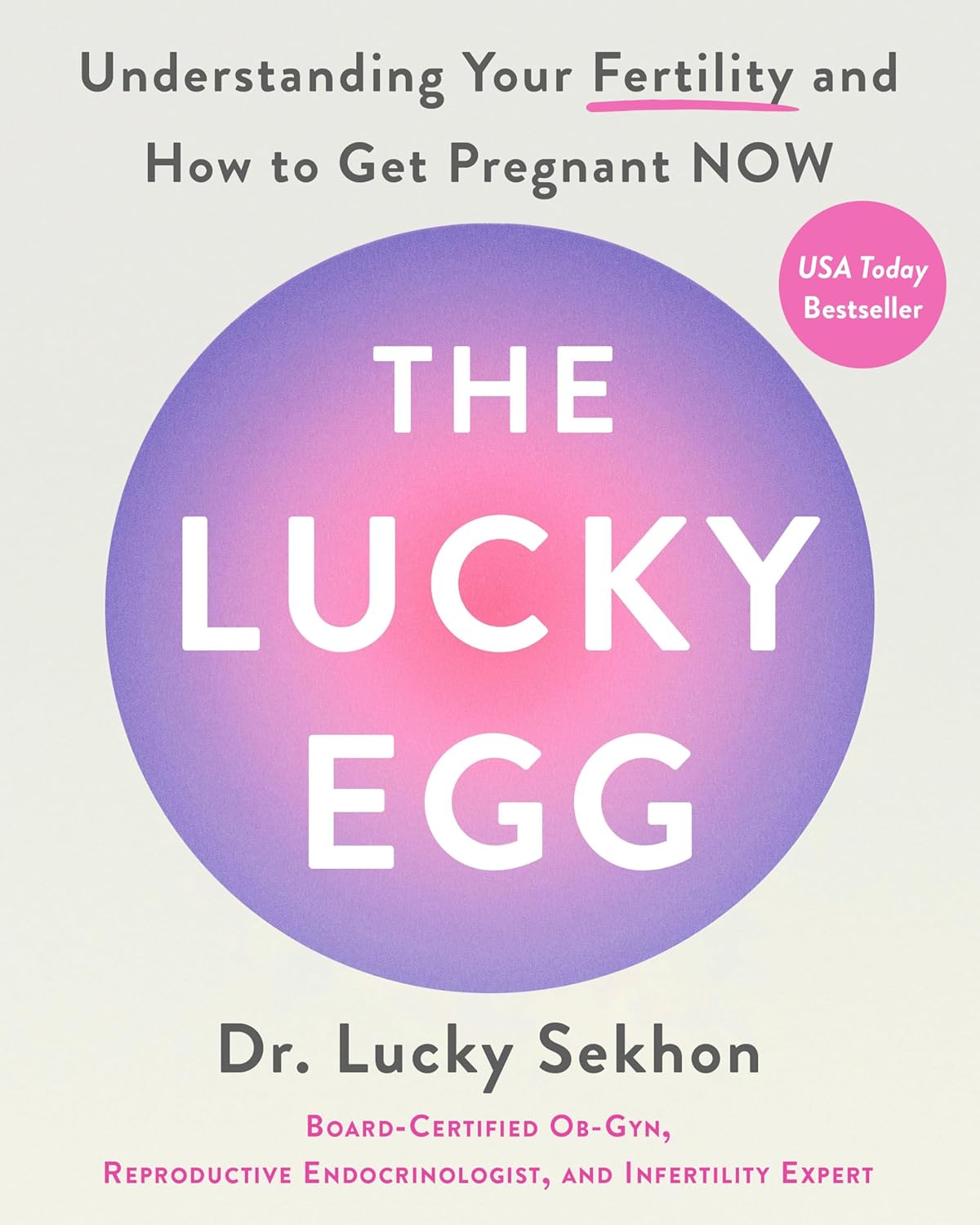
So, it might take several rounds of just randomly ovulating an egg. And I name my book the lucky egg because it really is a random ovulation. As much as we can talk about the science and the stats, there is some element of luck and serendipity. And this explains why, okay, as you age, right, your chance of ovulating an unhealthy egg increases. So, of course, at 35, we say, okay, now it's gone from maybe a quarter of embryos resulting from your eggs having these errors or typos to about a third.
And at 37 38 maybe 50%. And at 40 maybe 2/3 are going to be in that bucket where it's can be harder and take more ovulations to get there and there can be higher risks of miscarriage. But everyone has a story of well my mom was 45 when she had me. Well, there was still some normal eggs there and even though statistically it was less possible or probable, she was able to ovulate a healthy egg. She was able to ovulate that lucky egg.
And good thing your name is Dr. Lucky. Exactly. That worked out beautifully. What is the average age more women are coming to you now?
Is it older? I get asked that question all the time and it's so individual. It really depends. I mean, in general, yes. If you were to draw a line, like a line graph over the years, we know women in general have been waiting longer and longer.
It's not that they're waiting. I shouldn't say that it's taken longer for a lot of people to be financially independent and comfortable and ready to start a family or to find the right partner, right? Narratives have changed in terms of settling down, right? And what that looks like. And I think there are some great things about that.
But as a result, it has led to a lot of women, not all, pushing the boundaries of our reproductive system because while a lot of things are changing in society, the ability to ovulate that healthy egg, that that shifting over time with our age, that hasn't evolved, that hasn't caught up yet. So then let's define biological clock because you brought that up. Can we define that because that hasn't changed if you're looking at that graph, right? Maybe the age they're coming to has changed, but not necessarily how they're how they're able to get pregnant in those later years. Yes.
So, how do you define biological clock? So, that's one of the biggest misconceptions. If you ask a lay person on the sidewalk, they're going to say, "Well, I'm losing eggs all the time, right?" And so, my egg count's dropping. That's actually not what I, as a fertility doctor, care the most about. So, there's two separate components.
We're born with all the eggs we're ever going to have, typically 1 to two million. By the time we get into menopause, which as you know the average age is 5051, you you are falling below a critical threshold of about less than a thousand eggs at that point. And so it's almost like your ovaries become resistant to the signal your brain is sending to the ovary to try to randomly select that egg to ovulate. And so you stop getting periods, you stop ovulating. So most of the people who are coming to see me are somewhere between those two time points.
And how many eggs they have is something I can actually assess in an individualized sense. I can do an ultrasound on them and I can get a count. And I'm not counting millions or hundreds of thousands of eggs. I'm counting a small subset which represent a small number that have trickled to the surface. And it's kind of like rationing.
I always call it like the pantry in the ovaries is stockpiled. And you get that stockpile from the time you're born. You don't make new eggs and you can't repair or fix your eggs. And every month the pantry opens up and allows some to kind of escape to like the see-through kitchen cabinets and that's what I see on an ultrasound. Okay.
So getting a count helps me because it kind of gives me a relative sense of what's in the stockpile. But ultimately what your body is doing is not dependent on numbers. You're just releas you're releasing a signal from your brain and only getting one egg to mature and be released. So someone with a high egg count versus someone with a low egg count, they're on equal footing. They're they're all ovulating only one egg at a time.
Is that because it's egg quality that you're talking about now? Exactly. So, I'm talking about egg quantity right now, which you can check your AMH level, which is a blood test, a hormone test. What is what is AMH level? Antimalarian hormone.
Okay. So, when we look at the ultrasound and we count what's been removed from the pantry this month, and we kind of get a sense of how many eggs are available for ovulation, we know only one of them will be selected to ovulate. But AMH is a hormone that's produced by all the little cells that line each of the bubbles around each egg. So, if you see a lot on ultrasound, you're going to have a higher AMH. But both of those are quantitative markers.
And the only reason I care about those as a fertility doctor is if you're considering egg freezing or if you're considering an egg retrieval because you need to go through IVF for whatever reason, because it tells me how many I have to work with, what's in my toolkit. And obviously, the more tools I have to work with, the better the outcome, right? It tends to be more efficient. But the most important thing is quality. And we have no direct test for quality in 2025.
That is a massive blind spot. So many people come in and they're like, "My doctor told me that I have the eggs of a 25-year-old and I'm 42." And I'm like, they must have been talking about you having a higher than expected egg count for your age. So that's the quantity. Exactly. But quality is what I was referring to earlier.
The ability to make an embryo from your eggs that has all of the DNA it's supposed to have, right? Chromosomes, packages of DNA. And think about it like this. You have these proteins. Are called cohesins and they bind the chromosomes together and they keep everything organized.
When an egg and sperm come together, it goes through this process of genetic recombination. And when those proteins are breaking down because of normal aging, there's more disorganization and you can end up with embryos that have too much of those chromosomes or too few and those are not compatible with life. So either it won't implant or it will implant for a little bit and then miscarry. Ovulation tests. Are those helpful or is that what you're talking about when you talk about quality and quantity?
No. Ovulation is about understanding when you're in the game. Okay. When you ovulate, an egg only lasts for 12 to 24 hours. It's very fleeting and when you have sex within minutes or when you have an insemination, right?
If you're using donor sperm, sperm will get into the reproductive tract very quickly and it will sit there and wait and linger for up to 3 to 5 days. So, the ideal timing and why people are using ovulation predictor kits or why they're using a calendar to track their cycle and why they're coming to me from the get-go if they don't get a period or if their periods are really irregular and they have no idea when they're ovulating is that you ideally should know when to anticipate ovulation. So, you can aim to have sex in the 2 to three days leading up to that. Okay, that's really the most high yield time. Obviously, there can be outliers and you know the converse is using the rhythm method to try to avoid pregnancy and we all know that that's not as effective as using birth control because we don't always get it right when we're tracking our cycle and anyone who's had a period knows that you can have a period that's thrown off here or there.
Do you think that are the ovulation tests helpful in tracking? Is that they can be what they're do what you're basically doing is you're peeing on a stick and it's picking up LH in the urine. LH is one of the signals I was talking about from the brain. You have follicle stimulating hormone which starts sending signals to the ovary to mature and ovulate an egg. And LH is the actual ovulation signal.
So as it detects that you have a mature egg that's ready to ovulate, it will send out a stronger signal and that will very quickly end up in your urine. So when you start seeing that, if you start approaching midcycle, you're like, "Okay, I normally have a 28 day cycle. So, you know, maybe on day nine or day 10 I start peeing on these sticks. I want to see when that signal lights up. And there's many different ways that that shows up depending on the brand you're using, but that gives you about a one to two day window to say this is the key time to be trying.
Do you think women blame themselves too much if they're having problems with fertility? Absolutely. And I think it's societal conditioning. It's how we were raised. For me, you know, looking at my mom and all the women in my household, it's like that that's what you see and and it's learned behavior.
I think also it's it's kind of implied because we're carrying the pregnancy most of the time, right? And in that case, it feels like everything in the arena of getting pregnant, trying to get pregnant, and trying to stay pregnant is to do with the woman's health and the woman's body. And thankfully, this narrative is starting to go away. And I think men are much more likely to get tested concurrently with their partners, and they understand the importance of really optimizing their health as well. But that has been a thing for far too long.
I think women really internalize it and think it's their fault no matter what. Yeah, I think that too. And I think that, you know, friends that I've had in the past, it was it was them for 6 months and then oh, the guy would go get the test after she had gone through all these other things. Are you seeing that those tests run concurrently now? Like both are getting tested.
I mean, I insist upon it. If anyone ever gives me push back, I re-educate them and I talk to both partners about the fact that it's really 5050. Isn't it crazy though that it's like shocking to people that it's 5050 when it's sperm and the egg? Hello. It is.
It is. And I would think if you go walk out in the street and you ask 20 people, they're going to say, "Oh, the woman's 80% and the guy is 20%." But you know what? Part of it is the fact that men always make new sperm for the rest of their life. Yeah. So, I think that that gives them an air of invincibility.
But we know that male health habits, uncontrolled chronic medical conditions, all of that can play a role not just in infertility, but also pregnancy complications that can arise in their partner. Women are having kids later in a lot of in a lot of cases. Pmenopause, we're talking about I don't know if it's starting earlier or we're more of aware of it earlier. How do those two coincide with each other because we we know you can't get pregnant when you're in pmenopause. Can you talk about those two and the overlap?
Absolutely. So, let's start simple, right? Someone who isn't even coming to see me yet. Maybe they're not even actively trying to get pregnant, but their cycles are starting to become different. You know, the natural evolution of how your cycle changes as you go through reproductive aging.
If you're someone who from the get-go had a regular cycle, which not everyone is, let's just use the example of 28 days. We know that there are many different lengths cycles, but let's start with 28 days. You know, if you always had this clockwork-l like cycle or interval between periods that was 28 days, as you start to fall low on your egg count, your brain detects that and says, "Oh, I got to push the ovaries to work harder." So, it sends a stronger FSH signal. And as a result, that selection of that lucky egg that gets to ovulate happens a little quicker. And so, then if that doesn't turn into a pregnancy, you get your period a little quicker.
So women who come to me and they're like, "I used to have a 28 day cycle and now it's kind of like every 3 weeks or every 3 and a half weeks." I'm like, "Ding, ding, ding. I already know that the egg count's probably going to be lower and I I'm thinking that before I even do their ultrasound to confirm, right?" Meaning they're they're starting to go into the first part of pmenopause at that point or it's not even pmenopause. It's called diminished ovarian reserve. Okay? Because that's the lens I'm looking at everything with, right?
I'm I'm thinking more, okay, what does this mean in terms of their egg count? And then once the egg count falls even lower, then the ovaries start to become a little resistant to the higher FSH. It's like, yeah, I know you're yelling at me pituitary, but I'm going to I I can't take this anymore. So, it starts to sometimes skip a period. You don't ovulate, and then those become infrequent, and then they space out to the point where you stop getting periods.
And that's the natural evolution. So, when you think about being in pmenopause, right? Your cycles might be really erratic, but you're still ovulating here and there. And whether or not you're planning to be pregnant, pregnancy is possible. Now, usually, not everyone, but usually people are going into pmenopause in their early 40s.
And so, in addition to maybe the count starting to change in a way that changes the cycle and the frequency of ovulation and how predictable that is, in the background, you also have changes in the quality of the eggs. And so, it often can be more challenging because you're less likely to ovulate randomly, a healthy egg. But, it is possible. So you still have healthy eggs at that age. So women, yes, on without my help can get pregnant in pmenopause.
Sometimes it's underrecognized because they might say, "I'm already feeling all of these fluctuations and changes and they don't pick up that they're pregnant." So I always tell people if you're used to having an irregular cycle because you're experiencing these changes. It is important to rule out pregnancy and take a test. Now, if someone's coming to me for treatment, a lot of times, you know, we talked about the technologies and how things have shifted. One thing we've become really good at is freezing eggs and freezing embryos. When you go to thaw out an embryo that's been frozen, you can tell a patient most likely it's going to thaw out successfully and you can try with this embryo.
And I already told you about the success rates getting a lot better. So, I'm seeing a lot of women who froze eggs or embryos in their mid or late 30s or even earlier and they're coming back to continue building their family and also dealing with pmenopause, right? Because your uterus doesn't really age. I should have started this conversation with that. Oh, interesting.
So, your uterus doesn't age? Not really. No. I mean, there might be like slight decreases in implantation potential because as we get older with more and more ovulations and hormone fluctuations, things like fibroids can get worse. Endometriosis can get worse in the background.
But in general, the pregnancy rate remains kind of flat, which is incredible because even if someone has their ovaries surgically removed if they needed to for a medical reason or they stop functioning, I can still get them pregnant if I have something to work with. If I have frozen eggs or embryos, I can give them hormones to set up the perfect environment and then implant an embryo. They get pregnant. We continue to supplement those hormones until the placenta takes over between 7 to 10 weeks of pregnancy. If a woman wants to do that and wants to get pregnant later in life, what should she pay attention to and what should she stop stressing about?
And I think the latter part of that's the probably the most important. I mean, stop stressing about trying to control everything because so much of this is out of our control. But at the same time, you don't want to bury your head in the sand and say, "Oh, it's not in my control, so I don't need a plan." You know, I'm definitely not one of those fertility doctors that tells everyone everyone must freeze their eggs. Everyone must freeze embryos, but I do think everyone should have an informed conversation about it if they think they could find themselves in a situation where they might be trying to build their family in their mid to late 30s and beyond. Would you like everyone to have that conversation in their 20s, in their early 30s?
What's what's too I think if you're in your early 30s and you're nowhere near ready and you think it's realistic that you'll be 35 and older while you're trying to build your family, then it's actually a really smart idea. And something I'm seeing that I I find really uplifting is this trend where Gen Z is talking about fertility a lot more. And the number of women that have come to me in their late 20s, early 30s, maybe they don't have any intention of freezing their eggs, but for a fertility checkup, for a counseling conversation, because they as a generation are recognizing that health class is not sufficient. Yes. And relying on across the board, right?
And relying on Instagram or Tik Tok to just get scraps of information or hoping that you just happen to have a great OB/GYN that also has all the time in the world to counsel you and fill in that knowledge gap. So, they're like, "Let me just go straight to the source. Let me go to a fertility doctor and I just want to learn my options." Another really interesting thing that I'm seeing as a changing trend is the average age of the woman who's coming in to talk to me about freezing her eggs has dramatically shifted. And I published a paper on this coming from our clinic and 10 years of experience. We looked at the average age of the person who wants to freeze their eggs dramatically shifting from about 38 to 34 35.
Wow. Okay. As a result, that's significantly different. We're getting a lot more eggs per cycle frozen and better success rates when people are coming back to use their eggs. Is there anything a woman can do to improve the quality of her of her eggs?
Yes. Yes. So, that's confusing, right? Because I'm always kind of railing against these misinformation things you see online about, okay, you can regenerate your eggs, take this supplement, do this cleanse, but this is the best way I can explain it. There's nothing that's going to help you grow more eggs, regenerate more eggs, or repair the ones that have undergone the natural wear and tear of aging.
But every month or every cycle when your brain sends that signal to the ovary and one of those eggs begins to mature, what's actually happening when we talk about maturing eggs is that it's going through stages of genetic reorganization. So that's when those chromosomes are being moved around and you can do things to try to create a healthier environment around that process. There are really two points of that genetic reorganization. When the egg is being matured and being pushed through the different stages of development where it's capable of being fertilized by sperm and then when it's actually fertilized. So what are the things you can do?
So insulin resistance is probably one of the biggest things that I look at when someone comes to me and says you know what I'm dealing with these problems whether I'm trying on my own or often it's like an unexpected outcome. Someone who is young enough that I thought it would be reasonable to get a certain number of embryos from that certain number of eggs that were retrieved and there was a lot of drop off and attrition in a way that makes you think okay there might be an egg quality issue here. Now for sure there could be a sperm component as well but sometimes you can actually isolate out for that when you're going through treatment there are things you can do to try to improve the sperm that you're using. You can sort them differently and still you might see this attrition and they have these telltale risk factors for insulin resistance which is actually quite common and prevalent. So many women have some element of insulin resistance if they're struggling with their weight especially women with PCOS.
They're kind of just predisposed or a setup for for being a little bit resistant to insulin which is a hormone that helps you to store your blood sugar in your cells. And what that does if you tend to have resistance to that hormone is you end up producing more insulin and insulin actually acts like a growth factor on the ovaries and it can make your ovaries overproduce testosterone and having that unhealthy imbalance and now that's the environment where the eggs are undergoing all that genetic reorganization. It can make them more prone to errors. So, anything that is an external influence that can make those errors more likely is something that you could modify to try to improve egg quality. So, if someone's listening now, they should see whether or not insulin resistance is something that they're dealing with.
And is there a second thing to do to improve the quality? Well, smoking is another big example, right? And and this isn't sexy advice. Everyone knows that we're going to say smoking is not good for you, but that's another one where studies have shown objectively that this can not only affect your egg quality and your chances of getting pregnant with or without treatment, but it can also lead to a more rapid depletion in your egg count and it can lead to earlier menopause. Health of mansperm matters obviously, right?
So, how can you improve the health of a man's sperm? So, again, it's not sexy advice, but I always say whatever is better for heart health typically is better for fertility. When you think about all categories of lifestyle interventions or measures. So, exercise, we usually say cardio, you know, get make sure you're raising your heart rate and moving your body. Doesn't have to be perfect.
It doesn't have to be the perfect plan, but 150 minutes of cardio per week, whether that's a brisk walk or doing an exercise class, but we live sedentary lives. A lot of us are sitting at a computer in our office all day long and we don't realize the effect that's having on our general health and our fertility. Resistance training to build muscle will directly counteract insulin resistance. Right? Okay.
And so anything that's going to improve the environment where sperm is being created, just like what I said about the ovaries, that's the same thing, right? When you think about diet for both male and female fertility, the Mediterranean style diet, it's rich in antioxidants. Try to avoid processed foods. Again, this is all common sense stuff, but it's important to bring this up because you don't have to search too far online to see people do these crazy elimination diets or the carnivore diet or eliminating dairy and gluten just because someone on TikTok said to, right? And I think that really burns people out to be needlessly restrictive and it really robs them of their joy.
And I'm here to say that that actually doesn't make a difference and doesn't need to be done. Unless you're someone who is gluten intolerance or you're someone who's lactose intolerant, you don't need to be cutting those things out completely. I like that permission slip you're giving women though because I think they need to hear that because I do I agree with you. It's constantly like do this if you're not doing this, do this better. And it's it's all or none and it's these extremes.
So, if you look at a diet and you say Mediterranean diet, which is basically a pretty balanced diet, there's not a lot missing from it and it can be delicious and you can have a little bit of the sugar intake, whether it's in the form of wine if you decide that's what you want. And then exercise, you start that at a young age and that continues throughout your whole health span because I know that's what we talk about all the time when you're leading up past your reproductive years. Exactly. And sleep is a big one that often doesn't get talked about. You know, a lot of people aren't sleeping enough and that can lead to menstrual irregularities, irregular ovulation, and it can change our metabolism.
And so, even on the male side, you know, that chronic sleep deprivation can lead to unhealthy behaviors and coping mechanisms that are going to feed back into other things that can really negatively impact fertility. And maybe that's why we're saying like don't stress out and you'll be okay. But that's really not that's very simplistic, correct? And not okay. Let's talk about egg freezing and who that's really for and what age that makes the big difference.
So egg freezing or embryo freezing. Those are really the two ways that we know how to help people preserve their fertility. Distinguish between those two. So egg freezing is where you're just freezing eggs which are a single cell, right? And embryo freezing, you're taking those eggs out of the body and you're fertilizing them with sperm and then you're growing them out in the lab for about a week.
You can freeze them. You can also remove a small number of cells from the outer part of the embryo that would one day become the placenta if that was an embryo that implanted and you can send that off for genetic testing. So you could actually at that stage pick up those genetic reorganization errors that we were talking about which is pretty wonderful and something that has transformed the success rates and allowed us to more confidently put back one embryo at a time without saying oh we're putting this patient at a higher risk of not having a successful transfer. We're like, no, we're not really compromising on success rates and we're able to really choose the best embryo and we're able to lower their risk of miscarriage, which is really important, especially as women are going through these types of treatments in their 40s and beyond. So, there are really these two methods and the whole premise is around the fact that your uterus doesn't really age the same way your ovaries do.
And the amount of time that an egg or an embryo is frozen has no bearing on its reproductive potential. So, how long can that be frozen for? Indefinitely. Indefinitely. There are some countries I think they've changed the law in the last few years but they had a limit in the UK that you could only store them for 10 years or long not longer than 10 years here there isn't such a limit but you do have to ask yourself you know at what point is it maybe too high risk and that's you know an ethical debate in our field you know because we do have the ability now to kind of stop the clock so to speak but I think there's a lot of confusion in the headlines when you hear about egg freezing because you know there There are many headlines that are negative that say it's not all it's cracked up to be.
Pun intended. But it's because people don't realize that human reproduction isn't all it's cracked up to be. Like a lot of people when they start trying they're like, "Oh, I used a o ovulation predictor kit. Why didn't I get pregnant that first month?" And then when I tell them even in your 20s, it's a 20% chance that all these things would have lined up. It's like playing the slots.
That's why it's really about the lucky egg and it making it past all of those different hurdles. And as we get older, that percent chance goes down because the chance of that egg that you ovulated being healthy goes down, right? And so it's really understanding that just because you did this process, which is often very expensive, it can be covered by insurance, but sometimes it's not. People will have this feeling of, well, I put all this effort and time into this, it needs to be a guarantee. And I always say, you're still working within the confines of a very inefficient system.
And instead of having one long shot like what you ovulate each month, maybe we're freezing 15 to 20 long shots. But you need to think of them that way. There might be a 10 to1 ratio of eggs to get to one live birth. And that's why when it comes to egg freezing, you have many steps to get through. You have to come back and thaw those eggs, fertilize them, grow them for a week into embryos.
Maybe you'll test them, maybe you won't. I usually recommend testing. And so if you might start out with this many and end up with this much. And so it's really hard to calculate how many do you need to feel confident when you freeze embryos. I froze embryos when I was 34 with my husband.
You actually know in real time, okay, in a week of from the egg retrieval, how many actually turned into embryos and you can test them and know what you have. Even then, it's not a guarantee that every embryo will th and a 60 to 70% chance with a high quality tested embryo is pretty good. So if you say freeze two embryos per goldch child, three if you want to be really conservative, you have a better handle on numbers and where you stand when you look at things like, you know, conditions that most women start to know about when they're, you know, a little bit younger, but whether we're talking about fibroids or polyps or PCOS or endometriosis, what how do those conditions play a part in where a woman is? If a woman knows she's dealing with those in her 20s, definitely in her 30s, is that woman, is it more important for that woman to have this conversation about fertility? Absolutely.
You know, when I was giving those guidelines earlier about, okay, it's been a year and you're under 35, go see a doctor. That's the bare minimum. Am I ever going to turn a patient away because they came to me at the six-month mark? No. You know, I think if you are worried or anxious or confused about your fertility, it's never too early to go see a doctor.
But particularly for women who have been told, "You have a diagnosis of endometriosis or you have these fibroids, you have PCOS, I encourage them to see a fertility doctor from the get-go and I encourage them to get an ultrasound, a pelvic ultrasound before they even start trying because, you know, at baseline that you have this gynecologic issue. And there are so many different ways that endometriosis can impact fertility. It doesn't mean you're going to have infertility, but certainly it's multiaceted. It could mean that you're going to have a tendency towards egg quality issues. It could mean that you're more likely to have blocked fallopian tubes because of scarring.
It could mean that it's harder for an embryo to implant if it affects the muscle that makes up the uterus. For fibroids, they grow over time. So, even if you had an ultrasound 5 years ago, but now you are ready to start trying, it would be really nice to know, has it gotten bigger? Is it pushing on the uterine cavity? Because the worst thing is is when you finally get pregnant and if there ends up being complications knowing, hey, this is something I could have maybe looked into and maybe have avoided.
If someone asks you, Dr. Lucky, how can I improve my fertility? What is the honest, you know, answer that you can give based on data? Is that it's got to be a tough question. I'm sure you get it all the time.
I always say try and be the healthiest version of yourself without driving yourself crazy, right? There's a balance to it. Good advice. You know, we talked about some of the lifestyle things to think about. But a big one is our environment and toxins, right?
Microlastics, endocrine disruptors. Those aren't just buzzwords. Those are real things, but they're really not so tangible. Like, it's really hard for any one person to know what is the load of toxins that I've been exposed to in my lifetime. I mean, some of this starts when you're a fetus in your mother's womb, right?
So, what can you do today in your kitchen or in your house? It's all about practical swaps because it's easy to feel like I need to live in a bubble. I'm never going to be safe anywhere. But we're all in this together. And I think it's all about doing things that are just smart and practical.
Everyone should now in 2025 know it's not smart to heat your food up in plastics, right? And plastics are a part of our life. We have to live with it. But we should really try to avoid, you know, drinking and eating out of anything plastic. When it comes to simple things that you can eliminate from your beauty routine, I as of the time I started trying to get pregnant and even now because I have two young girls and they're exposed to me, I stopped wearing perfume.
I really eliminated fragrance because it was something that didn't really bring a lot of joy to my life to begin with. And also, I felt like my lung health got better. I have asthma and I felt better after eliminating that. But also there's a lot of data that shows that there can be endo endocrine disrupting chemicals, volatile compounds in any fragrance. And so that's something that you can think about as you think about cleaning supplies, you know, like the plugins that people use, the the Christmas tree air fresheners, like anything that you can eliminate that's not really necessary, but you're not going to be able to completely rid your home of toxins.
And I think you really just have to be balanced in your approach. Your take on supplements. Where do you stand with supplements? Are supplements helpful at all? So, supplements feel like the wild west, right?
And I think that too much is never a good thing. I think there is this misconception for people that it's natural. This is something, you know, that's not going to be dangerous. It doesn't have a medicinal property to it. And that's not true.
Supplements are vastly unregulated. And so when you compare it to some medications we might prescribe, I mean those have undergone rigorous trials, right? Sure. So you don't always know what you're getting and you don't always know about the purity and other additive compounds, heavy metals and other things that could be in it. And when you think about the average patient going through a fertility journey, often they have a a countertop in their bathroom littered with supplements.
And you know what that tells you? That they're grasping for control. And sometimes less is more when it comes to things like that. Obviously, at baseline, everyone should be on a prenatal vitamin if they're trying to conceive. And they really should contain folic acid.
And that's not so much about improving your fertility. It's about setting you up for the healthiest pregnancy possible. And lowering your risk of something called spinobipida, a neural tube defect, a type of birth defect. Now, aside from that, aside from telling someone an antioxidant-rich diet is going to potentially have some improvement in the overall environment where the eggs are being matured, right? You can think of things like CoQ10 as like a low lift intervention and it's not really associated with side effects or major adverse outcomes or effects in the studies that have been done.
And there's actually quite a lot of literature on the animal model and in human studies that show a trend towards improving outcomes, whether you're talking pregnancy rates without treatment or even the yields of eggs or the quality of the embryos from IVF cycles. So, the data is not all there as I would like it to be, but it's enough that that's one that I'm like, you know, we can you can add that to cart and I think that that's fine, but I think there's a lot of other supplements that have overreaching claims. Like for example, DHEA is a big one. Okay? And it's confusing to a lot of patients because DHEA is like an androgen.
It's like a testosterone like compound. And there there was a lot of data that came out at one time in really small not so well-designed studies. But it really took off and it was this narrative of as we age our DHEA levels drop. And so by supplementing we're giving our body something we're lacking and that might be the secret behind improving egg quality as we get older. And I've seen it cause a lot of issues.
I've seen people with elevated liver enzymes. I've seen women with horrible breakouts, hair growth, even voice deepening. Oh my gosh. And it's something that can be permanent. And it's not really proven to have an actual benefit in well-designed studies.
So prenatal vitamins, CoQ10. You can do CoQ10. Is that kind of where you would limit and then figure out what you need based on exactly what you're dealing with? Exactly. Any nutritional deficiencies must be corrected.
You know, people with iron deficiency anemia, that actually is associated with a harder time getting pregnant. Is there one thing you wish every woman understood about her fertility before she was even starting to try to get pregnant? Yes. I think the biggest thing is that it's not in your control. One of the biggest questions I get asked, especially by younger patients who are coming to have really proactive conversations, I just want to know if I'm good, you know?
I just know if I just want to know if I'm going to have any problems. And the the biggest kicker in that conversation is me saying, "You have to try to know. I don't know. I don't have a crystal ball to be able to. They want to know before they're even really trying.
Am I going to run into any issues? Do my how do my eggs look?" And I'm like, "I can tell you how many you have at this snapshot in time, but that's not necessarily protective. That doesn't tell me about your ability to ovulate a healthy egg, and that doesn't tell me that you're going to be able to resist the effects of the biological clock. It's one of those things that's certain in life that all of us have to contend with. I have to imagine whether you're thinking about starting to try or you're trying, you feel a lot of women have got to feel overwhelmed.
If you have a woman out there listening right now that says, "Look, I've been through this. I've been trying for six months and I've I've talked to all these different doctors. I'm not sure what to do." If someone is listening and feels overwhelmed by all of this, what do you want her to do first? Well, I want them to prioritize their mental health. And that sounds like such a platitude, right?
But it's so important. Something that's very unique and different about my book is that there is a huge emphasis on mental health because I've seen it all. You know, at this point, I've seen and treated so many patients and the the differentiating factor in all the different diagnoses and types of challenges that I've encountered with my patients. The the common thread between the patients that emerge from the journey and they have their relationships intact, their sense of self intact is that they prioritize their mental health. Right?
It's not a sprint. It's a marathon. And don't be cocky. I was cocky when I went through treatment. I'm like, I'm doing my cycles where I work.
I'm the expert. I know what's going on. Obviously, I didn't treat myself. I went to one of my wonderful colleagues. But when things didn't go according to plan, I had a cycle that was canceled due to low response.
I had a retrieval where I woke up and had two eggs retrieved and nothing turned into embryos. That actually really threw me for a loop because I thought, okay, I'm doing this as prevention. I'm I'm doing, you know, fertility preservation. I'm not actually worried about my fertility. I'm coming at this from a place of control, you know, and when those things happened, I was blindsided.
And I often think to myself, if I was blindsided, being an expert in the no, how do patients feel when they're coming into this thinking, well, look at all these celebrity headlines. Like, IVF works for everyone. It's the solution. And when things don't go according to plan, plus if they're paying out of pocket, you know, there's so many things that can make this the weight of this just so heavy and so difficult, it's very easy to burn out. And if you add on top of that this feeling that you're never doing enough, you need to be living in a bubble, you need to be taking 15 supplements cuz your friend did and then she had a successful outcome and you're not putting your best foot forward.
It's just there's so much noise and it's so hard. So my advice is drown out the noise. If you feel confused, because often people feel overwhelmed and they're like, I just don't know what's going on. Even though they're going to see an expert, they still kind of feel lost. Don't settle.
Don't settle for I'm seeing the expert and I'm just going to trust them. You should understand your plan. You should understand your diagnosis and what your your test results mean. And if you don't feel like you can get those answers, get a second opinion. I feel like also your this book is helping women be a partner and men be a partner in this journey and walk in.
You have got to be. Dr. Lucky, thank you so much. It's such a pleasure. Yeah.
Well, thank you for this because I can only imagine the number of women that this is helping. By the way, if you want to go deeper into everything we've talked about today and touched on, make sure and pick up Dr. Ly's new book, The Lucky Egg. Now, I love this title even more that I really understand the lucky egg, understanding your fertility and how to get pregnant. Now, the link's all in the show notes.
And if this episode helped you, please take a moment to leave a review. It means so much and helps more women find the show. Thanks for Mitti, the care women deserve.